China, Africa aim to boost cooperation amid FM’s visit
Traditional relationship remains solid despite global changes: expert
By Published: Jan 09, 2026 11:51 PM

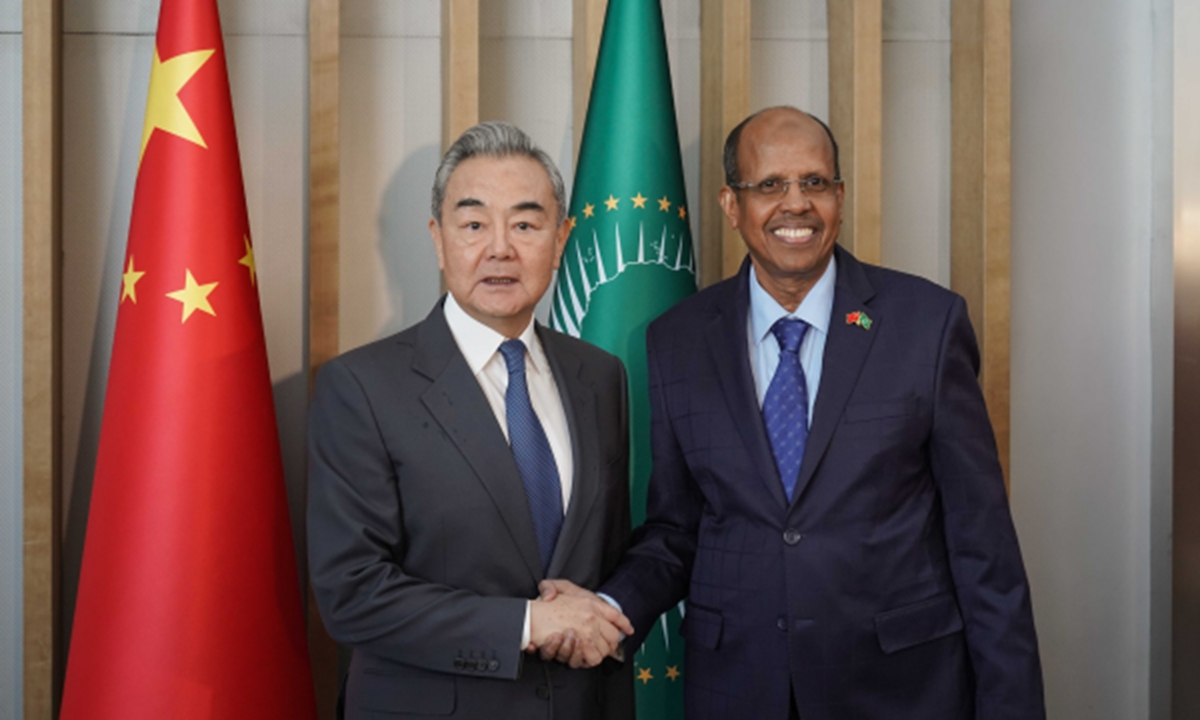
Chinese Foreign Minister Wang Yi shakes hands with African Union (AU) Commission Chairperson Mahmoud Ali Youssouf at the AU headquarters in Addis Ababa, capital of Ethiopia, on January 8, 2026. Photo: Chinese Ministry of Foreign Affairs
Chinese Foreign Minister Wang Yi is visiting Africa, continuing the unbroken 36-year tradition of Chinese foreign ministers selecting Africa as their first overseas destination each year. In Ethiopia, the top Chinese diplomat proposed multiple initiatives to further deepen China-Africa cooperation and shared development.Notably, during the trip, both sides, in addition to boosting their cooperation, also expressed concern over the recent developments in Venezuela, and stressed that sovereignty and territorial integrity of all countries must be respected, according to Xinhua.
According to the Chinese Foreign Ministry, Wang's visit to Ethiopia, the first leg of his Africa trip, would last until Friday, followed by visits to Somalia, Tanzania and Lesotho until January 12.
During the meeting between Wang and Ethiopian Prime Minister Abiy Ahmed on Thursday, both sides pledged to strengthen mutual support and the alignment of development strategies, Xinhua reported.
Ethiopia is leading the way in China-Africa cooperation, and both sides should work together to implement the outcomes of the Forum on China-Africa Cooperation (FOCAC) Beijing Summit, Wang said. He called for making full use of China's zero-tariff policy for all African countries with which it has diplomatic relations, accelerating the upgrading of trade and economic cooperation, strengthening cooperation in infrastructure, green industries, and the digital economy, and advancing high-quality Belt and Road cooperation between China and Africa, per Xinhua.
Previously, on Thursday local time, Wang and African Union (AU) Commission Chairperson Mahmoud Ali Youssouf jointly held the ninth China-AU Strategic Dialogue at the AU headquarters in Addis Ababa, the capital of Ethiopia, Xinhua reported on Friday.
Wang and Youssouf exchanged views on cooperation in various fields, including China-Africa joint efforts in advancing modernization. They underscored the importance of the enhanced alignment between China's 15th Five-Year Plan and the implementation plan of the AU's Agenda 2063.
Song Wei, a professor at the School of International Relations and Diplomacy at Beijing Foreign Studies University, said that China-Africa cooperation is continuously undergoing quality enhancement and upgrading.
This visit demonstrates that China-Africa relations are expanding from traditional areas such as infrastructure cooperation, poverty reduction, and industrialization to broader people-to-people and cultural fields, Song said. "This reflects the multidimensional and comprehensive development trend of China-Africa cooperation."
Through Wang's visit, China is showing stability and predictability, which are precious nowadays, according to Song. "No matter how the international landscape changes, the traditional friendship between China and Africa remains unchanged," said Song.
During Wang's visit, China and Africa jointly voiced their positions on the ongoing situation in Venezuela on several occasions.
During the China-AU Strategic Dialogue on Thursday, both sides expressed concern over the recent developments in Venezuela, saying that the sovereignty and territorial integrity of all countries must be respected, and the fundamental principles of the United Nations Charter and international law must be adhered to, Xinhua reported.
Similarly, in the joint press release of China and Ethiopia after Wang's meeting with Ethiopian Prime Minister Abiy Ahmed and Minister of Foreign Affairs Gedion Timothewos, both sides reaffirmed that all countries should abide by the basic principles established by the UN Charter and international law, respect the sovereignty and territorial integrity of all countries, and oppose the use or threat of use of force in international relations.
"The law of the jungle runs counter to international law and the basic norms of international relations, while power politics and acts of bullying infringe on the legitimate rights and interests of developing countries," Wang said in his speech at the launch ceremony of the 2026 China-Africa Year of People-to-People Exchanges. "In the face of a turbulent world, China and Africa more than ever need to uphold fairness and justice, strengthen solidarity and mutual support, and deepen exchanges and cooperation."
Li Haidong, a professor at the China Foreign Affairs University, told the Global Times that this positive stance shows that China, Africa, and the broader Global South nations remain a stabilizing force in a world fraught with intertwined crises, and are a force for prosperity and enduring peace, as well as an active driver in the evolution of global governance.
Coordinated China-Africa cooperation helps counteract the destructive impact of deglobalization, fosters the healthy development of global governance, and contributes to shaping a future world characterized by civilizational inclusiveness, economic interconnectedness, and indivisible security, said the expert.
While the US continuously creates crises and conflicts and disregards international law, China, rooted in solidarity with Africa and the broader Global South, is providing stability and cooperative momentum, Song said.
RELATED ARTICLES