Chinese experts criticize Japanese official’s rare earth claim, calling it wishful, infeasible decoupling attempt
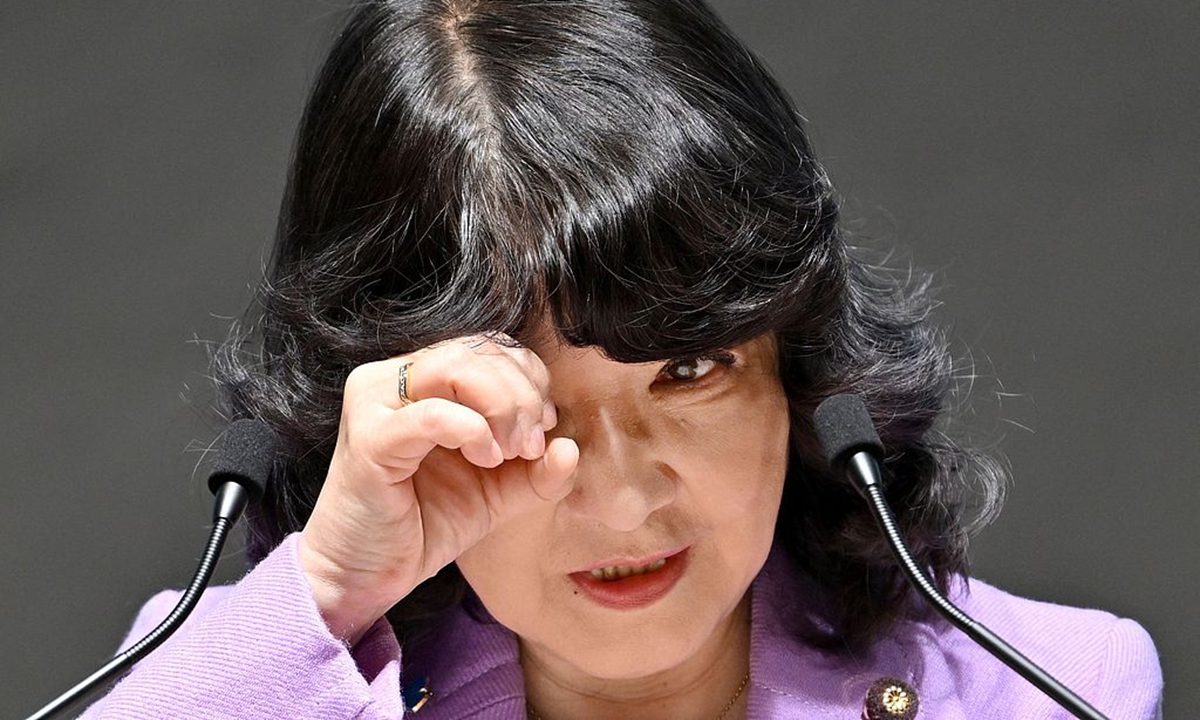
Japan's Finance Minister Satsuki Katayama Photo: VCG
Criticizing the Japanese finance minister's claim that Japan seeks to "take away" China's power to "weaponize" rare earths, Chinese experts said her wishful attempt to decouple supply chains is politically motivated and violates market principles.Japanese Finance Minister Satsuki Katayama claimed that Japan should work with the US and Europe to build a supply chain for rare earths and prevent China from "using the critical minerals as an economic weapon," Nikkei Asia reported on Saturday.
Japan's slandering that China is "weaponizing" rare earths are misleading and intended to deceive the international community, Lü Yaodong, Deputy Director of the Institute of Japanese Studies at the Chinese Academy of Social Sciences, told the Global Times on Saturday.
On Tuesday, China tightened dual-use export controls destined for Japan, applying them to all items on China's control list, including rare-earth-related products.
Responding to media inquiries about the move, He Yadong, a spokesperson for China's Ministry of Commerce (MOFCOM), said on Thursday that the decision to tighten export controls on dual-use items destined for Japan is fully legitimate, reasonable, and lawful. The spokesperson added that the move aims to curb the Japanese government's attempts at "remilitarization" and nuclear armament.
China's legitimate move stems from Japan's "remilitarization" and its wrongful actions and statements, Lü said, noting that Japan violates its commitment to a peaceful path and seriously undermines regional stability. China's actions, which are reasonable and lawful, do not affect civilian use at all. China, as a responsible major country, is acting to safeguard world peace.
The remarks by Japan's finance minister came ahead of her departure to attend the G7 finance ministers' meeting in Washington on January 12, where they may discuss rare earths supplies, according to Reuters on Friday.
Japanese claims of attempting to use the G7 platform, together with the US and Europe, to build a rare earth supply chain and "take away" China's power to "weaponize" rare earths are attempting to mislead public opinion and stage political stunt, Lü said.
Since taking office, Japanese Prime Minister Sanae Takaichi has made erroneous remarks on the Taiwan question, implying Japan's military intervention in China's Taiwan Straits, and pushed for revisions to Japan's "three national security documents," while people close to her have made remarks advocating nuclear armament.
In response to questions about China's strengthened export controls on dual-use items destined for Japan, Chinese Foreign Ministry spokesperson Mao Ning said on Wednesday that with the aim of defending national security and interests and fulfilling non-proliferation and other international obligations, China took measures in accordance with laws and regulations, which are fully legitimate, justified and lawful.
The spokesperson stressed that Prime Minister of Japan Sanae Takaichi's erroneous remarks on Taiwan violated China's sovereignty and territorial integrity, blatantly interfered in China's internal affairs, and threatened the use of force against China.
If other countries support Japan's wrong moves stemming from "remilitarization" attempt, they are standing opposite to global peace, Lü said.
Independent rare earth analyst Wu Chenhui told the Global Times on Saturday that Japan currently relies on China for approximately 50-60 percent of its rare earths. Japan and related countries' attempt to promote a "decoupling and supply-chain disruption" plan to curb China's rare earth industry advantage over the years have shown very limited results.
Japan's heavy rare earths, such as dysprosium and terbium - used in neodymium magnets for electric vehicle motors - are almost 100 percent sourced from China, according to the Nomura Research Institute.
China's advantage in the rare earth supply chain is the result of long-term, market-driven development," Wu said, adding that any unilateral attempt to contain China's industrial advantage would contradict market rules and is unlikely to succeed.
RELATED ARTICLES