IN-DEPTH / IN-DEPTH
Reporters’ Notes: Witness ‘Okinawa division’ at US Henoko base
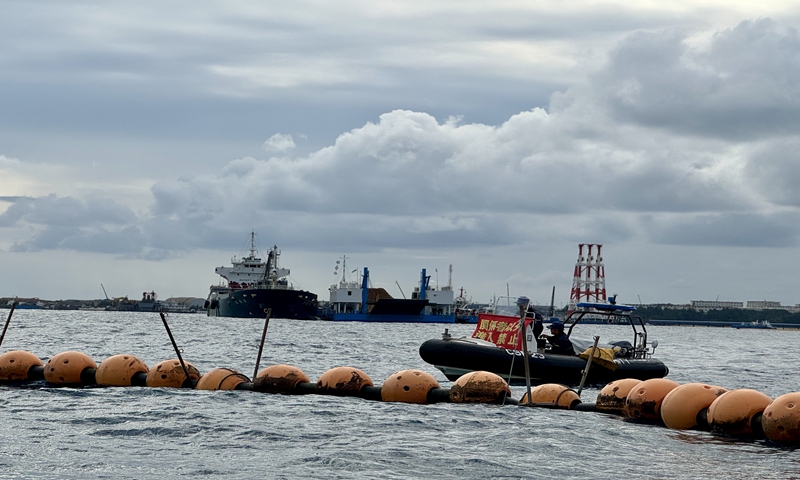
The Japanese government cordons off waters near the Henoko base with orange buoys. A patrol vessel closes in and issues warnings to the boat of the Global Times on approach to the construction site, on December 24, 2025. Photo: Xing Xiaojing/GT
Faced with mounting discontent among the people in Okinawa, the Japanese government has tried to solve the problem with money and to weaken the protest movement by dividing interests.
For Okinawans living by the sea for generations, protest is not confined to land. It also takes place on the water. Without obtaining local consent, the Japanese government cordoned off waters near the Henoko base with orange buoys and hired patrol vessels to cruise on both the inner and outer sides. When we boarded a boat and approached the restricted area, the patrol vessels closed in and issued warnings over loudspeakers: "This is a restricted zone. Leave immediately."
Local residents told me that the patrol boats on the inner side are operated by a maritime security company hired by the Japanese government, while those on the outer side are local Okinawan fishermen. By anchoring their boats at sea and reporting any protest vessels they spot, they could receive up to 50,000 yen per day (about $317) from the Japanese government. Each hired fisherman works 15 days a month on these patrol boats and spends the remaining 15 days fishing.
The median annual income in the Okinawa Prefecture is about 3.31 million yen. Aside from the fishing income, these hired fishermen can earn about 9 million yen a year from monitoring work alone, maintaining an income far above the local average as long as the Henoko base construction continues.
And at the gate of the Henoko construction site, local police work in groups of four, each responsible for a limb, lifting the protesters away from the entrance so that trucks loaded with soil, rocks, and cement could enter. Officer Miyagi (pseudonym) told me that he himself is from Okinawa and this is his hometown. He fully understands the protesters' demands, he said, but as part of his job, he must carry out orders. "Seeing what Okinawa is facing now, I have very complex feelings," Miyagi said.
"Do you personally support the construction of the base?" Facing my follow-up question, Miyagi glanced at his watch and said he was about to get off work. He said that he did not want to think about it and hurried away.
RELATED ARTICLES