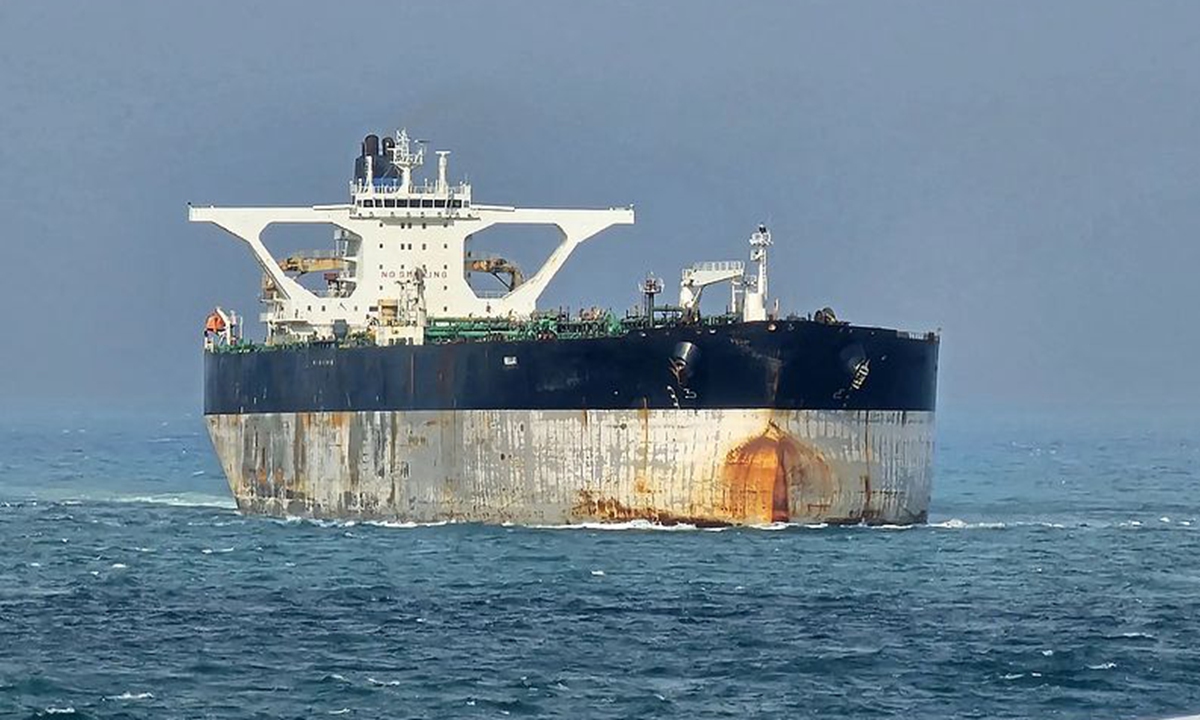
Oil tanker Marinera, foremrly known as Bella 1 photographerd at sea in the Singapore Strait on March 18, 2025. Photo: VCG
Since September 2025, the US has repeatedly boarded, intercepted and even seized foreign commercial vessels and cargo ships on the high seas in the Caribbean, the eastern Pacific and the Indian Ocean, under the pretext of "counter-narcotics operations" or "sanctions enforcement." The latest case is the seizure of a Russian-flagged oil tanker Marinera (formerly Bella-1) on the high seas of the North Atlantic, citing the vessel's alleged "links to Venezuela" and its alleged violation of US-imposed sanctions. These actions, involving vessels from multiple countries and regions, have severely disrupted the international shipping order and once again laid bare the true nature of the US stance on international ocean governance.From the perspective of international law, the US actions constitute a direct infringement upon the fundamental principle of freedom of navigation on the high seas. Under the 1982 United Nations Convention on the Law of the Sea (UNCLOS), the high seas are open to all states and the freedom of the high seas includes freedom of navigation. This freedom is not merely an abstract legal proclamation; it is concretely manifested in international commercial practice.
Yet over the past several months, the US has relied on its domestic law and unilateral political judgments to impose coercive measures against other countries' vessels on the high seas. In essence, this practice represents an extraterritorial extension of US domestic law into an international public space.
It flagrantly undermines and negates the legal characterization of the high seas as a non-sovereign domain, and runs directly counter to the principles and spirit of UNCLOS, which emphasizes the facilitation of international communication and the peaceful uses of the oceans.
Moreover, the conduct of the US authorities fails to conform to the strict limitations on the right of visit set out in UNCLOS. The Russian-flagged oil tanker seized in this case does not fall within any of the legally prescribed categories for boarding, inspection or seizure of other countries' vessels, nor has the US presented sufficient evidence demonstrating that the vessel was engaged in activities prohibited under the Convention. Taking coercive measures against a foreign vessel solely on the basis of a unilaterally determined "suspected sanctions violation" clearly falls outside the scope of the internationally recognized right of visit.
For a long time, the US has frequently invoked the banner of "freedom of navigation" to criticize the legitimate maritime activities of other states, and has even dispatched warships to conduct "freedom of navigation operations" in waters under the national jurisdiction of other states, thereby heightening regional tensions.
In stark contrast to this rhetoric, however, the US has continuously manufactured exceptions, expanded intervention and abused coercive measures on the high seas, the very domain where the principle of freedom of navigation should be most fully respected. Such practices themselves represent one of the most serious violations of that principle.
More troubling still is the blatant double standards exhibited by the US on this issue. It portrays freedom of navigation as a global public good imbued with moral superiority. However, in practice, it applies divergent standards to different states and different vessels based on its own geopolitical interests.
From a broader perspective, such actions by the US reflect not respect for international law, but rather its instrumentalization. Rules are vigorously defended when they serve US interests, yet selectively ignored when they impose constraints. Under this logic of "using rules when convenient and discarding them when inconvenient," freedom of navigation has been distorted into a rhetorical tool in the service of hegemony, rather than a genuine legal principle.
The stability of the high seas order depends on the collective observance of international law by all states, not on unilateral enforcement by any single power. Actions that undermine the freedom they claim to uphold will only deepen international skepticism toward the true intentions of the US.
Repeated experience demonstrates that the US double standards on freedom of navigation are not accidental, but rather a concentrated manifestation of its long-standing hegemonic approach to maritime affairs, one that is increasingly unacceptable to the international community.
Bao Yinan is an associate research fellow at Huayang Center for Maritime Cooperation and Ocean Governance. Cao Qun is an associate research fellow at the China Institute of International Studies. opinion@globaltimes.com.cn
RELATED ARTICLES