Mass protests reportedly erupt across the US following ICE shootings; Federal-state rifts, social divisions deepen in a polarized America: experts
Experts point to deep federal-state rifts, enduring social divisions in a polarized America
By , and Leng Shumei Published: Jan 12, 2026 12:03 AM


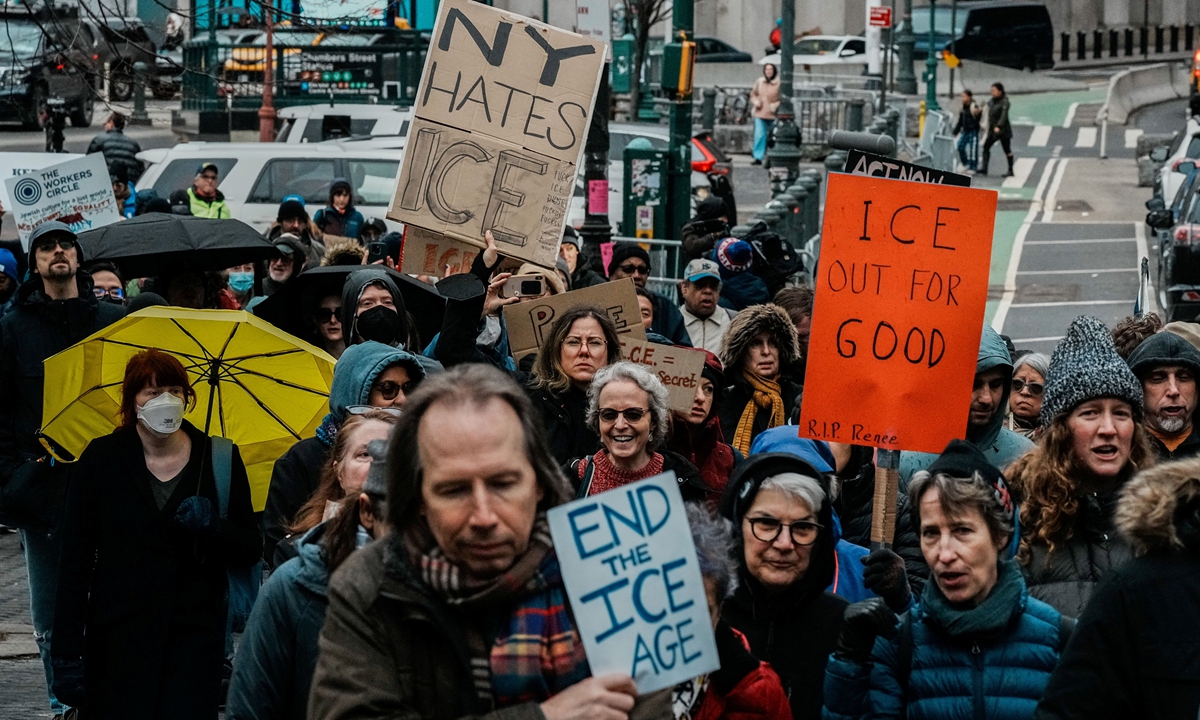
People gather in Foley Square, Manhattan, New York City, on January 10, 2026, to protest against ICE following the killing of 37-year-old Renee Nicole Good by ICE agents in Minneapolis. Photo: IC
Following a killing in Minneapolis and the shooting of two people in Portland, Oregon by US immigration agents, more than 1,000 protests were planned across the US over the weekend, according to multiple US local media reports. In Minneapolis, demonstrators demanded a thorough investigation into the fatal shooting of 37-year-old US citizen Renee Nicole Good, who was killed by an Immigration and Customs Enforcement (ICE) officer on Wednesday while in her vehicle. The protests also called for an end to large-scale ICE deployments.The incident has sparked intense debate within the US, amplified by newly released evidence that has led to contradictory narratives. On Saturday, the Department of Homeland Security posted a video on X claiming it showed the victim "stalking and impeding a law enforcement operation over the course of the morning."
The accident fueled polarized reactions, evident in the stark divide between Democratic-leaning "blue states" like Minnesota and the federal government, as well as contrasting public opinion on immigration enforcement. One side views the Trump administration's tough stance as essential for upholding national security, while the other sees it as abuse of enforcement powers involving excessive force.
Analysts note that shootings stemming from immigration disputes and the ensuing large-scale protests reflect irreconcilable clashes in values and security perceptions between the "two Americas".
Even as more videos emerge that may, to some extent, alter perceptions of the incident, the deeper contradictions in US immigration policy are not the result of a single event but the culmination of long-standing tensions and divisions, Wu Xinbo, director of the Center for American Studies at Fudan University, told the Global Times.
As protests in the US simultaneously target both the recent ICE shootings and US military actions against Venezuela, experts believe this reveals a profound moral challenge regarding the government's handling of both domestic and foreign affairs. They warn that the risk of such violence could spill over and exert significant impacts on more countries worldwide.
Sharp rift between federal and local authorities
After the incident in Minneapolis, a Department of Homeland Security spokeswoman said the driver, identified as US citizen Renee Nicole Good, attempted to "run over" law enforcement officers in an act of "domestic terrorism" that required an ICE officer to fire three shots, according to the Washington Post.
The Trump administration defended the ICE agent's tactics by claiming the shooting was an act of self-defense by the agent, suggesting Good was using her vehicle as a weapon to attack the officer, Sky News reported.
But state and local officials, as well as protesters, have rejected that characterization, with her supporters saying they believe she steered away from the officer.
On the streets, rallies erupted on Saturday in dozens of US cities, including New York, Washington, DC, Boston, Philadelphia, Chicago, Seattle and Minneapolis. Some cities held candlelight vigils in Good's memory, while others saw marches calling for ICE to be dismantled, the Xinhua News Agency reported on Sunday.
Minnesota's Democratic governor Tim Walz stated during a news conference on Thursday local time that Minnesota's residents are "exhausted" by the president's "relentless assault on Minnesota," PBS reported.
The split between Washington and Minnesota was on full display from the outset of the shooting incident. Trump told reporters on January 9 that "we will always be protecting ICE and we will always be protecting our Border Patrol and our law enforcement," Politico reported that day. Vice President JD Vance claimed on the previous day that the ICE officer who fatally shot Good is "protected by absolute immunity," reported CNN.
The dispute has also rapidly escalated into a contest over investigative and enforcement authority. The fight over who would lead the probe further exposed the split, after the FBI announced it would take charge and, as Walz said, "purposefully excluded" Minnesota investigators, the Minnesota Reformer reported on Thursday. Walz also issued a warning order preparing National Guard troops, according to CBS.
From intergovernmental clashes among governors to widespread public demonstrations, the shooting incident and the ensuing chaos have laid bare a persistent imbalance in the US federal-state power dynamic, analysts told the Global Times.
Wu said that imbalance is particularly acute between the Republican Trump administration and some Democratic-led states, and appears unlikely to be resolved in the near term.
Long-standing contradictions over immigration policy
Americans have seen violent clashes play out for months as ICE takes actions to its deportation campaign in predominantly liberal cities. Just a day before the shooting, the administration announced it would send 2,000 federal agents to the Minneapolis metro area to conduct the "largest immigration operation ever." The Department of Homeland Security reported arresting 150 illegal immigrants on January 5 alone, the Washington Post reported.
Some X users expressed support for ICE and the Trump administration's immigration approach.
One account, @KeithSubby1955, stated: "They [ICE agents] have a job to do, legally, and they should be allowed to do it without fear or retribution what ever happens." Another account @MisekKathy said on X: "I voted for people here illegally to be removed. Trump admin is offering financial incentives to leave and come back legally. Or ICE. There is a choice."
Massive street protests and vocal online support for immigration policies have amplified divisions in the US. This underscores enduring rifts within American society on immigration, rooted in the policy's inherent contradictions and intertwined with issues of racial discrimination and expanding enforcement powers, Wu told the Global Times.
Under the current administration, departments like Homeland Security have expanded their authority and tightened border controls and immigration reviews, leading to more frequent violent incidents, the scholar explained. During Biden's four years, looser policies allowed significant inflows of undocumented immigrants into Democratic states; the Trump administration's deportations have targeted these areas, revealing an underlying partisan dynamic where immigration has become a focus in interparty struggles, he said.
British-based news podcast The News Agents, commented on X: "Whatever ICE is doing, it clearly isn't just about enforcing immigration, it's about enforcing politics."
Scholars also expressed concern over the vicious cycle - right-wing policies and violence provoking protests, which in turn spark further violence - potentially spilling over to other countries.
Social divisions in the US have intensified, with fierce conflicts between Democratic-led local institutions and the Republican-led current administration. This confrontational dynamic is likely to push the Trump administration toward further extreme actions both domestically and internationally, Lü Xiang, a research fellow at the Chinese Academy of Social Sciences, told the Global Times.
Lü suggested that this domestic dynamic partly explains why the administration has recently chosen Venezuela - a country that promises substantial strategic gains but possesses limited capacity for effective retaliation - as the target for testing its norm-breaking behavior. He warned that the spillover of domestic extremism and violence could eventually turn America's internal fractures into a major source of global instability, posing serious risks to the international order and worldwide economic security.
RELATED ARTICLES