Washington reportedly conditionally eases Nvidia H200 chip exports to China; market acceptance of US chips remains to be seen: expert
By Ma Jingjing and Published: Jan 14, 2026 10:23 AM

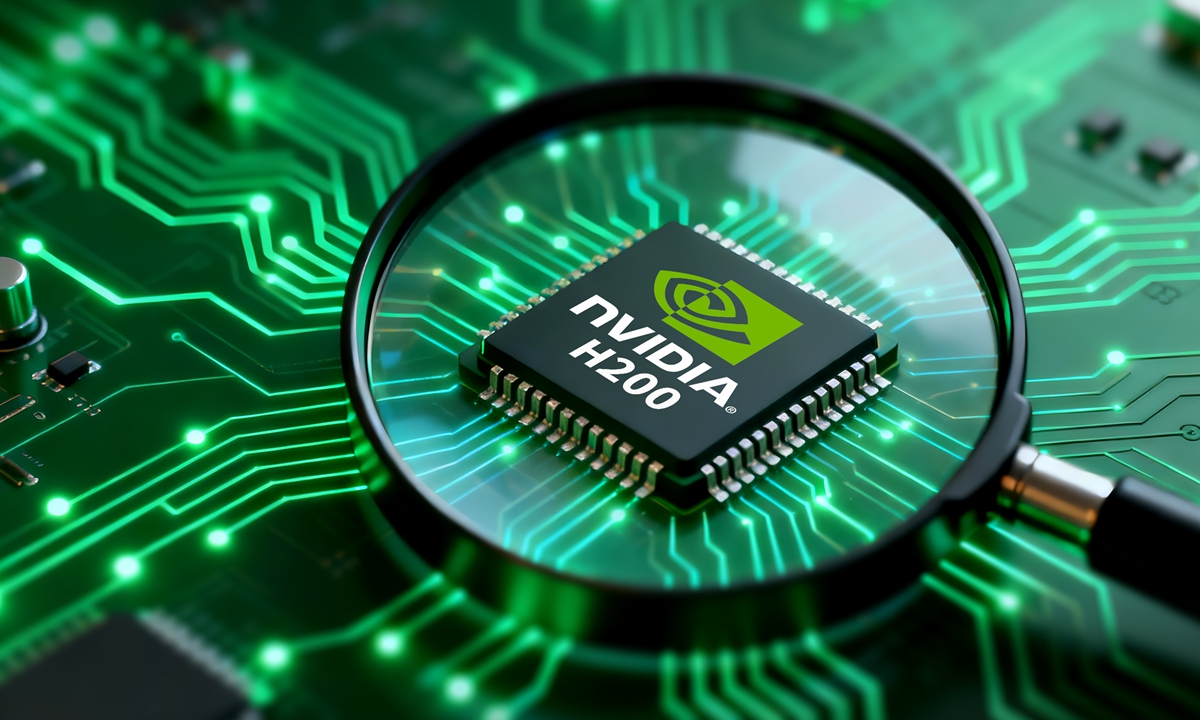
Nvidia H200 chip Photo: VCG
The US administration moved closer to allowing Nvidia Corp to sell H200 artificial intelligence chips to China by easing a previous US stance of presumption denial to case-by-case review for exports of certain semiconductors to China, according to a Bloomberg report on Wednesday. A Chinese expert said the US' ease of its export restrictions reflects the fallout of US protectionism on American companies themselves since losing access to the huge Chinese market affects their development, while it remains to be seen whether Chinese companies will accept US companies' chips.
According to the US' new regulations, US companies will be constrained in how many chips they can ship to China, with a limit of no more than 50 percent of the total products made for the US market. Under the rule, overseen by the Commerce Department's Bureau of Industry and Security, companies must also "employ rigorous Know Your Customer" procedures to prevent unauthorized use of the technology. The chips will also be required to undergo third-party testing in the US, according to Bloomberg.
A document on the website of the US Department of Commerce confirmed the report. The fresh move came after US President Donald Trump wrote in a post on Truth Social in December 2025 that "the United States will allow NVIDIA to ship its H200 products to approved customers in China, and other Countries," and that the US Department of Commerce is finalizing the details.
The US' shift from an outright ban on advanced chip sales to conditional export controls essentially marks the failure of the US policy aimed at stifling China's high-end chip development, Ma Jihua, a veteran industry analyst, told the Global Times on Wednesday.
The US currently finds itself in a dilemma: On one hand, it seeks to undermine China's domestic high-end chip manufacturing capabilities, while on the other, the US chip export controls also caused harm to US chipmakers as they are unwilling to give up substantial revenue from the huge market, Ma added.
Yet, given the uncertainty of US policies and the unreliability of US chips in terms of security, enterprises in China are bound to exercise caution in their procurement, Ma added.
He Weiwen, a senior fellow at the Center for China and Globalization, echoed Ma's view. He told the Global Times on Wednesday that the US' export restrictions on chip exports to China have impacted US chipmakers' development by losing access to one of the world's largest consumer electronics markets.
For months, Nvidia has made efforts to lobby the US administration and Congress for a relaxation of export controls that keep the company from selling its AI chips in the huge Chinese market. Huang said in May 2025 that China's artificial intelligence market will likely reach about $50 billion in the next two to three years, and that missing out on it would be a "tremendous loss," the CNBC reported.
Moreover, Huang said that access to the Chinese market is essential for US competitiveness in AI, noting that US export restrictions have brought Nvidia's chip sales to China to a standstill, with zero sales expected for the next two quarters, US media outlet Fox Business reported in November.
In July 2025, China's cyberspace regulator summoned Nvidia over security risks concerning its H20 AI chip sold to China. The company was asked to give explanations and submit relevant proof materials on this issue. This is aimed at safeguarding cyberspace and data security for Chinese users per laws on network and data security and personal information protection, according to the Cyberspace Administration of China.
Given that Nvidia's artificial intelligence chips were once alleged to pose serious security risks, it remains to be seen whether Chinese companies will accept its H200 chips even if the US government allows exports, He Weiwen said, stressing that imports of US chips must also comply with China's laws and regulations on safeguarding China's national security.
Regarding US administration's decision to allow the sale of Nvidia H200 chips to China, in response to a question over whether China will allow these H200 chips to be purchased and also whether and when leaders of the two countries would communicate the decision, Chinese Foreign Ministry spokesperson Guo Jiakun said at a regular press conference on December 9 that "We have noticed the reports. China always advocates that China and the US achieve mutual benefit through cooperation."
RELATED ARTICLES