India's Chief of Army Staff makes mixed remarks on China-India boundary issue; expert calls for trust-building, not the opposite
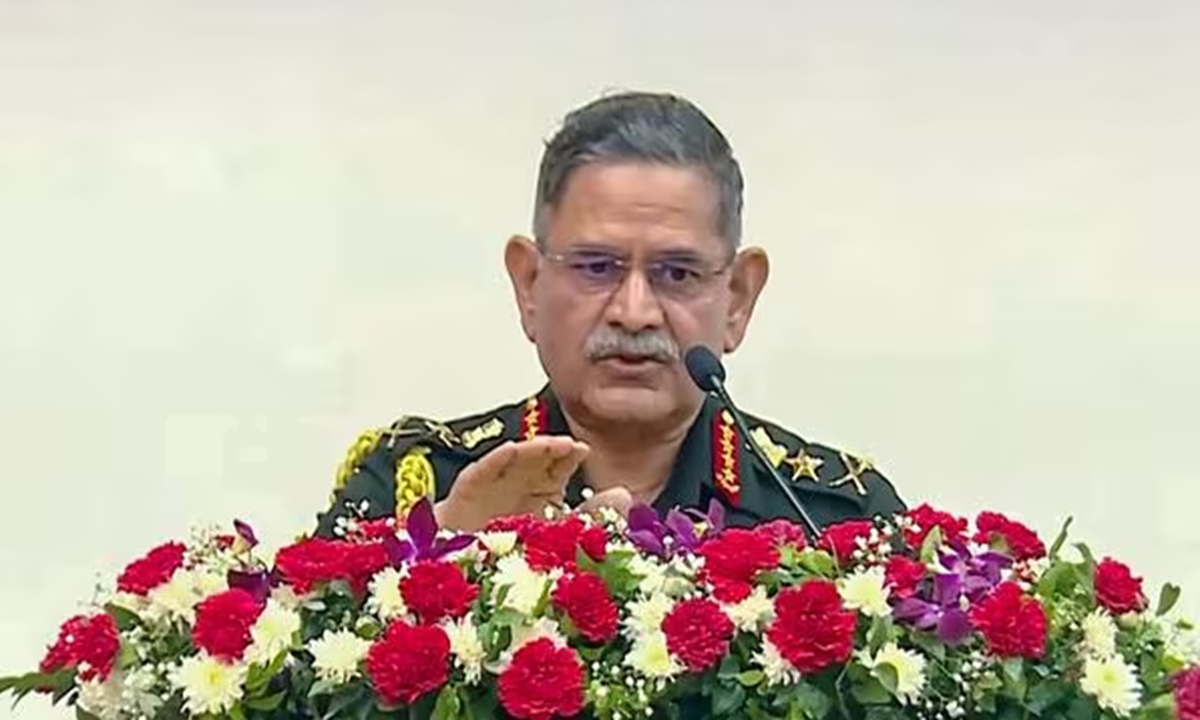
Chief of Army Staff General Upendra Dwivedi addresses the gathering at IIT Madras, in Chennai, Indian media Mint reported on January 13, 2026. Photo: screenshot of the Mint report
India's Chief of Army Staff reportedly said on Tuesday that the leadership of India and China are keen to preserve peace along their border and are making efforts to overcome the trust deficit between their militaries. However, on the same occasion, he also hyped the Shaksgam Valley topic involving the China-Pakistan Economic Corridor. Hype of the topic has been on the rise in Indian side recently.
Chinese expert said on Wednesday that against improvement in bilateral ties, the priority should be to properly manage the border situation and enhance mutual trust, noting the hype reflected some Indian officials' erroneous view on the China-India boundary issue and the China-Pakistan Economic Corridor.
"The top leadership, including prime minister, defense and foreign ministers, have met in the last few months" and there is a strong sense of urgency within the armed forces to maintain calm along the borders, Upendra Dwivedi said, according to a Bloomberg report.
Dwivedi said India and China have carried out "troop readjustment" as part of the plans to keep the border stable, and gradually increase the trust factor, according to The Print. He underlined that the situation along the northern front remains stable, but needs constant vigil, per the report.
Qian Feng, director of the research department at the National Strategy Institute at Tsinghua University, told the Global Times on Wednesday that as major neighboring countries, China and India have reached a clear consensus at the leadership level that the two sides should enable each other's development, view each other not as threats but as partners, and work toward mutual success.
On the same occasion, however, the Indian army chief also hyped the Shaksgam Valley issue. "As far as the Shaksgam Valley is concerned, India considers the 1963 agreement between Pakistan and China as illegal," he claimed. "Therefore, we don't approve of any activity in the valley."
The Indian side recently started hyping China's infrastructure development projects in the region as part of the China-Pakistan Economic Corridor (CPEC), claiming it Indian territory.
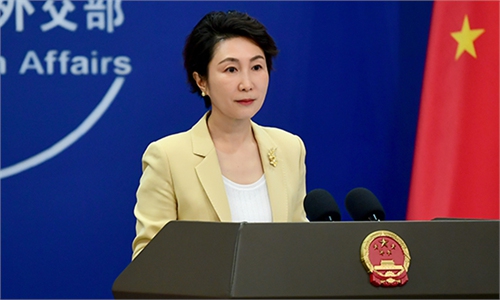
In response to recent hypes by the Indian Ministry of External Affairs spokesperson and local media outlets, Chinese Foreign Ministry spokesperson Mao Ning on Monday said that the territory India mentioned belongs to China, and it's fully justified for China to conduct infrastructure construction on its own territory.
China and Pakistan in the 1960s signed a boundary agreement and delimited the boundary between the two countries, which is the right of China and Pakistan as sovereign countries, Mao noted. The CPEC, as an economic cooperation initiative, aims at promoting local socioeconomic development and improving people's livelihood.
"The China-Pakistan boundary agreement and CPEC do not affect China's position on the Kashmir issue and the position remains unchanged," the spokesperson said.
Qian told the Global Times that the Indian Army Chief's hype over the region reflected India's erroneous view on the China-India boundary and the China-Pakistan Economic Corridor, which in essence is an attempt to oppose the Belt and Road Initiative on the pretext of so-called sovereignty disputes.
Another consideration for his claims, the expert said, is that March marks the beginning of India's new fiscal year budget cycle, and the Army Chief may be speaking out to secure a larger share of defense spending, especially as India's defense resources in recent years have increasingly tilted toward the navy and air force.
With overall improvements in bilateral relations, the priority should be to properly manage the border situation and enhance mutual trust, Qian said, urging the Indian side to do more to build confidence, rather than making irresponsible remarks that interfere with the thawing of bilateral ties.
Launched in 2013, CPEC, a flagship project of the China-proposed Belt and Road Initiative, is a corridor linking Gwadar Port in Pakistan with Kashgar in Northwest China's Xinjiang Uygur Autonomous Region, which highlights energy, transport, and industrial cooperation in the first phase, while in the new phase, it expands to fields of agriculture and livelihood, among others, the Xinhua News Agency reported.
RELATED ARTICLES