Anti-graft documentary shows AI’s power in rooting out corrupt officials, new means of bribery through virtual currencies
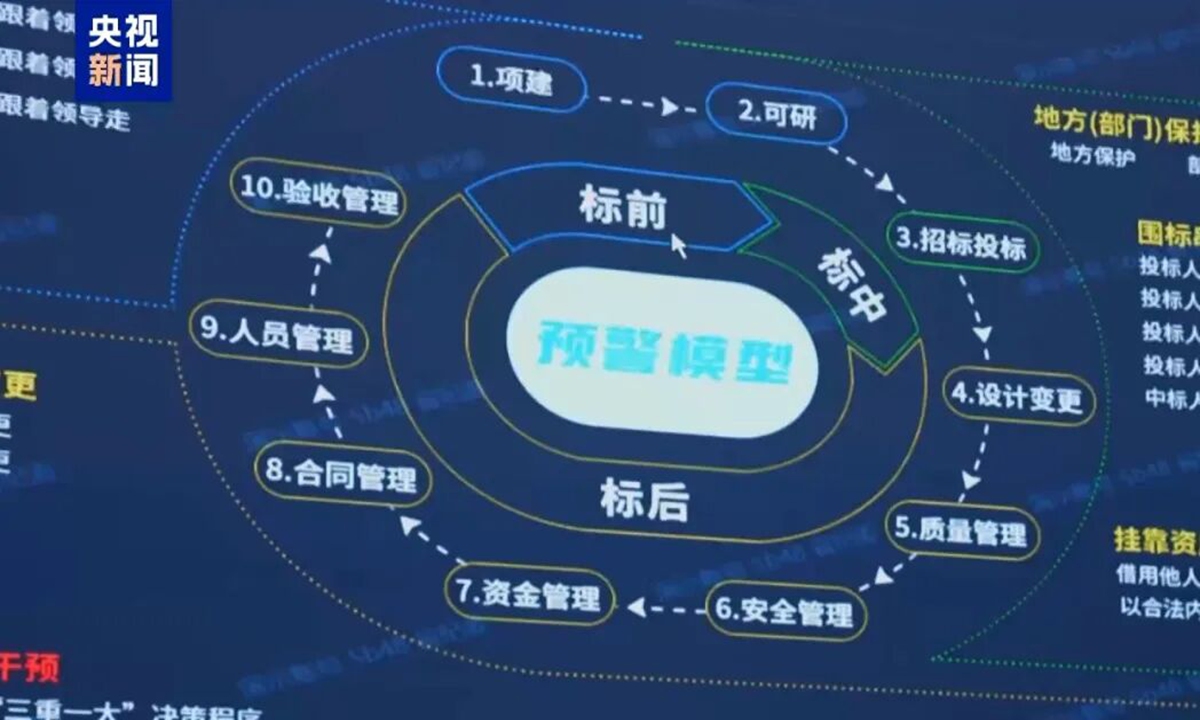
Big data and artificial intelligence (AI) technologies deployed in China's anti-corruption campaign Photo: CCTV News
Big data and artificial intelligence (AI) technologies have now been deployed in China's anti-corruption campaign to help root out corrupt officials, as showcased in the fourth episode of an annual anti-corruption documentary series produced by China's top anti-corruption watchdog, which aired on Wednesday.Jointly produced by the publicity department of the Communist Party of China Central Commission for Discipline Inspection (CCDI), the National Commission of Supervision and China Central Television (CCTV), the four-episode documentary series, titled "Never pause a single step, never yield an inch," is being aired from Sunday to Wednesday.
According to the fourth episode, the disciplinary and supervisory authorities have intensified crackdown on cross-border corruption, and used high-tech means to conduct thorough investigations.
The latest episode exposed the details of corruption case of Li Yong, former general manager of China National Offshore Oil Corporation (CNOOC), who was put into investigation in March 2024 and has been expelled from the Communist Party of China (CPC) due to serious violations of discipline and laws in September 2024.
He had long been in charge of a large number of CNOOC's overseas projects. More than 83 percent of the illicit proceeds came from overseas, with business owners collecting, transferring, and storing the funds on his behalf abroad. Overseas investigation and evidence-gathering efforts by the authorities involved 10 countries and regions, the documentary shows.
After receiving clues regarding Li's problems, the disciplinary and supervisory authorities suspected him of serious corruption. Taking into account his career history, and after repeated deliberation, the task force decided to use data-driven analysis as the breakthrough point.
For instance, they retrieved extensive business records handled by Li over several decades and made full use of data and information technology to conduct multidimensional analysis, identifying clues through the cross-referencing of multiple information sources.
According to Ouyang Baiqing, deputy director of the International Cooperation Bureau of the Central Commission for Discipline Inspection, tech-powered investigations helped the authorities quickly identify key bribery suspects linked to Li through big data analysis.
"While we have always had political and public support, strengthening our technological advantage will make our 'trinity' approach to anti-corruption even more powerful," Su Wei, a professor at the Party School of the CPC Chongqing Municipal Committee told the Global Times on Wednesday.
The investigators also found a businessman named Ren Fengde, using his legal identity, acted as intermediary to launder Li's "illegal gains."
Ren and Li were both from the same hometown and had worked together at CNOOC for many years, maintaining a close personal relationship. After Ren went into business in the 1990s, he began relying on Li's position at CNOOC to secure contracts and provided Li with substantial kickbacks, forming a relationship bound by shared interests.
Investigations found that Li abused his position to seek benefits for others and accepted property and huge sums of money in return. In August 2025, Li was sentenced to 14 years in prison for bribery and was imposed a fine of 3 million yuan.
In recent years, disciplinary and supervisory authorities have intensified efforts to combat cross-border corruption by using big data, AI and other information technologies to conduct in-depth investigations.
The fourth episode also cast light on bribery through virtual currencies, a new form of corruption that must be vigilantly addressed.
Yao Qian, former director of the Department of Technology Supervision and former head of the IT Service Center at the China Securities Regulatory Commission, was placed under investigation in April 2024 for abusing his position to assist an information services company in providing technology services to the securities and futures industry, receiving illicit benefits totaling 12 million yuan ($1.72 million).
As the investigation deepened, the task force found that several of Yao's major power-for-money transactions involved new and hidden forms of corruption, including the acceptance of virtual currencies.
In November 2024, Yao was expelled from the Party and removed from public office, and the case was transferred to the procuratorate for legal review and prosecution. The successful handling of this case has provided disciplinary and supervisory authorities with experience in investigating bribery involving virtual currencies.
RELATED ARTICLES