Illustration: Xia Qing/GT
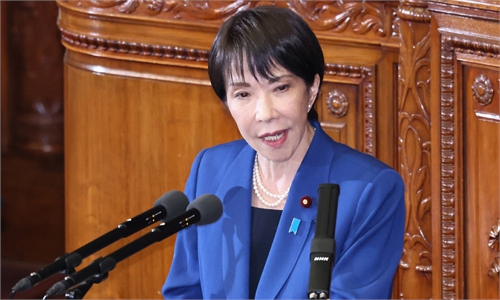
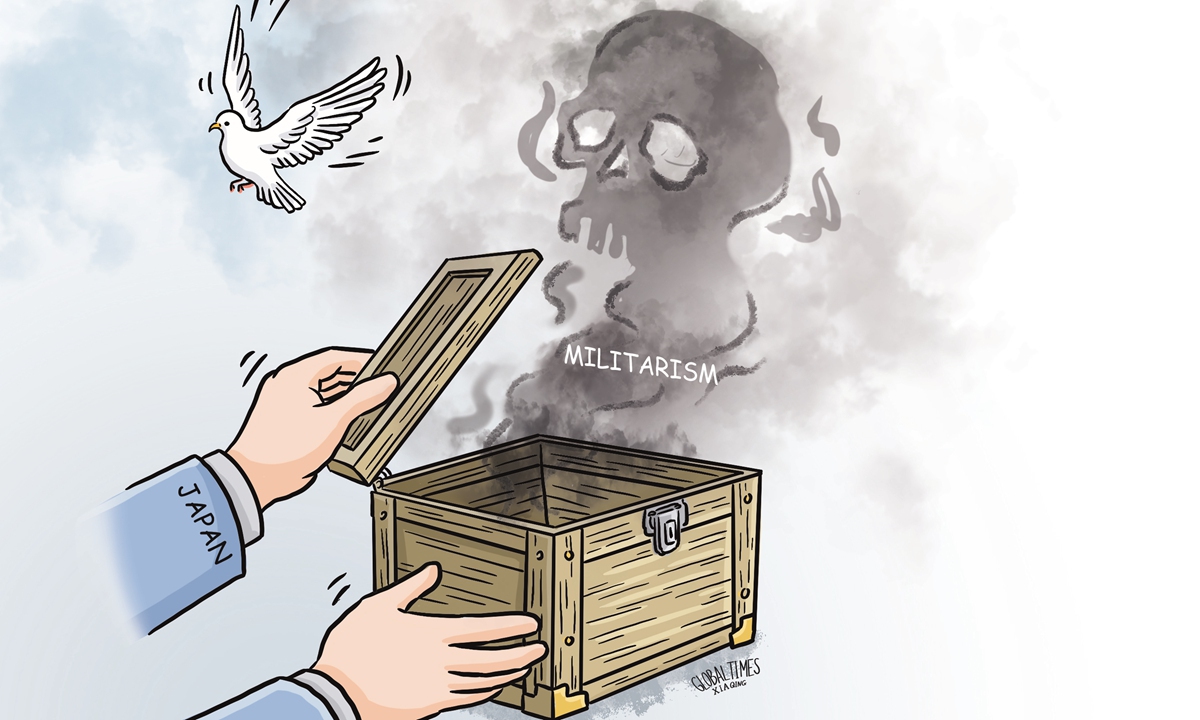
Recently, Japanese Prime Minister Sanae Takaichi claimed, while building momentum for revising the three national security documents within the year, that the move is intended to protect Japan's "independence and peace" and "lives and livelihoods of our people." While loudly proclaiming "peace," Japan is at the same time pushing ahead with military expansion. This stark contrast between words and deeds not only tears away its mask as a "peaceful country," but also fully exposes the dangerous trajectory of Japan's current strategic direction.
For a long time, Japan has carefully cultivated the image of a "peaceful country" on the international stage, seeking to whitewash the crimes of militarist aggression through carefully crafted rhetoric and superficial window-dressing, and to win the trust of the international community. However, many of Japan's actions in reality have inevitably cast serious doubt on its true intentions.
Why would a "peaceful country" regard its own constitution - known as the "pacifist constitution" - as a thorn in its side and be so eager to discard it? The constitution of Japan clearly stipulates that "the Japanese people forever renounce war as a sovereign right of the nation and the threat or use of force as means of settling international disputes," and that Japan's "land, sea, and air forces, as well as other war potential, will never be maintained; the right of belligerency of the state will not be recognized." These provisions laid the domestic legal cornerstone for Japan's postwar path of peaceful development.
Since coming into effect in 1947, the "pacifist constitution" has restrained Japan's impulse toward military expansion and sent a clear "non-war" signal to Asian neighbors who once suffered from Japanese aggression, playing an important role in improving Japan's relations with countries in the region. However, Japan's right wing has long viewed the "pacifist constitution" as an obstacle to "national normalization," and in recent years has accelerated efforts to hollow it out: lifting the ban on the exercise of the right of collective self-defense, enforcing the Act on the Protection of Specially Designated Secrets, enacting the new security legislation, rapidly expanding military spending, developing "counterstrike capabilities" and loosening restrictions on arms exports.
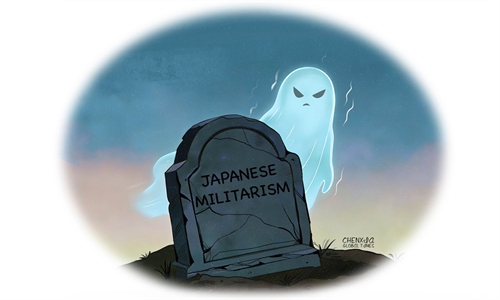
These moves run counter to the original intent of the "pacifist constitution", rendering the principle of "exclusively defense-oriented policy" little more than a name, tacitly accepting the right of belligerency, and effectively pushing Japan toward a form of "neo-militarism."
Why does a so-called peaceful country seek to revise the Three Non-Nuclear Principles, laying bare its ambitions to acquire nuclear weapons? As the only country in the world to have suffered nuclear attacks, Japan should be firmly committed to upholding the nuclear non-proliferation regime. Yet senior Japanese officials have floated fallacious arguments in favor of possessing nuclear weapons and are increasingly showing eagerness to revise the Three Non-Nuclear Principles. Such actions not only betray Japan's own professed commitment to peace, but also constitute an open challenge to the postwar international order and to the authority of the Treaty on the Non-Proliferation of Nuclear Weapons.
Japan is a threshold nuclear-weapons state, having long produced and stockpiled plutonium far in excess of what is required for civilian nuclear energy. For this reason, any relaxation of Japan's nuclear policy would deliver a serious shock to regional security dynamics and global strategic stability. In response to the current Japanese government's growing tendency toward possessing nuclear weapons, some Japanese media have raised a pointed question: If even the "Three Non-Nuclear Principles" are cast aside, it would represent the worst-case scenario. How far does the true nature of this hawkish administration intend to go before it fully reveals itself?
Why does a self-proclaimed "peace-loving nation" repeatedly stir up trouble and endanger regional peace and stability? The Takaichi administration has repeatedly made waves over the Taiwan question, interfering in China's internal affairs and even issuing threats of force against China, pushing China-Japan relations into a strained and confrontational state. This is not an isolated case. In recent years, Japan's right-wing forces have continuously hyped the "China threat" narrative, deliberately fanning flames and creating tensions over issues related to the Taiwan Straits and the South China Sea. Japan's relations with other regional countries, including South Korea, Russia and North Korea, have also been marked by persistent friction and recurring disputes. More alarmingly, Japan is actively positioning itself as a "vanguard" for external powers, promoting the creation of a "Asia-Pacific NATO." This attempt to import bloc confrontation into Asia has severely undermined mutual trust among regional countries and introduced major risks to regional peace and stability.
With a history of belligerence still clearly evident, any reckless or aggressive military adventurism cannot be allowed to go unchecked. Looking back at World War II (WWII), Japan once cloaked its aggression in the false slogan of "Greater East Asia Co-Prosperity," using diplomatic smokescreens to deceive its adversaries before launching a surprise attack on Pearl Harbor. Today, Japan once again wraps itself in the mantle of "peace." However, in practice, it pursues military expansion and policies that undermine regional peace and stability. This gap between rhetoric and action closely mirrors the tactics employed by Japanese militarism before and during the outbreak of WWII. The aim is to mislead the international community and create favorable conditions for strategic opportunism and risk-taking.
In 1954, Japan donated a "Peace Bell" to the UN, bearing the inscription "Long live absolute world peace." Ironically, today, Japan's right wing is moving ever further down the dangerous path of "neo-militarism." In the face of the Takaichi administration's profoundly misguided and highly dangerous strategic trajectory, the international community must remain clear-eyed, see through the façade of a "peace-loving nation," and take firm action to jointly safeguard regional and international peace and stability.
Zhong Sheng is the People's Daily international news commentary column. opinion@globaltimes.com.cn
RELATED ARTICLES