WEF 2026 opens as Trump returns to Davos amid US Greenland policy, tariff threats
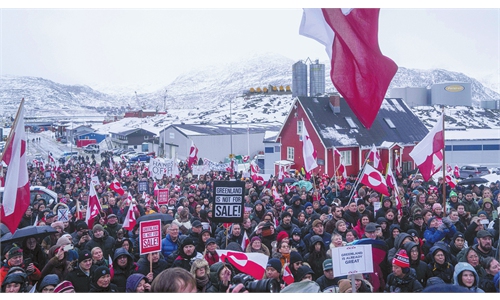
EU-US disputes widening as US steps up pressure over annexation of Greenland: experts
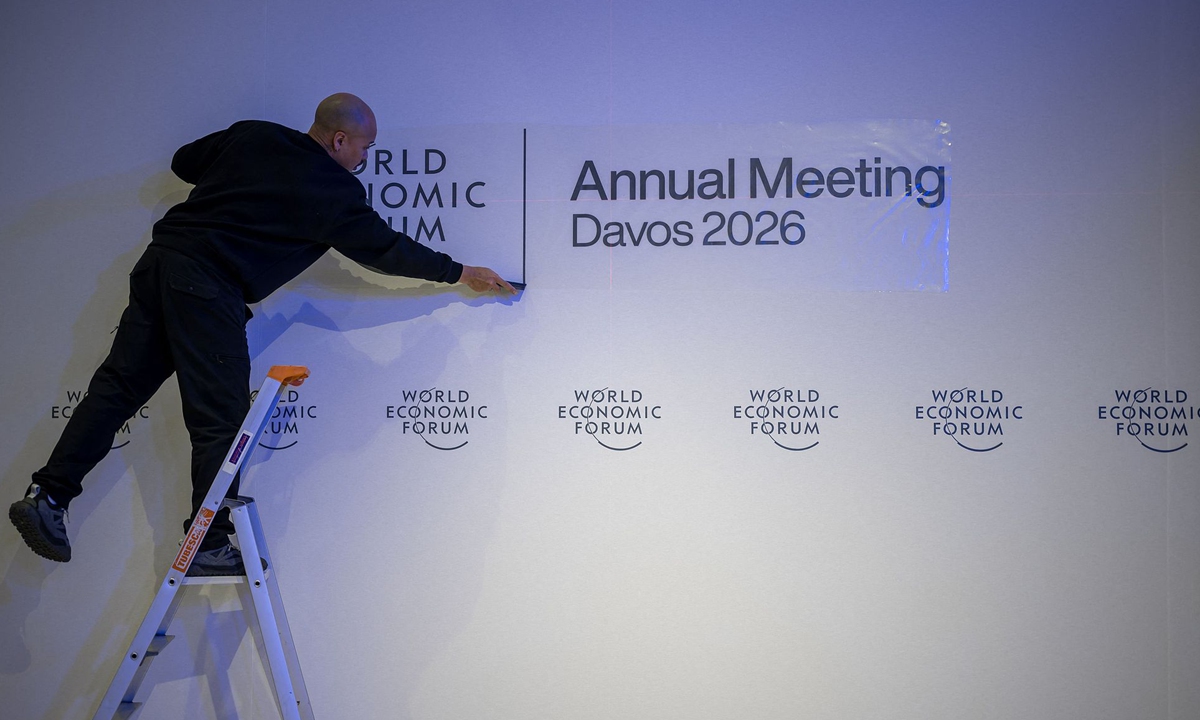
A staff member fixes a sign on a wall of the World Economic Forum at the Congress Center on its opening day in Davos on January 19, 2026. Photo: VCG
The 2026 annual meeting of the World Economic Forum (WEF) is set to open Monday evening local time in the Swiss Alpine town of Davos under the theme "A Spirit of Dialogue." However, the forum convenes against a backdrop of mounting geopolitical friction, as US President Donald Trump is reportedly preparing to return to Davos in person for the first time since 2020 amid controversy over his push to control Greenland and his fresh tariff threats against European allies, according to media reports.
Trump is reportedly about to lead the largest US delegation ever to attend this year's WEF, though his Wednesday keynote speech is likely to focus heavily on concerns back home despite the international setting. He will also address European leaders directly and will "emphasize that the US and Europe must leave behind economic stagnation and the policies that caused it," a White House official claimed, according to the Euro News.
Over the weekend, Trump said that eight European countries, including the UK, would be hit with a fresh 10 percent tariff on all goods exports for frustrating US attempts to annex Greenland. The threat marks a fresh nadir in transatlantic relations after a year in which the US has imposed the highest tariffs on European goods in nearly a century, and where US demands on Greenland now threaten to hollow out the NATO military alliance, the Times reported on local time Sunday.
Against such a backdrop, this year's WEF has drawn wide attention.
"A Spirit of Dialogue" is the official theme, and while there are certainly opportunities at an event like this for conversations not possible elsewhere, there is much in the US administration's approach that seems to be opposed to the call for global cooperation that is the essence of this place, economics editor Faisal Islam wrote in his article published by the BBC on Monday.
A report from the Associated Press noted that Trump's third visit to Davos as president comes as US allies worry about his ambitions to take over Greenland, Latin America grapples with his efforts to reap Venezuela's oil, and his hardball tactics toward Federal Reserve Chair Jerome Powell stir concern among business leaders and lawmakers alike.
The WEF official agenda features topics such as innovation, economic growth and "building prosperity within planetary boundaries", a phrase referring to discussions about how to achieve growth while still protecting the climate. "But conversations are expected to be dominated by the Trump administration's moves, from its calls to take control of Greenland to tariffs and the capture of Venezuelan President Nicolás Maduro," The Wall Street Journal reported.
While the WEF is best known for its focus on economic issues, its influence has long gone beyond economics. Over the years, Davos has served as a meaningful platform for dialogue on peace and international relations, He Weiwen, a senior fellow at the Center for China and Globalization, told the Global Times.
Although Trump's intention to bring politically charged issues that challenge the international order into Davos may create short-term disruption, it is unlikely to change the forum's broader role in promoting cooperation. Davos' core function and its long-term value as a venue for dialogue remain firmly in place, said He.
However, this year's Davos forum may be shaping up to be one of the most confrontational and divisive in its history. Inviting Trump reflects the expectation that he will be confronted with a broad international consensus - that economic globalization is an irreversible force. The US delegation, however, may come with a different agenda: to promote economic nationalism and argue that the existing globalization model no longer aligns with core US interests, Li Haidong, a professor at China Foreign Affairs University, told the Global Times.
Europe wants Davos to be about dialogue and bridge-building, but the US may see it as a stage to further impose pressure and demand that others follow the US lead, said Li.
Widening disputes
A Reuters report also predicted that national security advisers from a number of countries are due to meet on the sidelines of the WEF in Davos on Monday, with Greenland among the subjects on the agenda.
One European diplomat who spoke on condition of anonymity claimed Greenland had been added to the agenda of the previously scheduled meeting since Trump threatened to impose extra tariffs on eight European countries until ownership of the Arctic island had been transferred to the US, per the Reuters report.
Also on Sunday local time, Trump claimed in a Truth Social post that "NATO has been telling Denmark for 20 years that 'you have to get the Russian threat away from Greenland.' Unfortunately, Denmark has been unable to do anything about it. Now it is time, and it will be done!!!"
EU countries are reportedly considering hitting the US with €93 billion ($108 billion) worth of tariffs in retaliation or restricting American companies from the bloc's market in response to Trump's threats to NATO allies opposed to his campaign to take over Greenland. The move came after Trump vowed on Saturday evening to impose 10 percent tariffs by February 1 on goods from the UK, Norway, and six EU countries that sent troops to the Arctic island for a military exercise this week, according to the Financial Times.
It noted that the move "marks the most serious crisis in transatlantic relations for decades."
The Financial Times report also noted that EU's "retaliation measures are being drawn up to give European leaders leverage in pivotal meetings with the US president at the World Economic Forum in Davos this week," citing officials involved in the preparations.
Tensions between the US and the Europe are mounting over Greenland, with Washington's claims widely seen as lacking a credible basis under international law. Should Washington persist in its hardline approach, US-European frictions could spill over across diplomatic, political, military, and economic domains at the same time, said He.
On Greenland, the US and Europe are locked in a "tug-of-war", with no substantive steps taken so far. Washington's objective is clear: to secure substantive control over the island… Given Washington's hardline style and reliance on pressure tactics, the US may believe it can extract concessions on certain terms. Europe, however, is unlikely to yield quickly, Zhou Mi, a senior researcher at the Chinese Academy of International Trade and Economic Cooperation, told the Global Times on Monday.
China has stated its position on Greenland on multiple occasions. The international law underpinned by the purposes and principles of the UN Charter is the foundation of the current international order and must be upheld, Chinese Foreign Ministry spokesperson Guo Jiakun said on Monday.
In an interview with NBC News on Sunday, when asked whether President Trump was serious about annexing Greenland, US Treasury Secretary Scott Bessent claimed the president believes "enhanced security is not possible without Greenland becoming part of the US."
While for Europe, aside from mulling tariffs on the US, France has called for the bloc to hit back with the anti-coercion instrument (ACI) which has not been used since its adoption in 2023, according to the Financial Times.
EU country leaders will hold an emergency summit on Thursday to discuss the US threats to Greenland, a European Commission spokesperson said on Monday, the Xinhua News Agency reported Monday.
European Council President Antonio Costa, who presides over meetings of the EU's 27 national leaders, said in a post on X on local time Sunday that the group is firmly behind Denmark, which governs Greenland, said the report.
According to a BBC report, British Prime Minister Sir Keir Starmer has said Donald Trump's plan to impose tariffs on the UK and European allies until a deal is struck for the US to take over Greenland was "completely wrong."
How the current transatlantic tensions will evolve - and when they may ease - remains uncertain, Zhou said, noting that divisions of interest within the EU persist and member states differ in their assessments, shaped by varying security, economic, and US-related considerations.
For Europe, the current episode is both a test of strength and a test of how far the EU is truly willing to go in defending its stated principles. Only when confronted with unavoidable, high-cost challenges does the EU tend to shift its positions, and the current situation may therefore lead to a more realistic reassessment of policy within the bloc, the expert said.
The Guardian said in an analysis on Sunday that the coming weeks will test whether Trump has overreached with Greenland-related tariffs, amid growing calls for the EU to adopt a tougher stance. It noted that "Trump's tariff shock suggests the EU's strategy of flattery and appeasement has failed."
Today, the world is truly at a profound historical bifurcation point and a momentous turning point of the times: one path leads toward the forces of peace, prosperity, and foreseeable cooperation; the other toward destructive, confrontational, and divisive forces, Li Haidong said.
The collision between these two forces is growing ever more acute. The world is not at peace. The Davos meeting this time will convey — with clarity and gravity — this weighty and realistic message to the entire world on both the economic and international political levels, the expert noted.
RELATED ARTICLES