Germany reportedly opens EV subsidy program to Chinese carmakers; move to help boost cooperation: expert
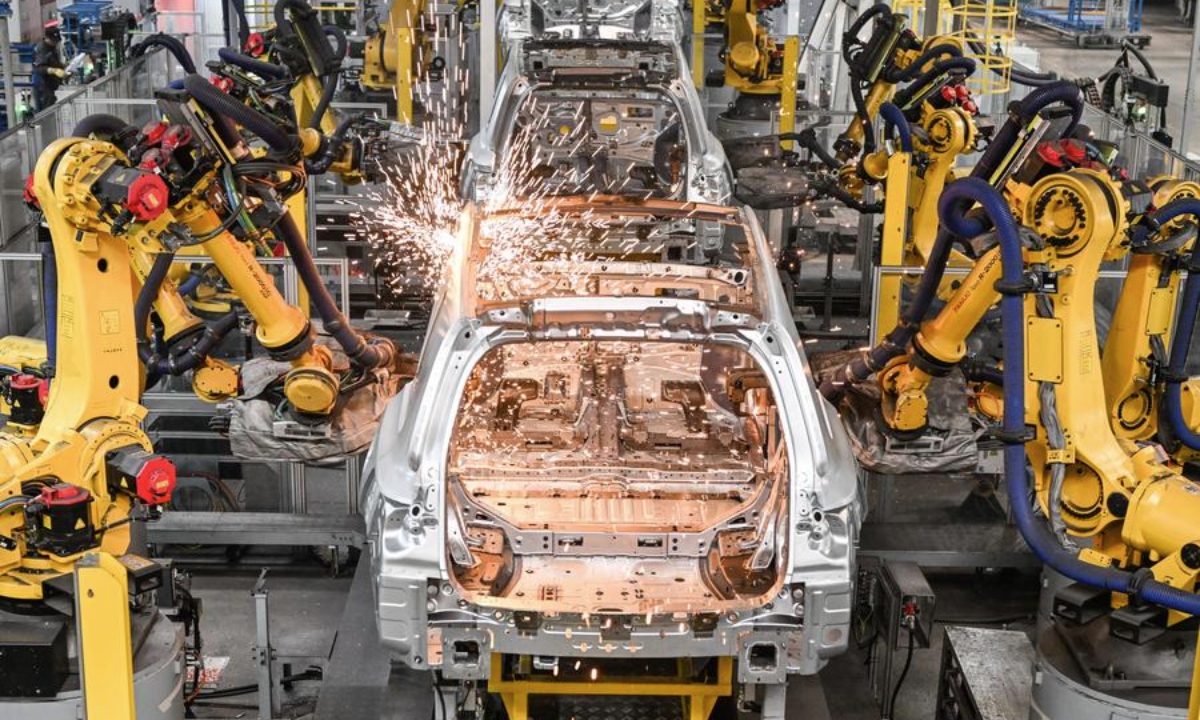
Robots weld bodyshells of cars at a workshop of Chinese electric vehicle (EV) maker Li Auto Inc. in Changzhou, east China's Jiangsu Province, Jan. 10, 2024. (Xinhua/Ji Chunpeng)
The German government is reportedly set to open its 3-billion-euro electric vehicle (EV) subsidy program, launched in autumn 2025, to all manufacturers, including Chinese carmakers. A Chinese industry expert noted that Germany's proactive stance could have a demonstration effect in the EU, eventually helping build a consensus in favor of cooperation over protectionism.
Germany's EV support program would help boost German and European industry, but would have no geographic restrictions, said German environment minister Carsten Schneider, according to the Financial Times.
Schneider claimed that he did not see Chinese manufacturers flocking into the country - neither in terms of registration numbers nor on the roads - as had been widely supposed, and that that's why Germany is facing up to competition rather than imposing restrictions, the Financial Times reported.
This stance highlights that the "Chinese EV threat" claim hyped by certain European politicians lacks a rational basis, Cui Hongjian, a professor at the Academy of Regional and Global Governance at Beijing Foreign Studies University, told the Global Times on Tuesday.
Cui further noted that the so-called "overcapacity" claimed by some in the EU is essentially a result of certain countries closing off their markets, rather than an inherent issue within China. "For Europe, the more rational choice—aligned with both its interests and reality—is to join China in promoting free trade and market openness," he said.
While Chinese brands are seeing steady growth, their market share remains low compared to German incumbents. For instance, BYD sold approximately 23,000 units in Germany in 2025; despite a seven-fold year-on-year increase, this represents less than 1 percent of the total German automotive market, according to the report.
Berlin's decision marks a sharp departure from other European nations. In the UK, a similar EV procurement scheme includes rules that effectively exclude Chinese manufacturers, said the Financial Times report.
Cui pointed out that previous EU voting results on levying tariff on Chinese EV indicate that the bloc is not unified on the EV issue. "Germany's proactive stance is expected to have a demonstration effect, potentially swaying countries that previously held 'wait-and-see' or abstentionist positions, eventually building a majority consensus in favor of cooperation," he noted.
Notably, Germany's move follows a major breakthrough in trade negotiations between China and the EU, as the two sides have agreed on price undertaking guidance for Chinese battery electric vehicles (EVs) makers, China's Ministry of Commerce (MOFCOM) announced on January 12, 2026.
According to the MOFCOM, the EU has issued guidance for submissions and committed to objective, non-discriminatory assessments in line with WTO rules. The Ministry noted that this progress reflects a mutual willingness to resolve differences through consultation while safeguarding the stability of global automotive supply chains.
Meanwhile, Canada has announced that it will grant a quota of 49,000 units for Chinese EVs annually. Within this quota, vehicles will enjoy the Most Favored Nation (MFN) tariff rate of 6.1 percent, and the 100 percent supplementary tax will no longer be applied. The quota amount will increase annually according to a certain proportion.
Wu Shuocheng, a veteran auto industry analyst, pointed out that the recent developments can be viewed together. "More countries that once imposed restrictions on Chinese electric vehicles are now opting for cooperation and openness, which in a sense also demonstrates the global leading edge of China's auto industry in products and technology," Wu said.
RELATED ARTICLES