Window of spacecraft Photo: CCTV
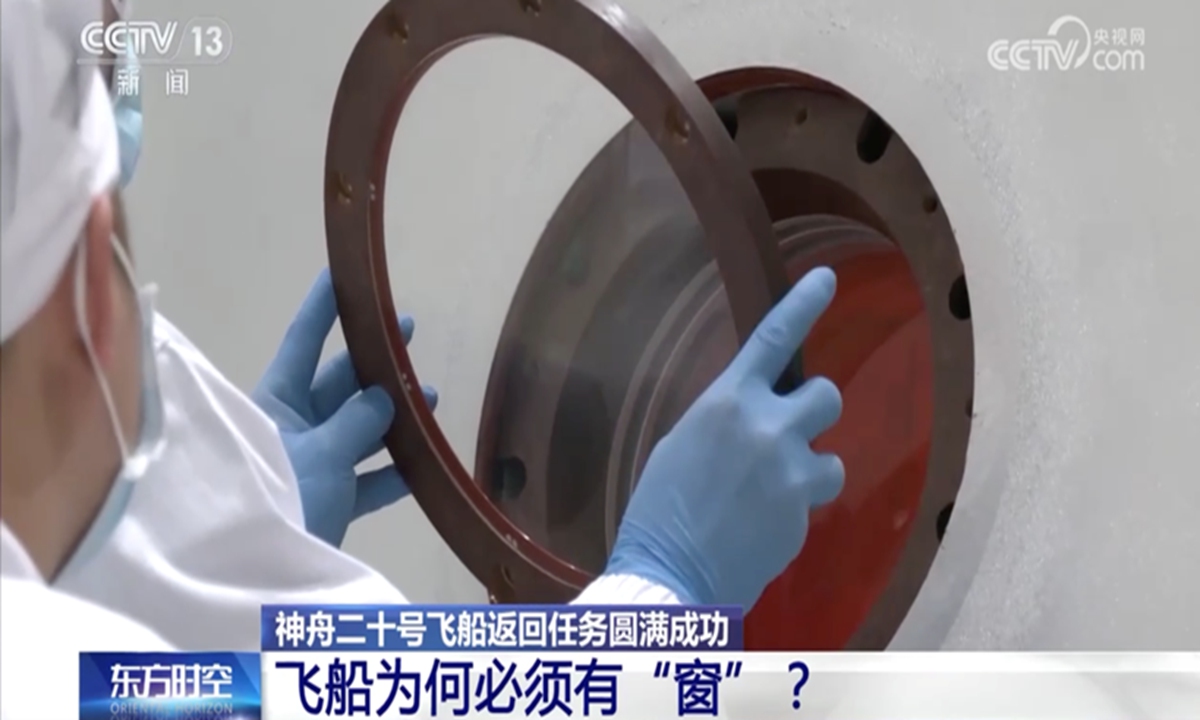
After the Shenzhou-20 spacecraft's return capsule touched down at the Dongfeng landing site in North China's Inner Mongolia Autonomous Region on Monday, what has drawn the public attention is the crack observed on the viewport window, which a CCTV report revealed on Tuesday that the maintenance operation confirmed a plan to reinforce the structure from inside the capsule.
According to the report, the return capsule's viewport window uses a three-layer composite glass structure, with the outermost heat-shielding pane designed to withstand scorching temperatures of over 1,000 C during atmospheric reentry.
After a penetrating crack was detected in this layer, engineers assessed that it could compromise reentry safety. As a result, the Shenzhou-20 crew returned aboard Shenzhou-21 instead. Because external repairs were not feasible, a plan was ultimately confirmed to reinforce the window from inside the capsule .
The Shenzhou-22 spacecraft delivered a dedicated handling device to the space station on November 25, 2025. Taikonauts installed the device inside the return capsule, improving its thermal protection and sealing performance. On Monday, the return capsule—having continued its mission despite the damage—landed safely, with its exterior intact and onboard items in good condition.
Shao Limin from the China Aerospace Science and Technology Corporation said that future work will focus on improving the viewport window structure to enhance resistance to space debris, while strengthening the monitoring of small orbital debris. Large and medium-sized debris is mainly addressed through avoidance maneuvers, while small debris is countered by relying on the inherent structural strength of the spacecraft's windows.
The report also explained why spacecraft must be equipped with windows. Their primary function is safety observation. During emergency escape procedures in the launch phase or an emergency return mission, taikonauts need to directly observe the landing environment outside the return capsule through the portholes to assess potential risks.
They also serve as a backup for attitude control, allowing taikonauts to manually stabilize the spacecraft by observing Earth's horizon and the stars if the automatic system fails.
Unlike previous crewed returns, the Shenzhou-20 spacecraft conducted an uncrewed return this time, with all critical procedures fully executed under ground command and no manual operation by taikonauts. According to CCTV, this marked the first uncrewed return during the space station phase.
The return this time also brought back a valuable retired extravehicular spacesuit as part of its return cargo, per the Xinhua News Agency. The suit, dubbed extravehicular spacesuit B, is the first of its kind on China's space station to achieve the lifespan extension goal of supporting 20 extravehicular activities (EVAs) within four years.
The Shenzhou-20 crewed spacecraft was launched on April 24, 2025. Its return was postponed in early November due to a suspected space debris impact incident, and it remained in orbit to conduct related experiments, Xinhua reported.
Global Times
RELATED ARTICLES