HK has a golden opportunity to think afresh and reinvent itself
By Published: Jan 20, 2026 08:42 PM

Illustration: Xia Qing/GT
As we just entered a new year, I think Hong Kong now has a golden opportunity to think afresh and reinvent itself. Rather than regretting the events of the very difficult days in 2019-20, Hong Kong should embrace a very different and new kind of future, based on "one country, two systems."I would like to make seven propositions concerning Hong Kong's future.
First, it must be based on deep integration with the Guangdong-Hong Kong-Macao Greater Bay Area (GBA). The dynamism of the Guangdong Province and its cities represents a huge opportunity for Hong Kong, which it must embrace in the fullest possible way. When I lived in Hong Kong in late 1990s, such thinking was still somewhat reluctant, with many looking down on Guangdong as Hong Kong's inferior. Now, I think that commitment is full-hearted. This is of absolutely fundamental importance. The GBA is one of the most innovative parts of the world, on par with Silicon Valley.
Second, Hong Kong has the great fortune to be part of China, a country that has not only transformed itself, but is now transforming the world. More and more people, especially in the Global South, look to China as the new global leader, the biggest contributor to global economic growth, the leader of the green transition and the de facto leader of the Global South. Integrated with the mainland, Hong Kong is now part of the future.
Third, a major task for the Hong Kong Special Administrative Region government, indeed, is to create a new sense of belonging among Hong Kong residents. A new sense of pride in a new Hong Kong. A new sense of identity that is inclusive, not exclusive, that embraces mainlanders, that treats those from elsewhere who have chosen to live in Hong Kong, whether permanently or temporarily. Think of the China-proposed Global Civilization Initiative in this context, which is a wonderful statement in praise of diversity.
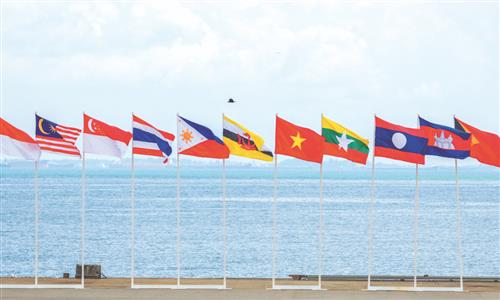
Fourth, Hong Kong should take every opportunity to develop closer relations with its neighbors in ASEAN. Together, these countries constitute one of the most dynamic regions of the world, with a population of around 700 million, a growth rate of around 5 percent, and one that is drawing ever closer to China. Hong Kong's role as a highly competent and dynamic financial center could become a major resource for these countries. The internationalization of the renminbi, and the offshore yuan in particular, could offer major opportunities for the Hong Kong financial sector in the ASEAN countries.
Fifth, it seems likely, at least for the foreseeable future, that Western countries and institutions will be much less involved with Hong Kong as a financial center. Yet, the Belt and Road partner countries could offer Hong Kong's financial institutions many diverse opportunities. But such connections will require a new kind of business and operating model. And the fees are likely to be much more modest than those of the West. Such work and such connections will demand a very different mind-set and culture compared with Wall Street, London or wherever.
Sixth, Hong Kong needs to develop a new mental map. Prior to the handover in 1997 and, to a much lesser extent, even until 2020, Hong Kong looked westward to North America and Europe. It looked increasingly to the mainland after the handover, but not until much more recently to the Global South and ASEAN. As it is likely that the world will become more balkanized, this needs to inform how Hong Kong and its institutions think about the future: Don't think Western, think the mainland and the Global South. Hong Kong needs to develop a new generation of talent that thinks the mainland and thinks the Global South. Schools, universities, business schools and think tanks must play a major role in this.
Seventh, although Hong Kong has long been associated with modernity, this is no longer as true as it once was. It is certainly a long time since Hong Kong was associated with cultural modernity, most famously the creativity of its film industry. Modernity is no longer just about economics; it is also increasingly about culture. This is an area that Hong Kong needs to give serious attention to. If Hong Kong wants to develop a new identity, as I have argued, an imaginative and dynamic culture is a crucial aspect of this. But it will need and depend upon a very different kind of thinking and mind-set from a new young generation, which feels comfortable with and energized by a new Hong Kong.
The author is a visiting professor at the Institute of Modern International Relations at Tsinghua University and a senior fellow at the China Institute, Fudan University. Follow him on X @martjacques. opinion@globaltimes.com.cn
RELATED ARTICLES