EU vows 'unflinching' response as US escalates pressure over Greenland
Transatlantic ties face most challenging situation since WWII: expert
By and Li Yu Published: Jan 20, 2026 09:00 PM

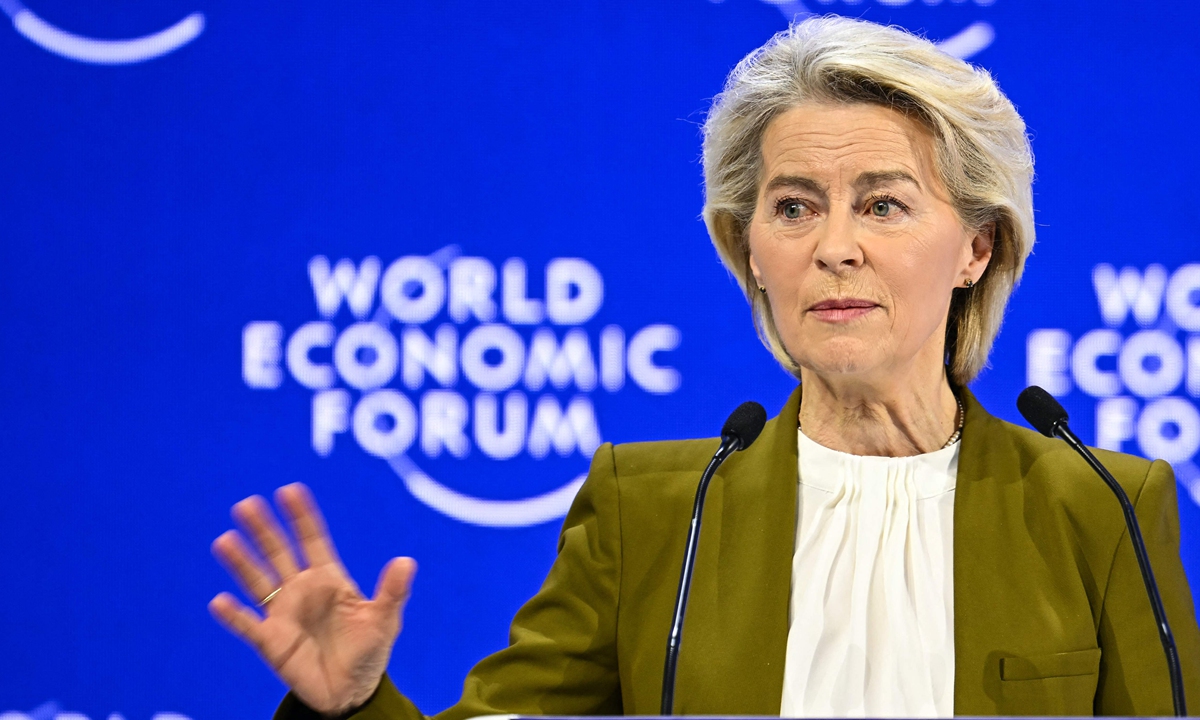
European Commission President Ursula von der Leyen delivers a speech during the World Economic Forum annual meeting in Davos on January 20, 2026. She said that the EU stands in full solidarity with Greenland and the Kingdom of Denmark, stressing that their sovereignty and territorial integrity are non-negotiable. Photo: VCG
Amid escalating tensions with European allies over Greenland, US President Donald Trump spoke with NATO Secretary General Mark Rutte and once again stressed his tough stance on acquiring the semi-autonomous Danish territory. Multiple EU officials and European leaders have expressed strong opposition, vowing to defend European interests while mulling possible retaliation.Trump claimed on social media on Tuesday that his phone call with Rutte concerning Greenland was "very good." He also said he has agreed to meet with various parties in Davos, Switzerland. "As I expressed to everyone, very plainly, Greenland is imperative for National and World Security. There can be no going back - On that, everyone agrees!"
Trump also posted an image of himself placing the US flag on the territory of Greenland on Tuesday on his social media platform Truth Social. In the image, Trump is accompanied by US Vice President JD Vance and Secretary of State Marco Rubio, with a sign nearby reading "GREENLAND - US TERRITORY EST. 2026," according to the Xinhua News Agency.
On the same day, Trump released another image: He met with European leaders in the Oval Office, with a map displayed behind him showing the US, Canada, Greenland, and Venezuela under the American flag.
European Commission President Ursula von der Leyen said Tuesday that the European Union stands in full solidarity with Greenland and the Kingdom of Denmark, stressing that their sovereignty and territorial integrity are non-negotiable, Xinhua reported.
The Associated Press reported that in a speech at the World Economic Forum in Davos, Von der Leyen also said that Trump's planned new tariffs over Greenland "are a mistake especially between long-standing allies."
If Donald Trump goes ahead with the 10 percent tariffs against eight European countries to force a sale of Greenland, the European Union will hit back with an "unflinching, united and proportional" response, Ursula von der Leyen said on Tuesday morning as she extended her hand to the American president to deepen cooperation in the Arctic region, the Euro News reported.
Citing an official source, the Financial Times reported on Monday that EU leaders are preparing to meet for an emergency meeting to discuss the crisis on Thursday. The FT added that European Commission officials have drawn up detailed options for further retaliation. If the US president follows through with extra tariffs, the EU is likely to hit back with its own levies on 93 billion euros of US goods.
"For many European governments, including America's longest-standing and most loyal allies, Trump's threat of punitive tariffs against anyone who tries to stop him taking Greenland was the final straw. Divorce, they believe, is now inevitable," Politico.eu said in an analysis published on Monday.
Li Haidong, a professor at China Foreign Affairs University, told the Global Times that Transatlantic relations are truly in crisis, and it is the most challenging situation for transatlantic relations since the end of World War II, the expert said.
Appeasement or confrontation
On Tuesday, Trump also leaked a screenshot text image from French President Emmanuel Macron, who wrote to the US leader: "My friend, We are totally in line on Syria. We can do great things on Iran. I do not understand what you are doing on Greenland," according to the CNN.
Hours earlier when speaking to reporters, Trump threatened to impose a 200 percent tariff on French wines and champagne as Macron was reported to be unwilling to join Trump's Gaza "Board of Peace".
On Monday, a French official confirmed to ABC News that Macron "will request the activation of the EU's anti-coercion instrument in the event of new US tariffs." That mechanism, colloquially known as the bloc's "trade bazooka," would allow the EU to impose severe restrictions on US goods and services, according to ABC News.
According to the Financial Times, Denmark sent several aircraft carrying troops and military equipment to Greenland late on Monday. The Danish defense forces said a "substantial contribution" of soldiers and the head of the country's army were flown out to the Greenlandic capital Nuuk and to Kangerlussuaq in the west of the autonomous territory, on top of the more than 200 troops already present.
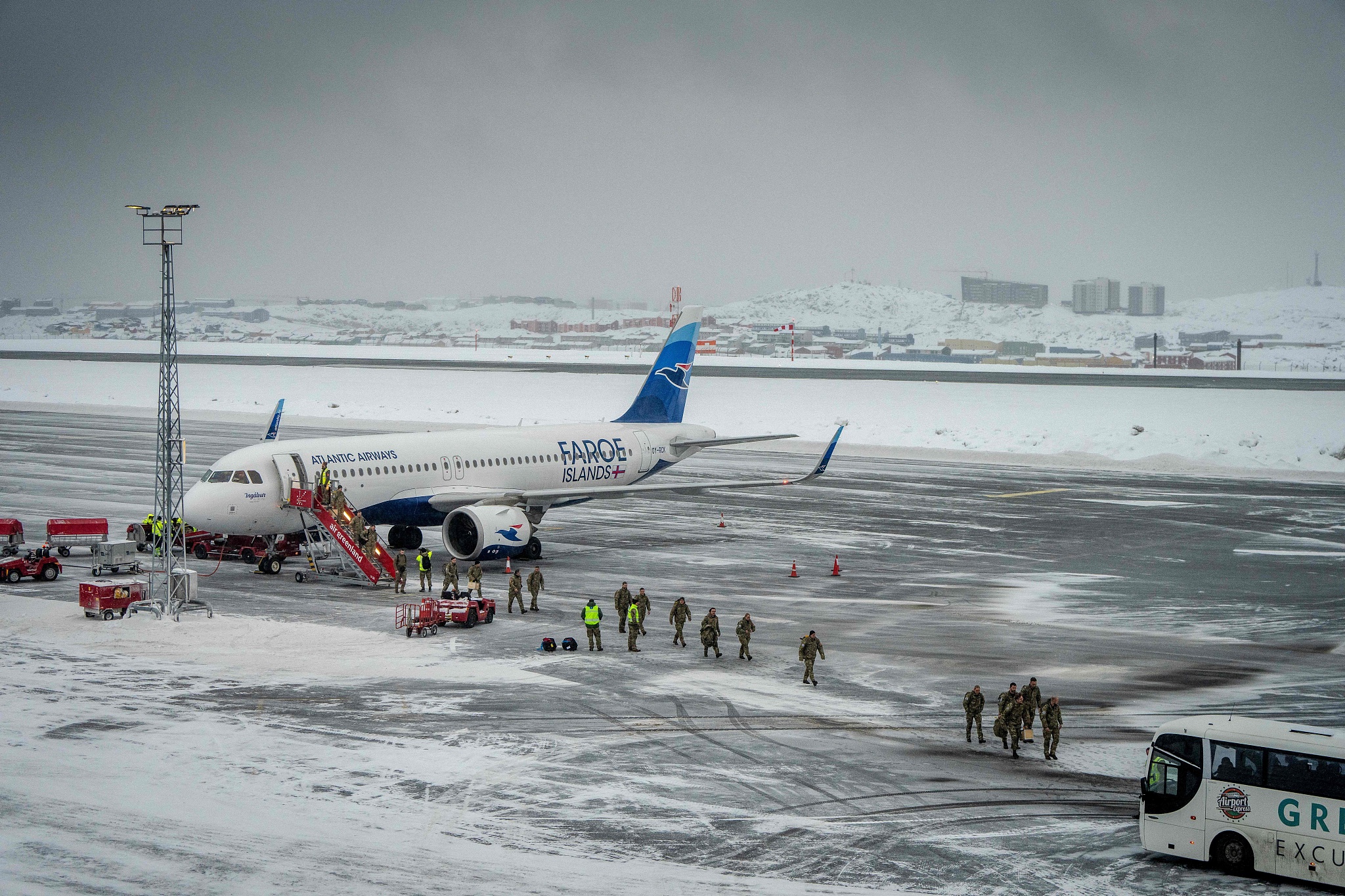
Danish soldiers walk across the frozen tarmac after arriving at Nuuk airport, Greenland, on January 19, 2026. The Danish Defense will continue its increased presence with exercise activities together with a number of NATO allies in and around Greenland in 2026. Photo: VCG
Following meetings with Denmark defense minister Troels Lund Poulsen, and Greenland's foreign minister Vivian Motzfeldt on Monday, the EU's High Representative Kaja Kallas said on X that "tariff threats are not the way to go about this. Sovereignty is not for trade… We have no interest to pick a fight, but we will hold our ground. Europe has a slate of tools to protect its interests."
However, speaking to reporters on Monday local time, Trump claimed that NATO allies would not "push back too much" on his claim over the island and dismissed European deployments there as "not a military," the BBC reported.
In response to an NBC question on Monday about whether he could seize the island by force, the US president replied, "no comment."
Wang Yiwei, a professor at the School of International Studies at the Renmin University of China, told the Global Times that if the US chooses to employ coercive or hardline measures, Europe lacks the military capability to confront it head-on. The means of resistance available to Europe are quite limited and are primarily concentrated in the economic domain, for example, restarting countermeasures in the area of tariffs.
"Moreover, the European Union has never been a monolithic bloc," said Wang, "Many member states remain heavily dependent on the US, and these countries are far more concerned with immediate security pressures than with Arctic geopolitics or Danish sovereignty issues."
Earlier on Monday, British Prime Minister Keir Starmer denounced the US' escalation as "completely wrong," yet he also called for a "pragmatic sensible, sustainable solution." Similarly, German Chancellor Friedrich Merz has vowed to "protect our European interests as well as German interests," while also saying that "We want to avoid any escalation," according to Euro News.
The likely outcome is that at the political and rhetorical level, the EU and its member countries will issue stern condemnations, but at the substantive level, they will struggle to impose any meaningful constraints on the US, the expert added.
"Transatlantic relations have indeed reached a historic turning point, but they will unlikely truly break apart," Wang said. "The reason lies in the clear one-sided and asymmetrical nature of Europe's dependence on the US. In transatlantic relations, it is Europe that needs NATO far more than the US needs NATO.
"Europe offers a tragic case study: it has outsourced the very shield of strategic autonomy and strengthened defense capabilities to the US. For Europe to achieve genuine strategic autonomy in any meaningful sense, the path ahead remains long and arduous," Li said.
RELATED ARTICLES