Japanese public splits over life sentence of ex-PM Abe’s killer; case reflects issues of religious group oversight, dubious benefit transfer in Japan: expert
By Published: Jan 21, 2026 06:57 PM

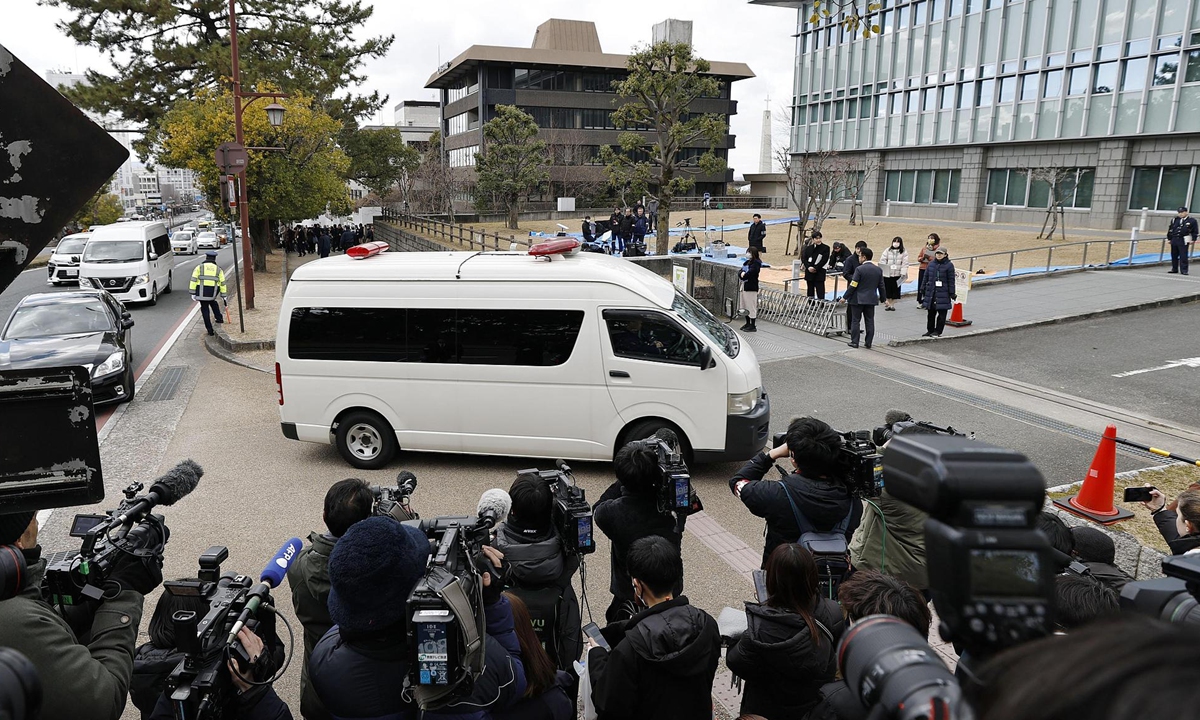
A vehicle carrying Tetsuya Yamagami, the man who fatally shot former Prime Minister Shinzo Abe, enters the Nara District Court in Nara for a ruling on Jan. 21, 2026. The court sentenced him to life in prison for killing Abe during an election stump speech in the western Japan city in July 2022. Photo: VCG
A court in western Japan on Wednesday sentenced a man to life in prison for fatally shooting former Prime Minister Shinzo Abe in 2022, according to media reports. While the court delivered its verdict, Japanese society remains split over the punishment, with some expressing sympathy for the defendant, whose personal tragedy is linked to a controversial religious group, which reportedly has close connection with Japan's ruling LDP.
According to a Chinese expert, this public sympathy is largely rooted in widespread distrust and antipathy within Japan toward controversial groups like the Unification Church, highlighting deep-seated social contradictions. The expert noted that the case has exposed the long-standing issue of "benefit transfers" between Japanese political circles and religious groups.
Mainichi Shimbun reported Wednesday that the defendant Tetsuya Yamagami, 45, pleaded guilty to the crime at the trial's opening last year, but what punishment he deserves has divided public opinion in Japan. According to media reports, while many see the 45-year-old as a cold-blooded murderer, some sympathize with his troubled upbringing under the harmful influence of a religious group.
Abe was shot and killed on July 8, 2022, while delivering a campaign speech on a street in the western Japanese city of Nara in support of a ruling Liberal Democratic Party candidate in the House of Councillors election. Yamagami was arrested at the scene, according to media reports.
Kyodo News reported Wednesday that prosecutors had demanded the life sentence for Yamagami, calling his act "an unprecedented crime in the country's postwar history."
During Yamagami's trial at the Nara District Court, which uses a lay judge system, his defense counsel argued that his prison term should be no more than 20 years. They claimed that Yamagami was a victim of harm caused by a religious group and that his "tragic" upbringing motivated him to kill Abe, Kyodo News reported.
The defendant said he held a grudge against the Unification Church because his family suffered financial ruin due to his mother's large donations to the religious group, with the payout totaling 100 million yen ($633,000), according to the report.
Yamagami said he believed Abe, who was 67 when shot, was "at the center of the Unification Church's political involvement" in Japan.
NHK News reported that Yamagami also admitted to having a desire for revenge following the suicide of his brother, who opposed their mother's faith, in 2015.
Yamagami revealed that a video message he saw from Abe to an affiliate of the religious group had filled him with despair, NHK News reported.
Public views in Japan are divided over the case. On X, some Japanese netizens argued that the "life imprisonment sentence" for defendant Yamagami is too harsh, and some support the sentence.
A Japanese netizen @yw_bsv commented on X that the sentence is a judicial decision that clearly separates "a background worthy of sympathy" from "an absolutely inexcusable act." "While Tetsuya Yamagami's isolation and family environment are serious facts, the act of taking a life in a public space cannot be justified for any reason. However, life imprisonment is quite severe," the netizen said, noting that the next urgent issue should be "whether society will ignore the isolation and religious victimization reflected in this case."
Another Japanese netizen @6onKg said "I am filled with deep frustration and a sense of injustice. It feels as if Yamagami alone is being made to bear all the blame. In South Korea, there is such an uproar over politicians receiving money or gifts, so why is it different in Japan? Is it because the ruling party is the LDP, so they try to cover up scandals and prevent them from being uncovered?"
Xiang Haoyu, a research fellow at the China Institute of International Studies, told the Global Times on Wednesday that while sympathy for the perpetrator should not obscure the illegality of the violent act, Japan needs to reflect on how to improve its legal oversight to prevent religious organizations from exploiting 'freedom of belief' to infringe upon public rights.
According to Kyodo News, with the case shedding light on the Unification Church's solicitation of ruinous donations from members, a government probe was launched, leading to the Tokyo District Court's order for the church to be dissolved and stripped of its tax benefits as a religious corporation. Scrutiny over the church's links with lawmakers of the ruling Liberal Democratic Party grew, with some reportedly having received support during election campaigns, Kyodo News reported.
Xiang said that historically, the ties between the LDP and the Unification Church provided electoral mobilization support for the conservative camp. This invisible exchange could corrupt policy impartiality.
However, the current Japanese government lacks the will for thorough reform, making it difficult to address the root cause.
Following Abe's assassination, some right-wing forces have attempted to use Abe's political legacy and influence to stir nationalist sentiments and advance their agenda for constitutional revision and military expansion, Xiang said.
Nippon.com reported in November 2022 that following Abe's assassination, arguments have resurfaced urging that constitutional revision should be advanced as they claimed this is a way to "honor his legacy."
Xiang added that countries in the region must remain vigilant against the Japanese right-wing's exploitation of this case to pave the way for historical revisionism and military buildup.
Lü Chao, a professor at the Liaoning Academy of Social Sciences, told the Global Times that although this verdict marks the conclusion of the Abe assassination case, the right-wing path and ideology he promoted, as well as the political legacy he left, will continue to influence Japanese society and public perception—far from coming to an end, the expert noted.
RELATED ARTICLES