Trump claims not to use force to acquire Greenland, yet WEF speeches expose widening US-Europe divide

Canadian Prime Minister Mark Carney delivers a speech at the World Economic Forum Annual Meeting held in Davos, Switzerland on January 20, 2026. Photo: AFP
The US and its traditional allies in Europe and Canada appeared increasingly divided in Davos, Switzerland, as a string of Western leaders voiced direct or thinly veiled concerns over Washington's recent policies during the ongoing World Economic Forum's annual meeting, while US President Donald Trump also turned his criticism toward Europe.
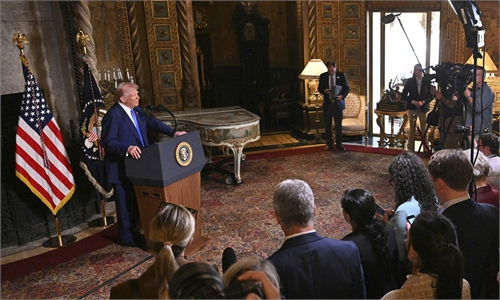
At the World Economic Forum on Wednesday, Trump "wasted almost no time raising sharp criticism of Europe," telling a packed convention hall of European officials that parts of the continent were "not even recognizable," according to CNN.
While claiming in his speech that The US cares greatly about the people of Europe, Trump also slashed out that Europe is not heading in the right direction and that they [Europe] are destroying themselves, according to the full text of the speech provided by the Canadian media outlet Global News.
While saying he would not use force to acquire Greenland, Trump reiterated his demand for control of the island during the meeting and criticized Denmark as "ungrateful" for refusing to relinquish it, contending that the nation owed the US for defending it during World War II, CNN reported.
Meanwhile, leaders including French President Emmanuel Macron, Canadian Prime Minister Mark Carney, European Commission President Ursula von der Leyen, Belgian Prime Minister Bart De Wever, and Swedish Deputy Prime Minister Ebba Busch raised concerns - explicitly or implicitly - about the US actions. Their remarks underscored widening divide within the transatlantic alliance, following Washington's moves related to Greenland, Venezuela and other regions.
Several of these leaders also addressed China during the forum. Carney cited newly concluded strategic partnerships with China and Qatar as part of Canada's effort to diversify its external relations, while Macron called for more Chinese foreign direct investment in "some key sectors" in Europe.
Chinese experts said the leaders' comments suggest that both Canada and Europe are reassessing their ties with Washington amid intensifying US pressure. Statements about strengthening cooperation with China, they noted, reflect attempts to rebalance China policy under the US pressure.
At Wednesday's WEF meeting, Trump, in addition to his sharp criticism of Europe, also warned Canada that it should be more "grateful" to the US, CNN reported.
He added that Canadian Prime Minister Carney "wasn't so grateful," referring to Carney's speech at the forum this week, according to CNN.
"Canada lives because of the United States. Remember that, Mark, the next time you make your statements," the US leader remarked in the speech.
The closely watched speech Carney delivered on Tuesday, warned that the world is "in the midst of a rupture" in the international order and urging middle powers to remain both principled and pragmatic.
During his address, Carney elaborated on what he sees as the responsibility of middle powers in the current environment. "What does it mean for middle powers to live the truth?" Carney said. "First, it means naming reality. Stop invoking rules-based international order as though it still functions as advertised. Call it what it is - a system of intensifying great power rivalry, where the most powerful pursue their interests, using economic integration as coercion."
He also addressed Arctic issues, saying, "On Arctic sovereignty, we stand firmly with Greenland and Denmark, and fully support their unique right to determine Greenland's future," while noting that Canada "strongly opposes" tariffs over Greenland. According to the BBC, the remarks drew applause from the audience.
Macron voiced similar concerns, warning of a global "shift toward a world without rules," where international law is trampled and "the only law that seems to matter is that of the strongest." He cautioned that without collective governance, cooperation would give way to relentless competition, citing US trade agreements that undermine European export interests, demand maximum concessions and rely on endless accumulation of tariffs that are "fundamentally unacceptable," and used as leverage against territorial sovereignty.
France is among eight countries that US President Donald Trump has threatened with an additional 10 percent tariff on exports to the US starting February 1 if those countries do not drop their opposition to the US acquisition of Greenland from Denmark. That rate would increase to 25 percent on June 1 if they stand firm, according to The New York Times.
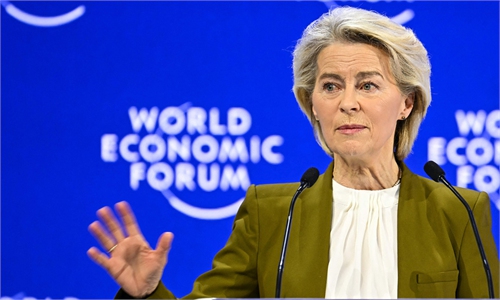
Von der Leyen warned Washington to keep its hands off Greenland and said Europe's response to the US threats would be "unflinching." In a speech, she said the self-ruling Danish territory's sovereignty is "non-negotiable," despite Trump's repeated promises to purchase or annex it, according to Politico.eu.
Intense attention
These leaders' speeches drew intense attention from Western media, many of which linked the statements to Washington's recent rhetoric about annexing Greenland and Canada, as well as US military actions in Venezuela.
Commenting on Trump's criticism about Europe, the CNN called it "a harsh message from a president who had already thrust US-European ties into crisis territory with his ambitions of annexing Greenland."
The New York Times reported that Carney described the end of an era underpinned by US hegemony, calling the current phase "a rupture." "He never mentioned President Trump by name, but his reference was clear," the paper wrote. The BBC and CNN similarly highlighted the speech, noting that while unnamed, its criticism was widely read as directed at Washington.
Canada's Global News went even further, saying that the "rules-based" international order is collapsing - a collapse driven primarily by the US, which for generations championed that order - a reality that would come as no surprise to people in Venezuela, Greenland or Denmark.
The outlet paired its coverage with an AI-generated image posted by US President Donald Trump on Tuesday, depicting European leaders in the Oval Office while Trump sits behind the Resolute Desk. To Trump's left was a map of the Americas, with Canada - along with Venezuela and Greenland - shown with the stars and stripes of the American flag grafted over them.
The Washington Post said the surreal clamor over the Arctic island provoked by Trump has shadowed proceedings in Davos, and sharpened the sense of an emerging hinge point in ties between the US and Europe.
European leaders' strong reaction to the US action is not surprising, as two important NATO members Denmark and Canada have both become targets of US territorial claims, Lü Xiang, a research fellow at the Chinese Academy of Social Sciences, told the Global Times on Wednesday.
"If Denmark were to lose Greenland, it would signal that Europe lacks sovereignty and could be subject to arbitrary US demands," Lü said.
During his Tuesday speech, Macron said Europe has very strong tools now, and "we have to use them when we are not respected, and when the rules of the game are not respected, by the way. The anti-coercion mechanism is a powerful instrument and we should not hesitate to deploy it in today's tough environment."
Commenting on Carney's speech, Li Haidong, a professor at China Foreign Affairs University, told the Global Times on Wednesday that the speech avoided conventional diplomatic platitudes. Instead, he said, it reflected new thinking shaped by real pressure from the US, while also articulating sentiments that resonate deeply within parts of Europe. In this sense, the remarks carry a representative quality, reflecting concerns shared by many Western countries amid mounting uncertainty over the global order.
RELATED ARTICLES