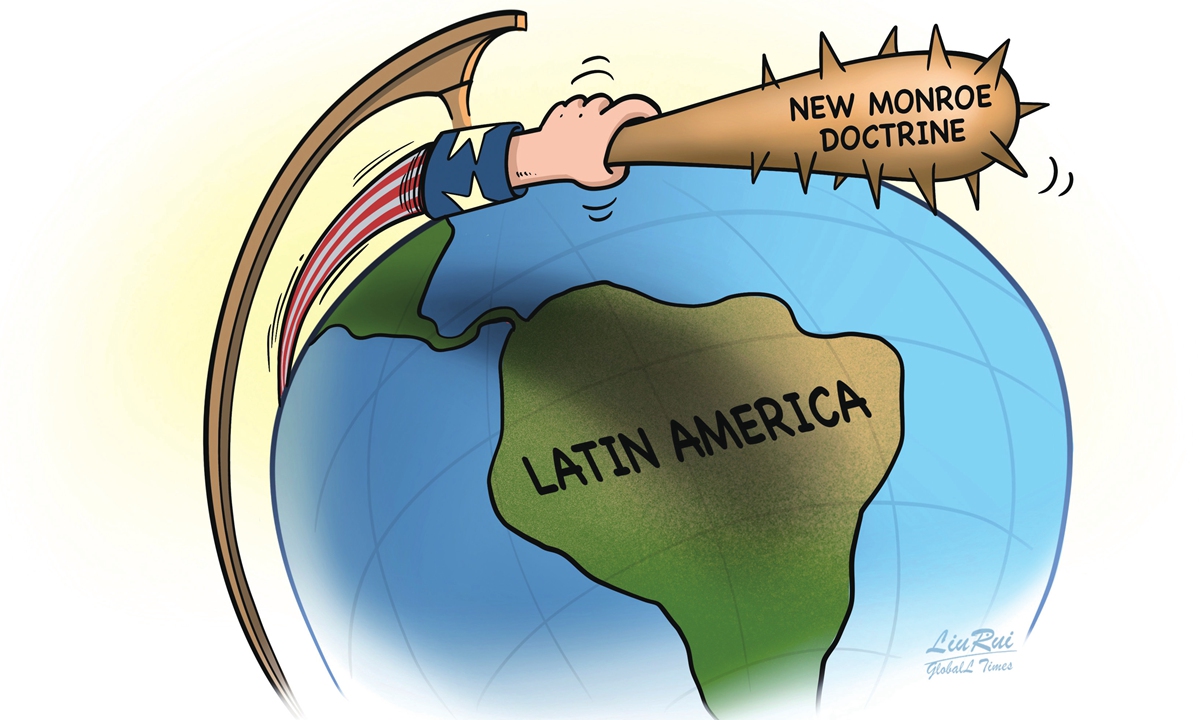
Illustration: Liu Rui/GT
As the headlines of US military strike on Venezuela and the forcible seizure of its President Nicolás Maduro gradually give way to Greenland and the US-Europe divide at Davos, a chilling reality remains: the sovereignty and regional security of Latin American countries are still being held hostage by a blade from their northern neighbor.
On Thursday, The Wall Street Journal (WSJ) cited people familiar with the matter claiming that the Trump administration is seeking Cuban government insiders to facilitate a regime change by year-end. While US officials "don't have a concrete plan" to end the Cuban government, according to the US media outlet, such discussion serves as little more than salt in the still-burning wounds of Latin America against the backdrop of the Venezuelan intervention.
This WSJ report once again drags the ghost of the Monroe Doctrine - a specter that has haunted the Americas for two centuries - back into the spotlight in a more barbaric form. Under the current US administration, the new Monroe Doctrine has revealed its most dangerous colors: a campaign of imperial expansion masquerading as "national security." Its hallmarks are no longer limited to simply political manipulation, diplomatic isolation or trade embargos; rather, it has evolved into a system of structural manipulation: a multi-pronged offensive blending military strikes, financial strangulation, energy blockades and pervasive internal subversion.
From the direct military interventions of the past to modern-day "color revolutions," economic warfare and psychological operations, Washington's interventionist toolbox has been continuously "upgraded." For Latin American countries, the new Monroe Doctrine is not a "gift" from its "good neighbor"; it is a sword suspended by a thread, its blade glinting with the cold light of interventionism.
The raid on Caracas was merely a blatant test run for the new Monroe Doctrine. For Washington's hawks, Venezuela is simply the first domino. They are leveraging the momentum of military hegemony to create a "chilling effect" across the region: submit, or become the next target. This naked power politics is a total desecration of the UN Charter and the fundamental principles of sovereign equality and non-interference.
We need not obsess over whether the WSJ leak is accurate or if a coup in Cuba will indeed manifest by the end of 2026. The true danger lies not in a specific timeline, but in Washington's mindset of treating intervention as a right and hegemony as order. As long as the machinery of the new Monroe Doctrine remains in motion, peace in Latin America will remain fragile.
If the US is intoxicated by its temporary military gains in Venezuela, leading it to believe it can act with impunity across the region, it is committing a grave miscalculation of both history and reality. The Latin America of today is not the region of the mid-19th and early 20th century. While hegemony will sow division, the collective aspiration for sovereign development among the people of the region remains an irresistible force.
Furthermore, as Washington's unilateralist impulses are no longer confined to its "backyard," global resentment toward its hegemonic words and actions has reached a breaking point - Washington's recent threats regarding Greenland even forced US allies across the Atlantic Ocean to take a stand, pleading that "might is right" must not become the universal law of international conduct.
In effect, the US is attempting to tear out the pages of the 21st-century international legal code and flip the calendar back to the 19th-century era of the "law of the jungle." Against this backdrop, defending justice requires a sturdier shield to deflect direct blows, but even more importantly, it requires the forging of a "sharp blade" of equity to sever the chains of hegemonic interference.
This "blade" is not a call for escalating conflict, but rather a catalyst for the reconstruction of capabilities and the innovation of global order. It means steadfastly defending multilateralism within the framework of international law to form a potent counterweight to intervention. It means deepening South-South cooperation, strengthening regional integration and building resilient economic and financial networks to withstand unilateral sanctions. Above all, it's about enhancing strategic autonomy in critical sectors to fortify the foundations of national security.
The ultimate goal is to drive the international order toward a more democratic and multipolar future, thereby systematically shrinking the space in which hegemony and power politics can operate. Only when the hegemon realizes that its predatory ambitions will incur an unbearable cost will that dangling sword finally cease to fall.
RELATED ARTICLES