The 'Board of Peace' cannot replace the United Nations
By Published: Jan 23, 2026 09:00 PM

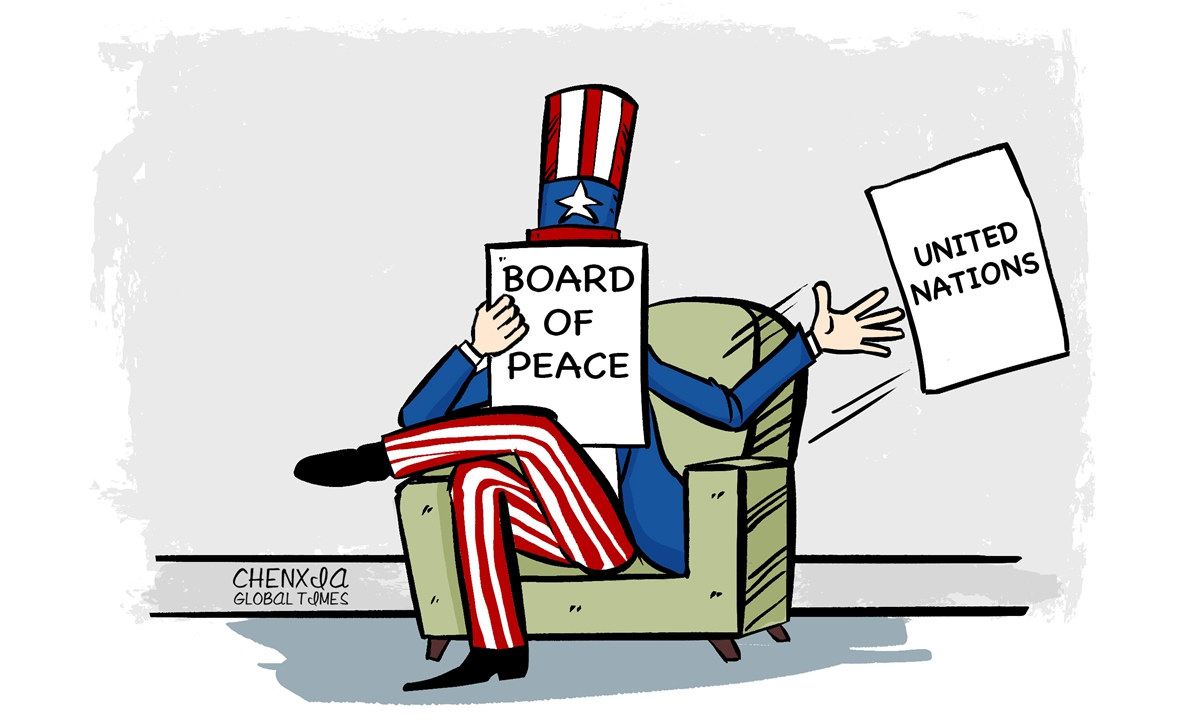
Illustration: Chen Xia/GT
On Thursday, US President Donald Trump once again turned on the klieg lights by launching a new major international initiative - the "Board of Peace." Though this multilateral body is supposed to start with managing the post-conflict restoration and future development of the Gaza Strip, many argue that its real goal has a larger scale and might reflect the US president's ambition to find an efficient alternative to the UN, which he shows no respect for.If the pilot Gaza project turns out to be a success story, this model can be swiftly upgraded and expanded to cover many other conflict areas of the world; they already hinted in Washington that the same innovative and flexible approach may be applied later on to Ukraine and Venezuela.
The idea of the Council does not come as a complete surprise to the international community; it has been around already for some time - at least since September of last year. It would be unfair to argue that it emerged in direct opposition to the UN. After all, the UN Security Council Resolution 2803, approved in mid-November by 13 members (with China and Russia abstaining from voting), explicitly called for a temporary international governance in the Gaza Strip and welcomed the establishment of the "Board of Peace."
However, when a more or less detailed plan was promulgated by the White House, the subsequent international reaction turned out to be mixed at best. The "Board of Peace" looks like an exclusive, luxury private club where an invitation must come from Trump himself. Furthermore, the permanent club card costs $1 billion, which means that the doors of the club will remain closed to the overwhelming majority of developing nations with modest financial resources. Not surprisingly, on the initial list of invitees, there were only two countries from Africa and three from Latin America. In summary, about 60 countries - fewer than a third of all UN members - were invited to join the Council.
The decision-making process within the club is also questionable, to put it mildly. According to what is known, the governance pattern of the proposed "Board of Peace" looks more inherent to despotic empires of antiquity rather than to 21st-century multilateral development projects.
Another apparent pitfall of the proposed "Board" is the enforcement of its decisions. It remains unclear how the "Board" is going to impose its will on the universe of headstrong, obstinate and often disobedient local and regional actors - be it in Gaza or in many other conflict-torn areas. So far, there are no appropriate legal mechanisms or administrative tools available which are capable of assuring that the "Board" decisions will be taken on the ground. Be mindful that in the case of Gaza, Palestinians have not even been invited to join the "Board," and some within the Israeli government have serious reservations about its composition.
The long-term or even mid-term sustainability of the "Board" also remains an open question. The operational layers of the body are heavily saturated with high-level bureaucrats from the Republican administration and it is hard to imagine how this body might outlast Trump's three remaining years in power.
And yet, even if the "Board" deals only with Gaza, three years might turn out to be absolutely insufficient to complete the post-conflict restoration project in the strip in full. If the "Board" were to expand to other conflict places, such as Ukraine, it would require much more time, commitment and institutional capacity.
One could add that, so far, the "Board" blueprint lacks a number of important dimensions that should be organic to any modern post-conflict recovery and rehabilitation, like human rights, poverty reduction, climate change and environment management, community building, among others.
It looks somewhat counterintuitive, but the plan has received most of the sharp criticism not from the Global South, not from Moscow or Beijing, but from a number of the most faithful US allies and partners. It was rejected by many EU member states and the United Kingdom and generated no enthusiasm in Canada, where they questioned the terms outlined by the US president.
Numerous critics did not like the suggested price tag for the club membership, ambiguities of the mandate, vague efficiency criteria, likely overlaps with UN specialized agencies. Nonetheless, it is crystal clear that no real plan for Gaza has any chance of success, unless it addresses the critical issue of Palestinian Statehood, which is not the case with the "Board of Peace."
The UN remains the sole international body that has the needed legitimacy, experience, resources and legal basis to steer large-scale post-conflict restoration projects like the one in the Gaza Strip. All new initiatives should strive to complement the UN rather than replace it. If the "Board of Peace" becomes one of the catalysts to speed up badly needed UN institutional reforms, it would play a useful role for the international community. If it attempts to compete with UN special agencies and even with the Security Council, it will only bring more instability and chaos in the highly volatile and worrisome international environment of today.
The author is a member of the Russian International Affairs Council. opinion@globaltimes.com.cn
RELATED ARTICLES