Illustration: Liu Rui/GT
When President James Monroe proclaimed the Monroe Doctrine in 1823, it was presented as a defensive principle aimed at protecting the newly independent nations of the Americas from renewed European colonial ambitions.
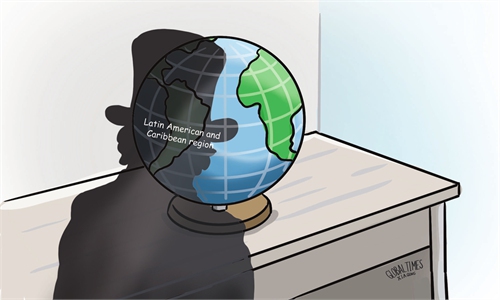
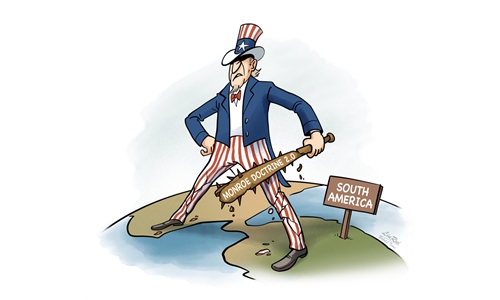
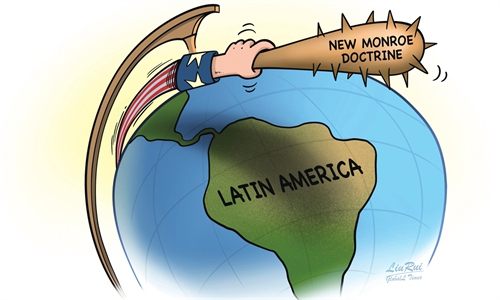
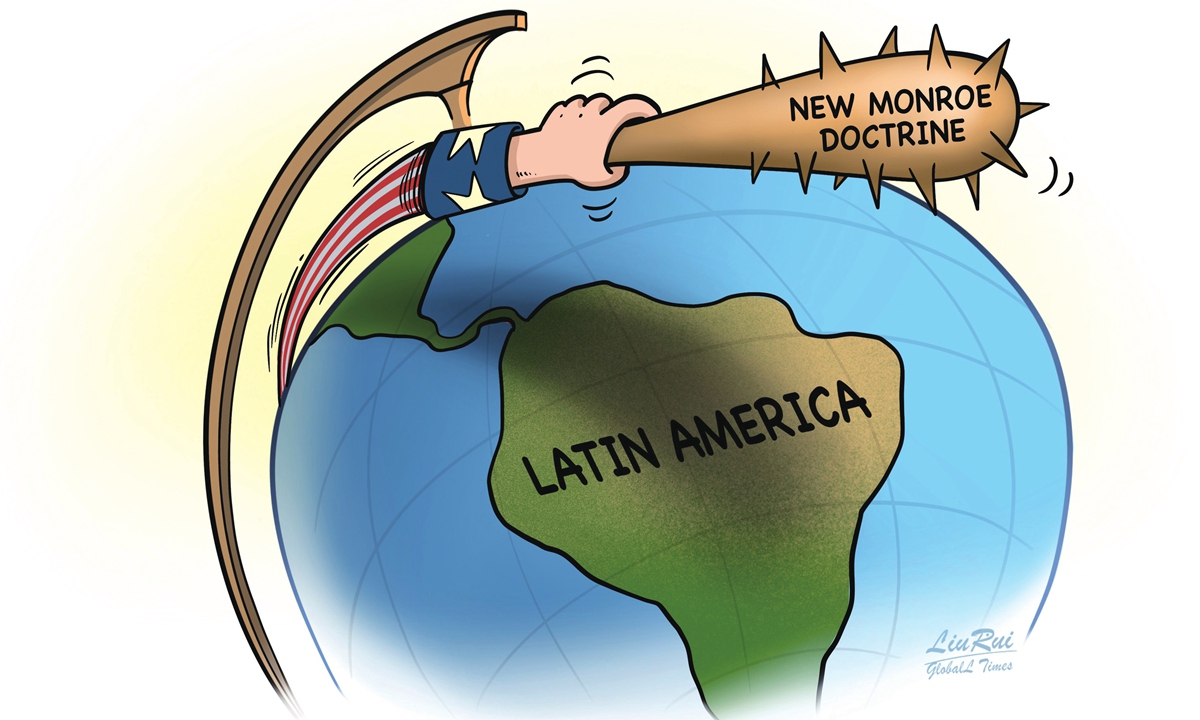
At its origin, the doctrine appeared to champion republican self-determination and hemispheric autonomy. However, over the course of the 19th and early 20th centuries, it evolved into a justification for unilateral US intervention, transforming from a defensive claim into an offensive imperialist dogma with long-lasting consequences for Latin America and the Caribbean (LAC).
In the period between 1823 and 1880, the application of the Monroe Doctrine was highly selective. Although the US invoked it rhetorically as a hemispheric shield, in practice it was applied only when US interests were directly at stake, particularly in North America and the Caribbean. During this early phase, the US lacked both the military capacity and the political will to enforce the doctrine consistently across the hemisphere. Nevertheless, the doctrine served as a symbol of US aspirations and had become embedded in American political faith rather than legal principles.
Monroe himself introduced ambiguities that later facilitated expansionist interpretations. He asserted that Washington reserved the right to judge events anywhere in the Americas based on their impact on US "peace and happiness." The Monroe Doctrine also claimed that the New World shared distinct interests and ideals separate from those of the Old World, without clearly defining them. These vague formulations allowed later policymakers to redefine those "interests and ideals" in ways that increasingly centered US economic dominance and political stability favorable to US capital and strategic control.
By the late 19th century, as the US entered its imperialist phase under the presidencies of William McKinley and Theodore Roosevelt, the Monroe Doctrine was openly reinterpreted. President Roosevelt argued that chronic instability or "misconduct" in LAC countries justified US intervention as an "international police power."
In effect, Monroe's original warning to Europe was converted into an affirmative license for the US to intervene militarily, economically and politically. The operative value of the doctrine shifted from the protection of sovereignty to the enforcement of political stability as defined by Washington.
The harm inflicted on Latin America by this evolution was profound. Under the banner of the Monroe Doctrine and its corollaries, the US intervened repeatedly in the domestic affairs of sovereign states, occupying territories, overthrowing governments, controlling customs revenues and supporting compliant elites. The doctrine also normalized the idea that LAC existed within a US sphere of influence rather than as a collection of equal nations in the international system.
Culturally and politically, the doctrine contributed to deep mistrust toward the US across the region. What was once proclaimed as a shield against imperialism came to be seen as imperialism itself. How, then, should Latin America cope with this legacy?
First, regional unity is essential. Fragmentation has historically made Latin American countries more vulnerable to external intervention. Strengthening regional organizations and fostering collective diplomatic positions can reduce asymmetries of power.
Second, LAC countries must continue to assert principles of sovereignty and non-intervention in international forums, grounding their foreign policies in international law rather than informal doctrines imposed from outside.
Third, economic diversification is crucial. Dependency on a single external power has often translated into political vulnerability. By expanding trade partnerships and strengthening internal markets, LAC countries can gain greater autonomy in decision-making.
Finally, historical memory matters. Understanding the Monroe Doctrine not as a neutral or benevolent principle but as an evolving instrument of power of US geopolitics.
In sum, the Monroe Doctrine's journey from a defensive declaration to an imperialist dogma illustrates how ideas can be reshaped by power geopolitics. For LAC, confronting this history is not merely an academic exercise but a necessary step toward building a more sovereign and equitable future.
The author is a professor of international relations and chair of the Contemporary China Center at the Pontifical Catholic University of Minas Gerais in Brazil. opinion@globaltimes.com.cn
RELATED ARTICLES