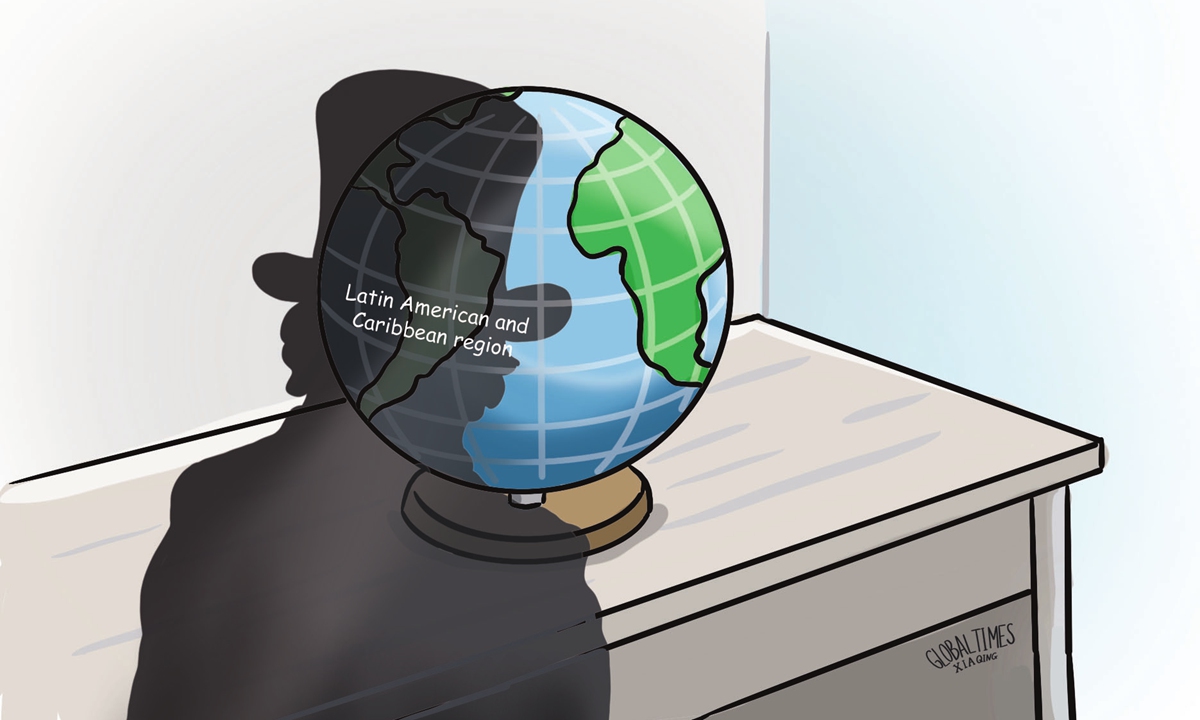
Illustration: Xia Qing/GT
The Latin American and Caribbean region has witnessed disturbing turbulence recently. From attacking vessels labeled "drug trafficking ships" and imposing airspace bans to launching military strikes and brazenly using force against a sovereign state to seize its head of state, these imperialistic and hegemonic actions have shocked the world.Such practices, which echo the colonial plunder of the 19th century, pose a grave threat to regional and global peace and security in the 21st century. Chilean President Gabriel Boric's warning - "Today it's Venezuela, tomorrow it could be anyone else" - reflects a shared concern of the international community. When the "law of the jungle" supplants international norms, no sovereign state is secure.
It then begs the question: Is international law in the 21st century less effective than the Monroe Doctrine of the 19th century? Why does the century-old colonial logic of the US persist?
From controlling "banana republics" to invading Grenada and seizing the Panama Canal, its "backyard logic" has consistently resulted in unilateral invasion and control, leaving a legacy of humiliation for Latin American and Caribbean countries. The recent illegal intervention in Venezuela has once again "cut open the veins of Latin America," proving that the Monroe Doctrine, openly upheld by the US, is in essence a form of neocolonialism.
To cloak this blatant aggression with a veil of legitimacy, the US has fabricated a set of excuses that cannot withstand scrutiny. It claims the action "supports the judiciary," yet internationalizing and militarizing one's own domestic criminal judicial procedures is nothing but a distortion of the basic norms of international law. While mature judicial cooperation mechanisms exist within the international community, the US selectively ignored these channels and resorted directly to force. This is tantamount to asserting that its domestic law overrides universally recognized principles.
Even CNN was shocked: "Expressions of unbridled power don't come blunter than abducting a sitting president from his capital in the dead of night." This act lays bare the essence of US actions.
Human rights? Justice? Sovereign integrity? International law? In the eyes of the US, these do not exist. Under Washington's double standards, no country can naively believe its packaged rhetoric. Otherwise, one could easily become a "prisoner of the empire."
The US has made clear that its true focus is Venezuela's oil, rendering its claims of "anti-drug" operations and "judicial" motives pale and unconvincing. The essence of US actions is regime change disguised by law, enforced by might and ultimately aimed at controlling resources - a design to take over the country with the world's largest proven oil reserves. Its playbook is fundamentally about plundering another country's natural resources.
The US has trampled on the sovereignty and legitimate rights and interests of other countries, seriously violated the principles of non-interference and the non-use of force in international relations, grossly infringed upon Venezuela's right to self-determination and blatantly contravened the purposes of the UN Charter. This undermines Latin America and the Caribbean's status as a Zone of Peace and threatens peace and security in the region and the world at large.
While the Pentagon may celebrate the "success" of forcibly seizing a head of state with "overwhelming American military power," is it truly a sweeping victory? I believe it is not. The US may appear to have "won a battle," but in doing so, it has fully exposed its hegemonic mind-set and bandit-like logic, losing legal standing, global public support and the moral high ground. Even at the height of its power, the US could not achieve overall control over Latin America through military invasion. Can it now, by wielding the "big stick," drag the Western Hemisphere back to the 19th century? The answer, undoubtedly, is no.
Following the events in Venezuela, numerous governments in Latin America and the Caribbean promptly expressed resistance or condemnation. Meanwhile, the UK, France, Spain and the EU have reaffirmed the necessity of respecting international law and the UN Charter. Protests against the aggression have erupted, with demonstrations in over a hundred cities in the US opposing the overthrow of foreign governments by force.
It is a profound strategic error to attempt to restore 19th-century hegemony in a multipolar 21st century. The US should earnestly heed the voices of regional countries and the international community, immediately cease infringing upon the sovereignty and security of other nations, halt its subversion of foreign governments and return to dialogue and negotiation to find political solutions. Otherwise, it will pay a heavy price.
The author is an international affairs observer. opinion@globaltimes.com.cn
RELATED ARTICLES