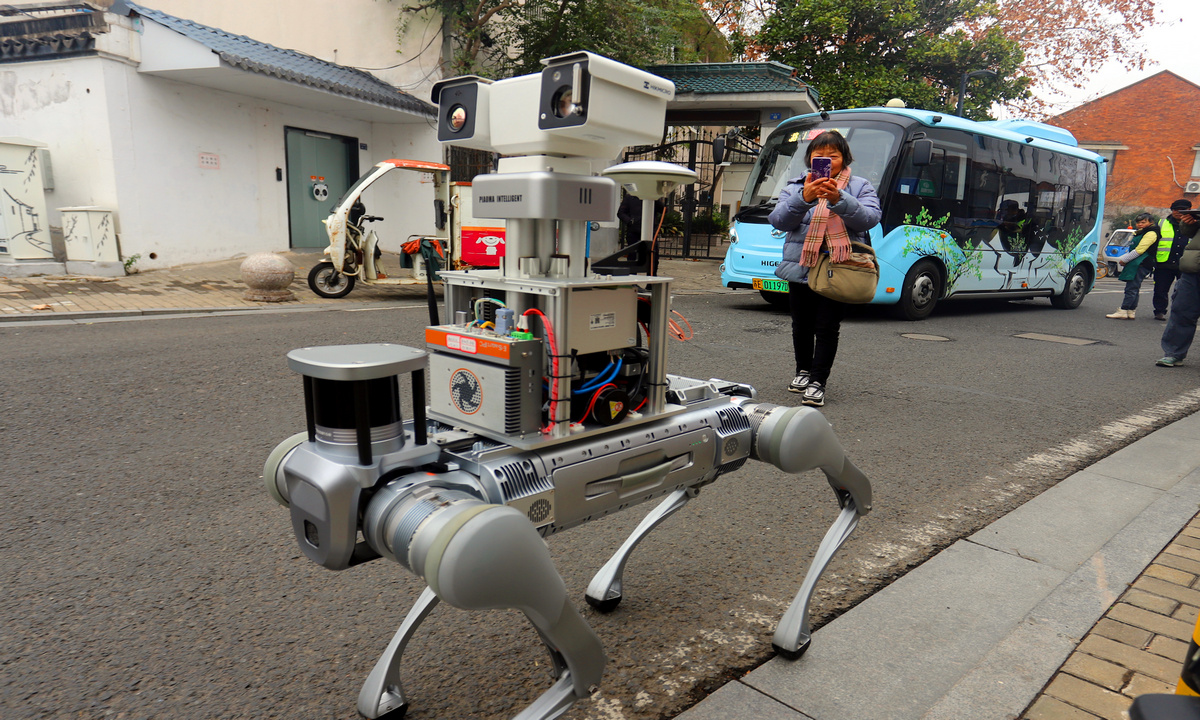
A four-legged power grid patrol robot dog walks along Huanti Road in Gusu District, Suzhou, East China's Jiangsu Province, on January 6, 2026. Its futuristic design drew crowds and gave the street a splash of "smart" color. Photo: VCG
China will roll out a set of policy measures to address the impact of artificial intelligence (AI) on employment as rapid technological adoption has reshaped the country's labor market, the Xinhua News Agency reported on Tuesday.
The Ministry of Human Resources and Social Security said on Tuesday at a press briefing that an official document will be released to respond to the AI's impact on jobs and promote employment.
The relevant authorities will also introduce targeted employment support measures for key industries and expand assistance for priority groups, including university graduates and young job-seekers, according to the ministry.
Responding to how to balance the potential job losses brought by new technologies including development of artificial intelligence, Zhang Yunming, vice-minister of industry and information technology, said on January 21 that technological progress often brings about the restructuring of employment patterns and the evolution of job positions.
"However, restructuring does not mean disappearance, and evolution does not mean replacement. We should view problems in motion from a developmental perspective," Zhang said.
The government is vigorously promoting the cultivation of interdisciplinary talent in "AI + manufacturing," precisely because in the factories of the future, operators will need to know how to collaborate with AI robots to optimize processes, and drive innovation in craftsmanship, Tian Feng, president of the Fast Think Institute and former dean of SenseTime's Intelligence Industry Research Institute told the Global Times on Tuesday.
It's similar to the "transition from driving a horse-drawn carriage to operating a car." Although the tools have changed, the core goal remains to reach the destination more efficiently and safely, while the skill requirements for the "driver" have become higher, Tian said.
AI is having a major impact on the world of work. The accelerating advance of artificial intelligence and emerging technologies is fundamentally reshaping societies and economies, creating both opportunities and challenges. On the one hand, AI brings enhanced productivity, new business models and growth, and on the other hand, challenges exist around worker displacement and an exacerbation of existing socio-economic disparities.
The World Economic Forum's Future of Jobs Report 2025, predicts that - mainly due to technological changes - this decade will see the creation of 170 million new jobs, offset by the displacement of 92 million positions, resulting in a net increase of 78 million jobs.
Last year witnessed China's AI industry flourishing with remarkable vitality and achievements. Domestic companies launched multiple AI chips, while AI-powered devices such as AI phones, AI computers, and AI glasses started to enter households across the country. Currently, AI applications have been deployed across key industries such as steel, non-ferrous metals, energy, and telecommunications.
The development of artificial intelligence will, on one hand, render some job positions obsolete. However, it will simultaneously create new job opportunities. Therefore, the key lies in enabling the existing workforce to adapt to the advancement of AI through training, helping them secure new jobs, Liu Gang, chief economist of the Chinese Institute of New Generation Artificial Intelligence Development Strategies, told the Global Times on Tuesday.
It is crucial to enable the existing workforce to adapt to the development of AI through training and help them transition to new job opportunities, Liu added.
Zhang from the Ministry of Industry and Information Technology noted that every country faces similar challenges in the process of developing AI.
The ministry will adhere to an application-driven approach, fully leverage AI innovations, and promote the restructuring of organizational models, work methods, and production paradigms. At the same time, it will continuously enhance workers' AI literacy and cultivate more compound talent who are proficient in both AI and manufacturing, according to Zhang.
RELATED ARTICLES