EU climate chief urges resistance to China’s clean-tech influence; analysts warn politicization could derail bloc’s climate goals
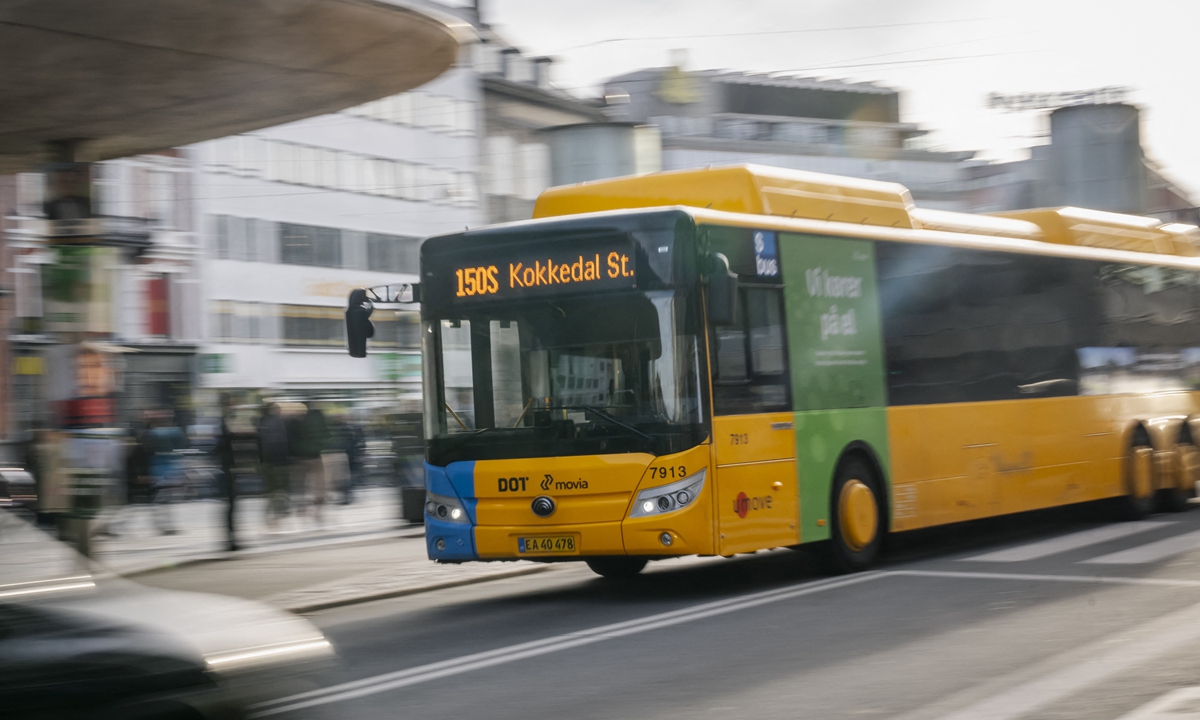
A Chinese-produced electric bus is operating for Movia in Copenhagen on October 31, 2025. Photo: AFP
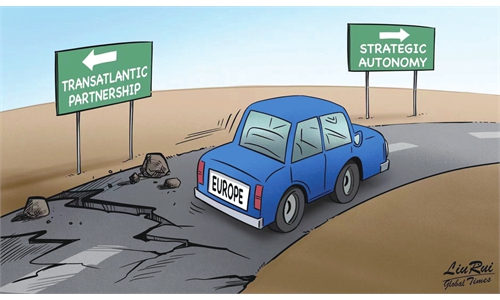
The European Union’s climate chief has claimed that the bloc must resist China’s growing influence in clean technologies, while criticizing recent efforts by the UK and Canada to seek closer cooperation with China – a stance analysts say reflects a tendency to replace technical rationality with political labeling, a move that could ultimately undermine Europe’s own climate ambitions.
The EU must resist China’s pull in clean technologies, even as it confronts the reality that deteriorating relations with the US may be “permanent,” Wopke Hoekstra, the bloc’s Commissioner for Climate, Net Zero and Clean Growth, claimed in an interview, according to Bloomberg on Thursday.
Hoekstra criticized moves by some of the EU’s close partners to deepen engagement with China, claiming that recent efforts by the UK and Canada to draw closer to Beijing were a “misstep” driven by Washington’s latest provocations, and adding that the EU would continue taking steps to reduce its reliance on Chinese technology.
Such remarks by the EU official amount to forcing climate change and clean energy – issues that should serve the shared interests of all humanity – into a geopolitical framework, a fundamental mistake that undermines Europe’s own climate efforts and the foundation of global cooperation, Li Yong, an executive council member of the China Society for WTO Studies, told the Global Times on Friday.
The EU is also in no position to criticize other sovereign countries for their economic and trade cooperation choices, Li stressed. “Countries are entitled to make policy and industrial decisions based on their own national conditions, and it lacks legitimacy to interfere in third parties’ decisions through ideological labeling or bloc-based alignment,” he said.
According to Bloomberg, the bloc is due to present a “Made in Europe” act next month, aimed in part at countering what they claimed China’s growing influence in the region.
The EU has already brought its Carbon Border Adjustment Mechanism (CBAM) into force as of January 1 this year, under which a carbon levy is imposed on certain high-emission goods entering the bloc and excessively high default carbon-intensity values are assigned to Chinese products – measures that China’s Ministry of Commerce (MOFCOM) has criticized as “unfair” and “discriminatory,” warning they may violate World Trade Organization principles.
“The repeated ‘de-China’ narrative reflects the EU’s inheritance – and amplification – of Cold War thinking in the new-energy sector,” Li said. He warned that politicizing clean-tech decisions and sidelining efficiency in favor of bloc-based alignment would raise transition costs, slow deployment, and ultimately undermine the EU’s ability to meet its climate targets.
Signs of strain are already visible. A report released last year by the European Environment Agency warned that the EU is likely to miss most of its self-set 2030 green targets on the path toward becoming the world’s first climate-neutral continent by mid-century, according to Politico.
The EU also faced difficulties last year in reaching an UN-mandated climate target, and although it passed a 2040 climate goal at the final moment, the target was “watered down” through added flexibilities that weakened its ambition, Reuters reported in November; the bloc has since revised its 2035 ban on new fossil-fuel cars, easing green regulatory requirements within the EU.
These setbacks reflect a significant gap between the EU’s existing technological and industrial capabilities and its stated emissions-reduction objectives, Li said, adding that Chinese solutions offer clear technological strengths and are deeply embedded in global supply chains, making any attempt to detach from Chinese technologies and products impractical.
China is increasingly taking the lead in clean technologies, according to a report by the European Commission. Producing photovoltaic modules in the EU costs about 60 percent more than in China, due to higher investment, labor and energy costs as well as smaller production scale, the report said.
A MOFCOM spokesperson previously said, in response to the EU’s CBAM, that while the bloc advances protectionist measures externally under the banner of green objectives, it has simultaneously relaxed internal regulations and lowered certain emissions-reduction requirements. The spokesperson described this self-contradictory approach as a typical case of double standards, urging the EU to abandon unilateralism and protectionism and keep markets open.
In contrast to the EU’s retreat, British Prime Minister Keir Starmer is paying what was described as a historic visit to China this week, pledging to strengthen cooperation in trade and climate affairs. Earlier, Canadian Prime Minister Mark Carney reached an arrangement with China to increase electric vehicle imports.
Against the backdrop of some countries withdrawing from the Paris Agreement, many others continue to seek ways to uphold their existing emissions-reduction commitments. From this practical standpoint, strengthening green cooperation with China is a natural outcome of efforts to improve efficiency and control transition costs, Li said.
Climate change is a global challenge, and only by integrating the world’s most competitive technological resources within an open and cooperative framework can carbon-reduction goals be achieved in a rational and effective manner, he added.
RELATED ARTICLES