Trump claims India will buy Venezuelan oil, welcomes China's investment; Chinese expert notices remarks 'unilateral,' no confirmation from Indian side
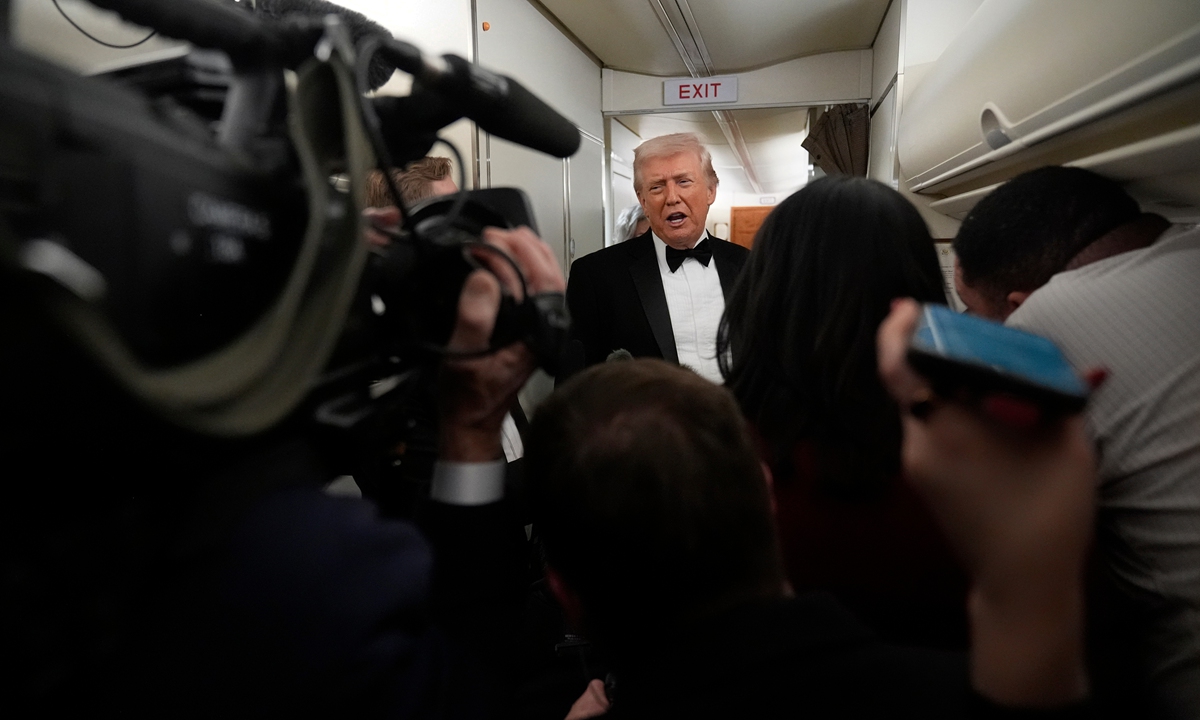
US President Donald Trump speaks with reporters aboard Air Force One as he travels from Joint Base Andrews, Md. to Mar-a-Lago in West Palm Beach, Fla., on January 31, 2026. Photo: VCG
US President Donald Trump claimed on Saturday that India will start buying oil from Venezuela "as opposed to Iran," adding that "China is welcome to come in and will make a great deal on oil," according to a Bloomberg report. However, as observed by a Chinese expert, Trump's claim remains merely his unilateral statement, with no confirmation from either the Indian or Venezuelan side.
"India's coming in and they're going to be buying Venezuelan oil, as opposed to buying it from Iran," Trump claimed to reporters during a flight to Mar-a-Lago on Air Force One. "We've already made the deal, the concept of that deal," Bloomberg reported on Sunday.
Indian media outlets, including NDTV, Hindustan Times and The Times of India, have paid close attention to Trump's latest claims. Local media reports called it "Trump's big claim," while noting that there has been no immediate reaction from New Delhi over the alleged "purchase."
Hindustan Times reported that Venezuela's acting president Delcy Rodríguez dialed Indian Prime Minister Narendra Modi on Friday to discuss the deepening of bilateral cooperation, including in energy, trade and investment - the first contact from the Venezuelan side with India at the leadership level since the seizure of Nicolas Maduro.
"Spoke with Acting President of Venezuela, Ms. Delcy Rodríguez. We agreed to further deepen and expand our bilateral partnership in all areas, with a shared vision of taking India-Venezuela relations to new heights in the years ahead," Modi said on social media after the phone call.
Hindustan Times said the US has repeatedly attacked India's oil purchases dominated by Russia and imposed tariffs on Indian imports, a move New Delhi slammed as "unjustified."
According to Reuters, New Delhi stopped loading oil from Iran in 2019 due to US sanctions over Tehran's nuclear program, and also stopped buying oil from Caracas last year after Trump imposed a 25 percent tariff on countries buying Venezuelan oil.
Indian refiners turned to US oil to make up for the loss of Iranian supply, then curbed US purchases and became the top buyer of Russian seaborne oil sold at a discount after Western nations imposed sanctions on Moscow, according to Reuters.
However, Trump in August last year doubled duties on imports from India to 50 percent to pressure New Delhi to stop buying Russian oil, and Treasury Secretary Scott Bessent signaled in January that the additional 25 percent tariff on Indian goods could be removed, given what he called a sharp reduction in Indian imports of Russian oil, per media reports.
Since the seizure of Maduro in January, Trump has claimed that the US has taken control of the oil-rich Venezuela.
The US President said on Saturday that the US and Venezuela would share oil profits and noted the US was "getting along very well with the leadership of Venezuela. They're doing a really good job."
"We're going to be selling a lot of oil, and we'll take some, and they'll take a lot," he claimed.
A fleet of 18 ships loaded with crude oil bound for refineries in Texas, Louisiana, and Mississippi in January, and combined crude deliveries to the US will reach about 275,000 barrels a day, more than doubling volumes seen in December last year, per media reports.
Li Haidong, a professor at the China Foreign Affairs University, told the Global Times on Sunday that judging from current media reports, Trump's claim that India will start buying Venezuelan oil is merely his unilateral statement. While Indian media have reported over the claim, they gave no indication of confirmation from the Indian side, nor any such response from the Venezuelan side.
"US-India relations have been volatile in recent years. In addition, the current US government's statements often come across as inconsistent, unpredictable, and unreliable. As a result, many countries now approach dealings with the US with caution and reservation," Li said.
The repeated US interference in India's oil purchase also reveals that the current US approach to international trade is increasingly bullying in nature: leveraging its own strength, it demands that other countries comply with American rules, or face damage to their own trade. "This reflects a classic 'law of the jungle' mindset. Such unilateral and heavy-handed behavior is undermining the norms of oil transactions and the overall international trade," the expert noted.
Responding to the Trump administration's request that Venezuela must "partner exclusively with the US on oil production," Chinese Foreign Ministry spokesperson Mao Ning said on January 7 that Venezuela is a sovereign state and has full permanent sovereignty over all its natural resources and economic activities. The US blatantly used force against Venezuela and asked the country to "favor" America with regard to its oil reserves. Such bullying seriously breaches international law, infringes on Venezuela's sovereignty, and violates the rights of the Venezuelan people.
RELATED ARTICLES