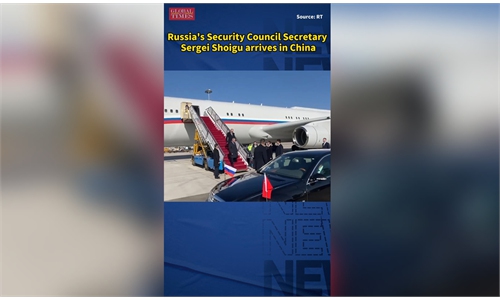
Chinese FM holds strategic dialogue with Russia’s Shoigu; Wang warns the world ‘faces risk of regressing to law of jungle’
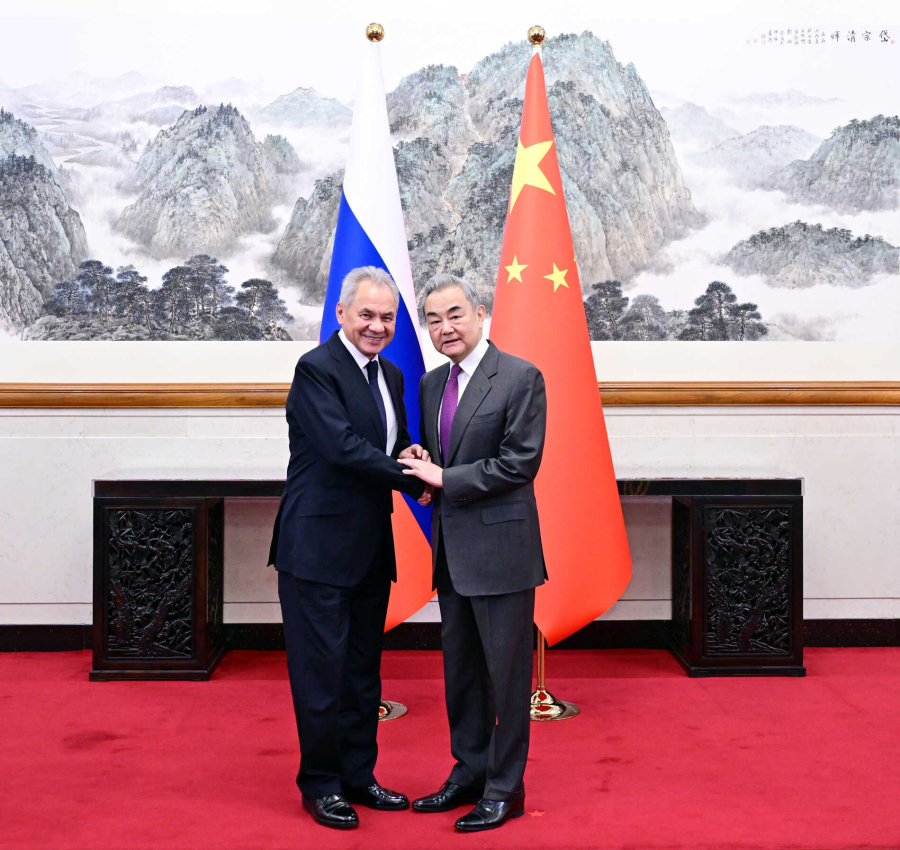
Chinese Foreign Minister Wang Yi meets with Sergei Shoigu, secretary of the Russian Federation Security Council, in Beijing on Feb 1, 2026. Photo: Chinese Foreign Ministry
Chinese Foreign Minister Wang Yi said that as the world faces a real risk of regressing to the law of the jungle, China and Russia, as major countries and permanent members of the UN Security Council, have the responsibility and obligation to practice true multilateralism, safeguard the international system with the UN at its core, advocate an equal and orderly multipolar world and a universally beneficial and inclusive economic globalization, and work to build a more just and reasonable global governance system.
Wang made the remarks when meeting with Sergei Shoigu, secretary of the Russian Federation Security Council, in Beijing on Sunday, Xinhua News Agency reported.
Wang, a member of the Political Bureau of the Communist Party of China Central Committee and director of the Office of the Central Commission for Foreign Affairs, welcomed Shoigu's visit to China for a strategic dialogue as designated by Russian President Vladimir Putin.
Wang noted that the world is increasingly undergoing both changes and turbulence, with the post-war international order and norms governing international relations severely impacted, and the world faces a real risk of regressing to the law of the jungle, Xinhua reported.
Noting that China and Russia are each other's largest neighbors and comprehensive strategic partners of coordination for a new era, Wang said the two sides should maintain close communication on major issues bearing on bilateral relations, step up mutual support on matters involving core interests, and safeguard both respective and shared interests, according to a release by the Chinese Foreign Ministry.
Shoigu extended Chinese traditional New Year greetings to the Chinese people and noted that this year marks the 25th anniversary of the signing of the Treaty of Good-Neighborliness and Friendly Cooperation between Russia and China. He said bilateral relations are grounded in mutual respect, trust, and equality, and have withstood dramatic changes in the global landscape since the beginning of the year, during which security hotspots have emerged frequently, per Chinese Foreign Ministry's read out.
Reiterating Russia's adherence to the one-China principle, Shoigu said Moscow is closely watching moves by hostile forces that undermine stability across the Taiwan Strait. He also said Russia firmly opposes Japan's accelerated attempt to push toward "re-militarization."
Shoigu added that Russia is willing to continue providing firm mutual support with China, enhance bilateral cooperation, and strengthen coordination within multilateral frameworks including the United Nations, the Shanghai Cooperation Organization, and BRICS. The goal, he said, is to maintain the momentum of high-level Russia-China relations and jointly promote a more just multipolar world as well as an indivisible security architecture across the Eurasian continent.
Chinese observers said Shoigu's visit was not focused on a single issue, but reflected broader strategic coordination between the two sides. Zhang Yao, a research fellow from the Shanghai Institute for International Studies, told the Global Times that the discussions covered a range of topics, including Japan-related issues, underscoring the breadth of concerns currently facing both countries.
Recent developments, Zhang said, help explain the context of the talks. Russia has reiterated its efforts to expose the crimes of Japanese militarism, including the recent re-designation of 14 Japanese individuals as war criminals. On the Chinese side, Beijing has issued several stern rebuttals in response to remarks by Japanese Prime Minister Sanae Takaichi. Together, these moves point to heightened sensitivities surrounding historical memory and regional security.
Zhang also highlighted the long-term significance of the China-Russia treaty signed 25 years ago, describing it as forward-looking. The framework of "partnership without alliance," he said, allows the two countries to cooperate without being constrained by rigid military blocs, avoiding mutual entanglement while leaving ample space for joint efforts to safeguard world peace and stability.
The meeting comes just about two months after their last meeting when Wang and Shoigu co-chaired the 20th round of the China-Russia strategic security consultation in Moscow on December 2, 2025, where both sides engaged in comprehensive talks on strategic security issues and reaffirmed their commitment to deepen bilateral cooperation.
"In this context, China and Russia need to closely consult on regional hotspots, exchange assessments, and better coordinate their positions," Cui Heng, a scholar from the Shanghai-based China National Institute for SCO International Exchange and Judicial Cooperation, told the Global Times, adding that the growing frequency of high-level exchanges itself serves as an indicator of the deteriorating security environment across Eurasia.
Russian media quoted Shoigu as saying that although he and Wang had held "in-depth and productive" discussions in Moscow in early December on global and strategic security issues, the rapidly changing international situation necessitated regular consultations. "In what seems like a short span of just over two months, so many events have occurred that they could fill an entire year, or even longer," he said, per RIA Novosti.
"The ongoing talk with the endeavor to reach consensus on many security issues expressed by both sides again found the base for both sides to continue in-depth strategic communication on international and regional issues of common concern," Zhang said.
RELATED ARTICLES