Uruguayan president visits Great Wall, Palace Museum on 2nd day of China trip; Chinese expert says growing interest in CPC history shows wish to learn from China
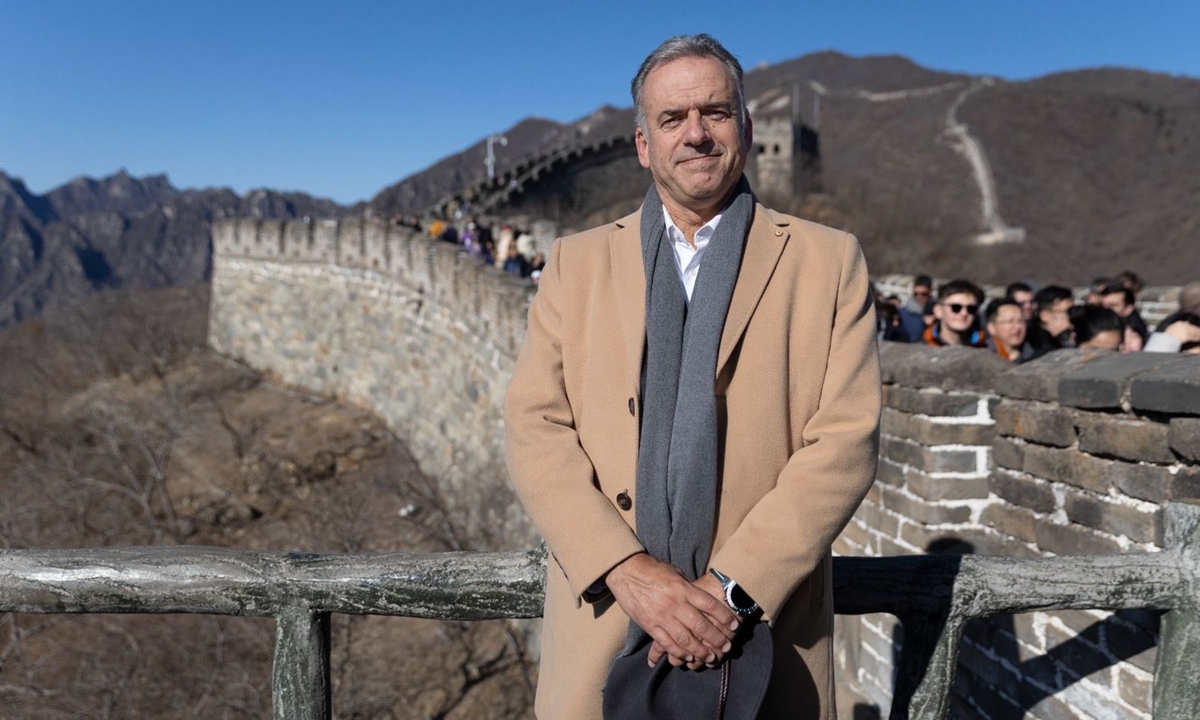
President of the Oriental Republic of Uruguay Yamandu Orsi posing for a photo with the Great Wall on February 2, 2026 in Beijing. Photo: official X account of the Uruguayan presidency
Kicking off the second day of his state visit to China, President of the Oriental Republic of Uruguay Yamandu Orsi paid visits to China's most iconic cultural sites on Monday, climbing the Mutianyu section of the Great Wall in Beijing in the morning while touring the Palace Museum, also known as the Forbidden City, in the afternoon, according to the president's social media account and videos circulating on Chinese social media platforms.
Orsi posted on Instagram on Monday a total of 15 photos of him and his delegation visiting the Great Wall. In the photos, Orsi can be seen surrounded by people as he moves forward on the Great Wall, pointing into the distance while conversing with Chinese staff, taking selfies with Chinese tourists, and sharing a plate decorated with a Great Wall motif.
In a video shared by a Chinese netizen on social media platform Douyin, the Chinese version of Tiktok, Orsi is seen shaking hands with passersby while climbing the Great Wall, moving forward amid a crowd of people. The footage also shows Chinese tourists recording the moment.
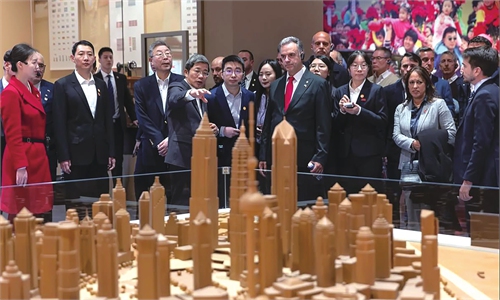
It is worth noting that Orsi paid a visit to the Museum of the CPC upon his arrival in Beijing on Sunday. According to a post on X by the Uruguayan presidency, the exhibition "offered a comprehensive journey through China's historical trajectory, featuring thousands of images, cultural relics, and audiovisual resources that combine heritage, technology, and historical memory."
The post added that the Uruguayan delegation "was able to appreciate the various exhibits and artistic expressions that form part of this iconic space."
According to data from local government department in Beijing in September 2025, nearly 600 groups of foreign guests have visited the Museum of the CPC, including 11 heads of state, nine heads of government, and more than 70 leaders of foreign political parties. Among them was former Argentine president Alberto Fernández, who made a special visit to the museum during his trip to China in 2022, becoming the first foreign head of state to visit the venue.
Many political leaders from Latin American countries and other Global South members choose to visit the Museum of the CPC during their trips to China largely because they share common ground and see China's development path as a point of reference, Yuan Dongzhen, deputy director of the Institute of Latin American Studies at the Chinese Academy of Social Sciences, told the Global Times on Monday.
He noted that learning about the history of the CPC is, in effect, a way to understand China's development trajectory, as some countries in Latin America are experiencing comparable stages of development and can draw lessons from China at some point.
Early in the morning on Monday, the official accounts of Orsi and the Presidency of Uruguay posted on social media platforms that "Uruguay strengthens its international integration to generate opportunities, investment, and development," adding that the president's state visit to China will be accompanied by a "multisectoral business delegation that seeks to deepen trade ties and attract concrete investments for the country."
According to the news agency Prensa Latina, a delegation of ministers, deputy ministers, and state agency chiefs, as well as more than 60 business leaders, came along with Orsi on this China trip.
Medios Públicos Uruguay reported on Monday that the business delegation will participate in events organized jointly with Uruguay XXI, a national agency that promotes Uruguay's exports and investments, and the China Council for the Promotion of International Trade, while the president will lead visits to universities and research centers in Beijing and Shanghai.
Christian Shaw, head of market access and development of the National Meat Institute of Uruguay, told the Global Times in an exclusive interview on Monday that China is a key market for Uruguay, especially for the agricultural and food sectors.
It is one of the main destinations for Uruguayan beef and plays a central role in the diversification and scale of our exports, Shaw said.
According to Yuan's analysis, agriculture, infrastructure and clean energy are likely to become the three core areas of future bilateral cooperation between China and Uruguay.
Especially at the beginning of the year, amid an increasingly complex political environment marked by instability and uncertainty, Latin American countries remain eager to strengthen economic and trade cooperation with China, and the Chinese market continues to hold strong appeal, he said.
"Located in the Southern Cone of South America and bordering Brazil and Argentina, Uruguay's geographic position gives China - Uruguay infrastructure cooperation unique value - not only in promoting Uruguay's own connectivity, but also in facilitating broader integration across southern South America," Yuan said.
"Economic and trade cooperation delivers the most tangible and visible results. It can realistically enhance Uruguay's international influence among Latin American countries and its role in South America. At the same time, China is a highly pragmatic country and also hopes to use economic and trade ties to promote overall bilateral relations," he added.
China remained the main destination for Uruguayan exports in the past year. According to the Annual Foreign Trade Report from Uruguay XXI, sales to China reached $3.493 billion, accounting for 26 percent of total exports and representing growth of nearly 12 percent compared to 2024. The Chinese market also absorbed 86 percent of Uruguayan soybean exports and was the main buyer of cellulose produced in the country, reported Medios Públicos Uruguay on Monday.
RELATED ARTICLES