Global crude prices to fluctuate widely in 2026: report; China to remain resilient: analyst
By Published: Feb 04, 2026 12:06 AM

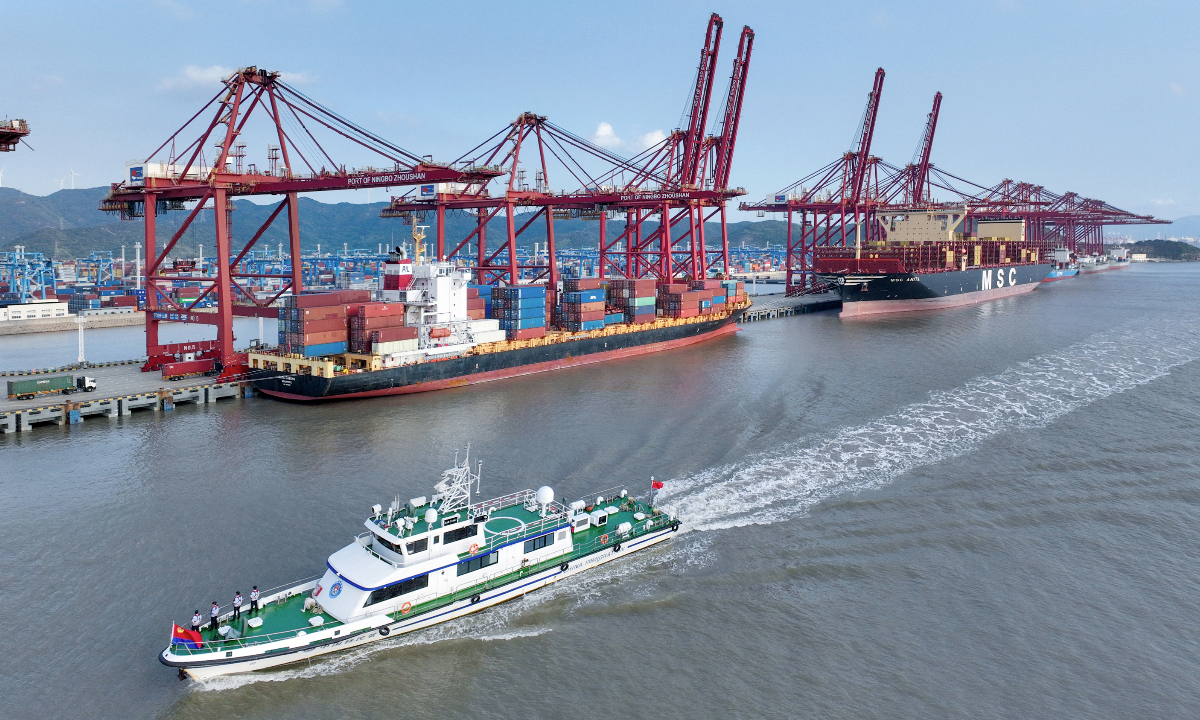
View of a container terminal of Ningbo Zhoushan Port in East China's Zhejiang Province on October 13, 2025. Photo: VCG
Global crude prices are expected to fluctuate widely in 2026 as the international market faces fragmentation and the energy issue morphs into being contested ground, according to a think tank report released in Beijing on Tuesday.
Meanwhile, China is expected to persist with its energy diversification strategy to ensure energy security, according to an expert at the CNPC Economics & Technology Research Institute (ETRI).
CNPC ETRI, one of China's premier energy think tanks, released its annual oil and gas industry report, titled 2025 Report on Oil and Gas Industry Development, in Beijing.
The report indicated that global geopolitical risks escalated and spilled over last year, leading to significant changes in the global energy supply landscape, and energy security faced mounting challenges.
The report presented two main scenarios for 2026, one being that global oil prices are largely determined by market fundamentals, with the other being that prices are determined by geopolitical conflicts. Depending on the scenario, the report predicted that international crude prices will fluctuate between the lower range of $60 per barrel or the higher range of $75 per barrel.
Given this situation, China is expected to demonstrate resilience in its energy supply, with continued incremental domestic output, an enhanced quality of growth featuring technological improvements, and smart and green technologies, as well as diversification efforts, according to the report.
Liu Jia, chief research fellow at CNPC ETRI, told the Global Times on Tuesday that China will continue to uphold several fundamental principles for ensuring energy security, including putting people first, and balancing development with security.
"At the same time, the Chinese government maintains a long-term strategic commitment to policy planning and stability, which in conjunction with the efforts of effective markets and enterprises, contributes to maintaining overall energy security," Liu said.
During the 14th Five-Year Plan (2021-25) period, China's cumulative newly proven geological reserves of oil have surpassed by 7 billion tons and natural gas reserves have exceeded 7 trillion cubic meters, data from the National Energy Administration showed. The data for oil represented a rise of 43 percent while that for natural gas was 40 percent, compared with the 13th Five-Year Plan (2015-20) period.
In the past 10 years, the country's energy consumption grew at an annual rate of 3.6 percent, supporting an annualized growth rate of 5.6 percent for the overall economy, the report said.
China has increased output from its overseas oil assets, which rose at a rate of 4 million tons a year during the past five years. These gains were driven by overseas oilfields in which Chinese companies have equity stakes as well as cooperation under the Belt and Road Initiative, the report said.
Data from the National Energy Administration showed that China's crude oil production last year is estimated to have reached a record high of 215 million tons.
RELATED ARTICLES