A view of Beijing (left) and Brussels Photos: VCG
Editor's Note:In late January, the "Global Dialogue - China-EU Resonance" media and think tank forum, hosted by the Global Times, was held in Brussels, Belgium. Scholars, entrepreneurs and think tank representatives from China and European countries gathered to engage in in-depth discussions on topics such as "China-EU Mutual Perceptions: Practical Experiences and Public Opinion Foundations" and "Moving Forward through Understanding: Diverse Cooperation and Future Pathways." In the fourth article of the "China-Europe Resonance" column, we invite scholars from both China and Europe to further dig into relevant topics.
Cognitive biases undermine the foundations of China-Europe cooperation
Tian Yilin (an associate research fellow of the Chinese Academy of International Trade and Economic Cooperation): China and Europe are important trading partners, and the core understanding between the two sides has remained steadfast. However, perceptions on both sides are undergoing prominent changes. With China's rapid rise in areas such as new energy, AI and the digital economy, Europe has begun to examine China from the dual perspectives of "systemic rival" and "partner." This shift in perception stems from China's rise and reflects a profound adjustment in the international balance of power.
Zhao Yongsheng (a research fellow at the Research Institute for Global Value Chains and director of the Research Center of French Economy, the University of International Business and Economics): In today's complex world order, for China and Europe to maintain an accurate mutual understanding, three key elements can be summarized as follows: keeping pace with the times, being humble and working together. "Keeping pace with the times" means that both sides, especially Europe, cannot be bound by outdated ideas. Europe needs to learn to "be humble"; otherwise, it will be difficult to make progress. Additionally, only by "keeping pace with the times" and "being humble" can China and Europe better "work together."
Wolfgang Pape (former official at the Directorate-General for the External Relations, European Commission): I think the comprehension on both sides has enormously progressed, particularly in Europe.
The internet, at the beginning, was very helpful in enabling us to understand each other much better. But now it is controlled by certain illiberal policies - not monopolies always, but largely in American hands - and that is a danger.
Recognizing that humanity shares a common destiny
Wolfgang Pape: For me, people-to-people relations are much more important. I call that "interpopular" - between peoples, not only between nations or between civilizations. With that, I think there is even a possibility of avoiding wars between nations. We still think in terms of nations. The idea of the nation has divided the world and created borders between different parts of the world, for which we Europeans are responsible through colonization. We have to overcome that now.
Zhao Yongsheng: In light of the new changes in the world, cooperation between China and Europe needs to be adjusted accordingly. First, from the perspective of the European people, the "US constraints" on Europe's foreign relations will decrease significantly before the next US government takes office; second, from the perspective of the Chinese people, given that China is now a world leader in many high-tech fields, coupled with its enormous capital and manufacturing capabilities, it can adopt a more long-term perspective in future cooperation with Europe.
Tian Yilin: Recent visits to China by a number of European leaders have sent a strong signal. In the face of a turbulent world, Europe is reassessing its strategic positioning toward China, and China-Europe relations now stand at a new starting point that connects the past with the future. This is by no means a mere diplomatic gesture, but rather a strategic rebalancing driven by multiple factors.
Avoiding the pitfall of putting all eggs in one basket
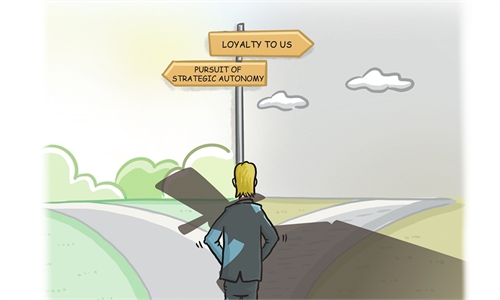
Zhao Yongsheng: The US threat to annex Greenland ultimately has become the "last straw" that triggered a fundamental shift in US-Europe relations. Besides directly affecting how EU citizens perceive the US, this shift has indirectly reshaped their views of China. It has forced Europeans to reflect on the post-World War II practice of blindly following the US, which now urgently needs adjustment. At the same time, Europeans are beginning to try not to put all their eggs in one basket. While the US remains important, in politics, trade and value chains, some of those eggs must be placed in another "basket," such as China.
Wolfgang Pape: On the current US-Europe rift triggered by the Greenland issue, we have to view it against the backdrop of American history. America was a colony of Europe in the beginning. They took over the land from natives who were already there through violence. This idea of violence is still very strong in America, and I'm afraid we have to see how this kind of American violence becomes more sublime.
Tian Yilin: China-Europe cooperation urgently needs to undergo three adjustments. First, China should move away from the traditional mind-set of treating Europe as a single entity and engage in precise alignment based on the actual needs of different countries. Second, China should establish dialogue mechanisms and, with willing and capable European countries, take the lead in building bilateral or small multilateral platforms. Third, China should partner with like-minded European nations to jointly design inclusive solutions and advance reforms of the international governance system.
From ties of interest to a partnership built on shared values
Zhao Yongsheng: In the era of AI, social media content creators from the younger generation can play a far greater role in shaping the future of China-Europe relations than traditional producers. To increase the number of such content creators, policymakers on both sides need to implement supportive measures. The two sides should enhance the AI-specific skills of students engaged in the field of China-Europe relations, and select individuals from the existing social media and AI sectors who are willing to dedicate themselves to advancing these relations.
Wolfgang Pape: AI is very important for the younger generation, as it is reshaping their understanding of the world. Human-to-human relationships can improve because we no longer have to spend so much time on repetitive tasks on the assembly line or elsewhere. This presents a chance for young people - if they know how to use AI positively - to advance together toward a better society.
Tian Yilin: As the global public opinion ecosystem is deeply reshaped by AI and social media, the future of China-Europe relations will depend not only on strategic interactions between governments but also on grassroots exchanges and digital narratives led by the younger generation. Young people from China and Europe can leverage platforms such as innovation camps to promote early convergence of technical standards and shared values.
RELATED ARTICLES