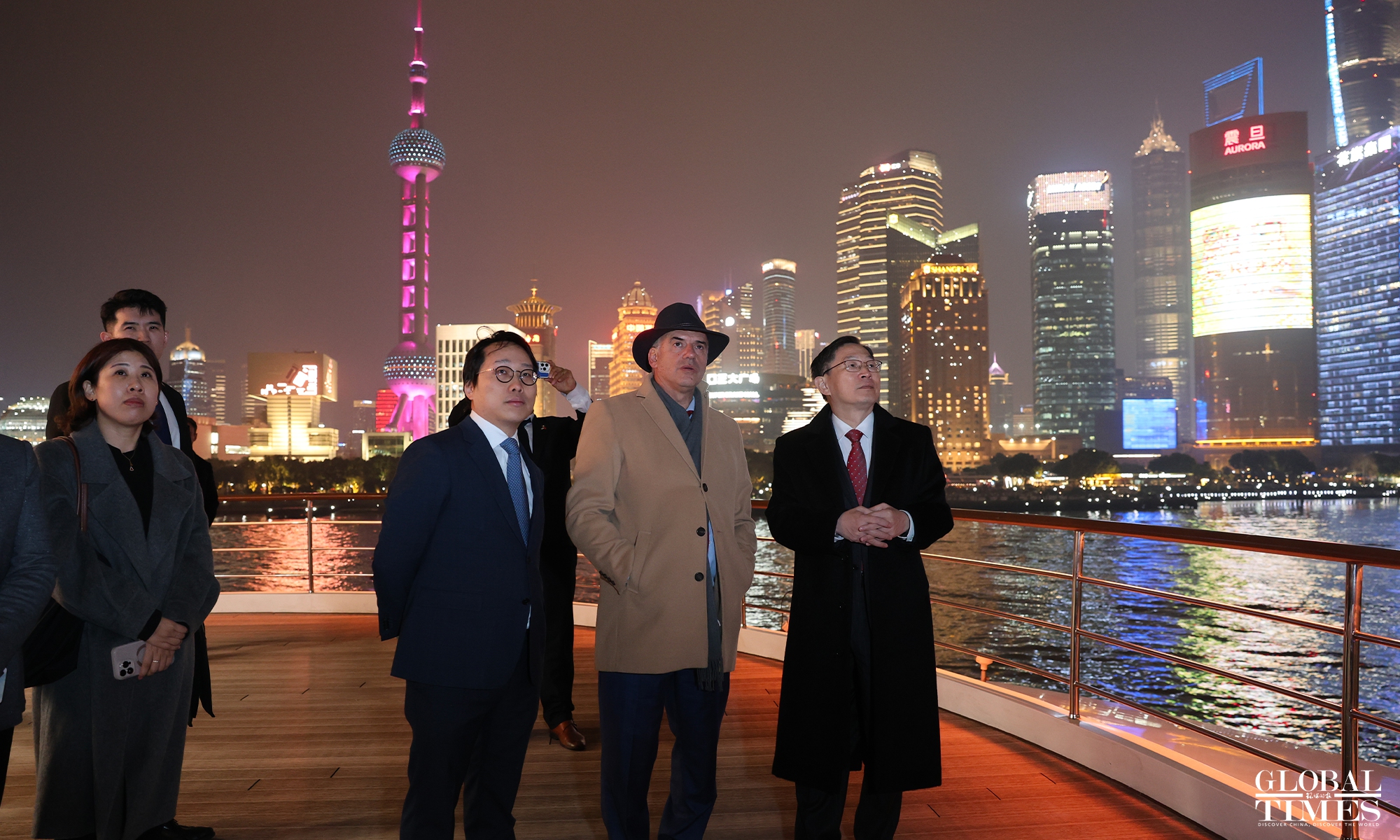
President of the Oriental Republic of Uruguay Yamandu Orsi (center) enjoys the night view of Shanghai's Huangpu River on a ferry on February 5, 2026, the fifth day of his China visit. Photo: Chen Xia/GT
"This trip to Shanghai has left me with marvelous experiences. So here comes a simple question: when can I return? Congratulations on so much wonder," wrote the President of the Oriental Republic of Uruguay Yamandu Orsi, who took a ferry to enjoy the night view of Shanghai's Huangpu River on Thursday evening, on the ferry's guestbook.
The note capped the fifth day of Orsi's seven-day visit to China and, together with his tour of Yuyuan Garden on Thursday, reflected a more culturally rich, warm itinerary that is increasingly becoming a defining feature of foreign leaders' trips to China.
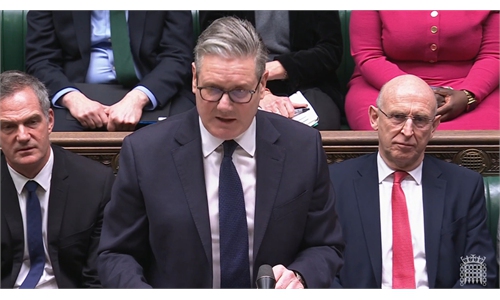
Orsi arrived in Beijing on Sunday for a seven-day state visit to China. This makes Orsi the sixth foreign leader to visit China and hold meetings with the Chinese leader since the beginning of 2026, following leaders of South Korea, Ireland, Canada, Finland and most recently the UK.
Amid profound geopolitical and economic adjustment, a growing wave of foreign leaders are gathering for visits to China.
According to public statements and media reports, potential visits by US President Donald Trump, Russian President Vladimir Putin, and Spanish Prime Minister Pedro Sánchez are expected to further extend this momentum, underscoring a broader recalibration as more countries turn their attention eastward.
Analysts say the trend reflects more than scheduling coincidence. While policy choices differ from country to country, the overall direction is clear: amid growing uncertainty in the global order, many governments are seeking engagement with China's policy stability, market scale and expanding cooperation in emerging sectors. At the same time, the increasingly immersive nature of these visits — marked by cultural exploration and interaction with local Chinese — signals a deeper, more people-oriented approach to diplomacy.
Planned visits
On Wednesday, Trump again said on his social media account that he plans to visit China in April, saying he "very much looks forward to" the visit.
On the same day, Yury Ushakov, a presidential aide, said that Putin will visit China in the first half of 2026, according to a release published on the official website of the Kremlin.
Meanwhile, Spanish PM Pedro Sánchez is planning to travel to China in mid-April, Bloomberg reported on Wednesday, citing a person familiar with the preparations.
If the trip goes ahead, Bloomberg noted, it would be Sánchez's fourth visit to China since 2023, following a visit by King Felipe VI in November 2025. The Spanish prime minister is expected to travel with a group of business leaders, the source said.
Sánchez's last visit to China was fruitful. As a result of his previous trip, Spain and China reached seven agreements aimed at facilitating the sale of Spanish food, health and cosmetic products to China, as well as increasing cooperation in culture, science and education, according to Spain's prime minister's office, La Moncloa.
As more leaders turn their attention eastward, experts say the trend reflects a strategic choice emerging after geopolitical realignments — one that prioritizes certainty and forward-looking cooperation.
Singapore's Lianhe Zaobao reported that Wednesday marks Lichun, or the Beginning of Spring, and China diplomacy is witnessing a warm season with a wave of visits by foreign leaders.
Wang Yiwei, a professor at the School of International Studies of Renmin University of China, told the Global Times that China is a very important "anchor of stability". This year marks the start of the 15th Five-Year Plan (2026-30), which in itself will bring a new wave of opportunities to the world.
Moreover, China is gradually becoming a leading force and playing an increasingly important role in international cooperation models and in the formulation of rules and standards. The fact that many countries are stepping up engagement with China at present is essentially about "connecting with the future," Wang noted.
Ongoing trip
While Beijing may be preparing for the next wave of high-level visits, President Orsi is continuing his China trip in Shanghai. On the fifth day of his visit, he toured Yuyuan Garden, a centuries-old landmark renowned for its exquisite layout, scenic beauty and annual lantern exhibitions — a site that also featured on UK Prime Minister Keir Starmer's itinerary during his China visit.
At the garden, Orsi crossed the iconic Zigzag Bridge, admired the scenery, posed for photos with a giant Spring Festival-themed lantern, and watched Chinese opera performances. With the Chinese New Year approaching, his experience was imbued with festive vibrancy.
Orsi's visit reflects a distinct shift from the traditional focus on high-level meetings and corporate tours. His social media posts have featured not only high-level meetings and economic discussions, but also visits to the Forbidden City and the Great Wall, tree-planting at Beijing Foreign Studies University, playing football with children in Beijing, and university students singing a song by Uruguayan singer Ana Prada.
Drawing on the over 460-year history of Yuyuan Garden, Orsi's China visit highlighted the artistic wisdom of traditional Chinese garden architecture and underscored the cultural depth and soft power of one of China's most representative cities, Xu Shicheng, vice president of the China Society of Latin American Studies, told the Global Times.
Cultural and sports venues have increasingly become a regular part of foreign leaders' itineraries during China visits, serving as key platforms for understanding China's history and promoting people-to-people exchanges, Yuan Dongzhen, deputy director of the Institute of Latin American Studies at the Chinese Academy of Social Sciences, said.
On Thursday evening, Orsi continued his exploration of China by boarding a cruise along Shanghai's Huangpu River. Global Times reporters on site observed him conversing with Chinese officials, while taking in the illuminated cityscape — scenes that, alongside Yuyuan Garden, may soon appear on his social media accounts.
Such social-media-documented cultural experiences have appeared across multiple leaders' China trips. In Starmer's posts, followers saw Shanghai pastries, traditional attire and teenagers playing table tennis. In posts of French President Emmanuel Macron, who visited China in December, viewers saw Dujiangyan and enthusiastic Chinese university students. These moments capture journeys that extend beyond politics and economics, offering a more textured view of China and its people.
As this immersive style of diplomacy becomes the new standard, a question arises: will Vladimir Putin's next visit to China venture beyond the usual stops of Beijing and Shanghai? Perhaps even taking him to the southern region of Guangxi for a bowl of luosifen?
RELATED ARTICLES