Canada unveils new EV strategy, stressing strategic partnership with China; win-win set to have demonstration effect: expert
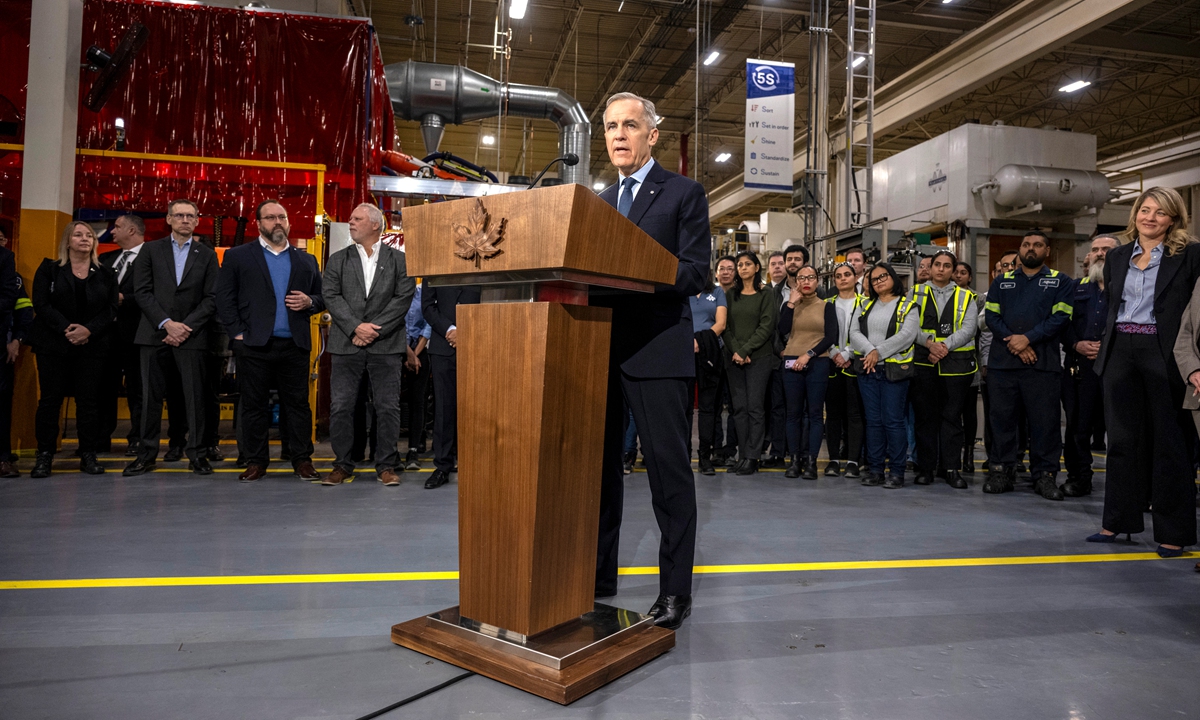
Canadian Prime Minister Mark Carney speaks to the press during an announcement while visiting an auto-parts plant in Woodbridge, Ontario on February 5, 2026. Photo: VCG
Canadian Prime Minister Mark Carney on Thursday (Canadian time) announced a new electric vehicle (EV) strategy for transforming the country's auto industry, and stressed strategic partnership with China to further diversify trade and catalyze new investment in the automotive sector, according to the prime minister's office.Chinese experts said the shift in Canada's policy to enhance win-win bilateral economic and trade cooperation with China, unlike that of the previous Justin Trudeau government which closely followed the US to contain China, shows that Canada is returning to the right track of mutually beneficial cooperation with China, which is set to have a demonstration effect on other countries, especially some US allies. Given China's EV advantages, partnership with China will help rebuild Canada's automotive industry competitiveness in the future, they said.
Diversify trade
Under the strategy, the Canadian federal government will launch a five-year, 2.3 billion Canadian dollar "EV Affordability Program," according to a news release from the prime minister's official website.
The program will offer consumers purchase or lease incentives of up to 5,000 Canadian dollars ($3,658) for battery-electric and fuel EVs, while those opting for plug-in hybrids can receive up to 2,500 Canadian dollars, it said.
Carney said in the release that the Canadian government has also agreed to a new strategic partnership with China, a global leader in EV manufacturing, to further diversify trade and catalyze new investment in the automotive sector. The recently announced partnership will look to drive new Chinese joint venture investment in Canada and allow for a fixed volume of Chinese EV imports into the Canadian market, according to the release.
The new policies, Carney said, are meant to transform Canada's economy and make it less reliant on a single trade partner after the US' economic assaults and threats on Canada's sovereignty have frayed relations between the two nations, according to a report by The New York Times.
"We must take care of ourselves," Carney told reporters at an auto parts factory near Toronto. "We cannot control what others do," he said, per the report.
Meanwhile, BBC reported that the new initiatives "mark Canada's latest effort to reduce its reliance on the US" amid the US government's push for more domestic car production.
Bao Jianyun, dean and professor of the Department of International Politics at the School of International Studies at Renmin University of China, told the Global Times that the new strategy showed the Canadian government's pragmatic attitude of strengthening cooperation with China in the EV field.
Compared with the previous Trudeau government, which closely followed the US and assisted it in containing China, the new Carney administration's active moves to enhance win-win economic and trade cooperation with China mark Canada returning to the right track in economic and trade ties with China, Bao said.
Enormous opportunities
During Carney's visit to China in January - the first visit to the country by a Canadian Prime Minister since 2017 - he lavished praise on China's EVs and announced tariff cuts, marking a significant shift in Canadian policy toward Chinese EVs over the past several years.
"China's strengths in the electric vehicle sector are undeniable. They produce some of the most affordable and energy-efficient vehicles in the world. For Canada to build its own competitive EV sector, we will need to learn from innovative partners, access their supply chains, and increase local demand," Carney said in Beijing then.
The Canadian government stated that it will allow an annual quota of 49,000 Chinese EVs into the Canadian market at the most-favored-nation tariff rate of 6.1 percent, exempting them from the 100-percent surtax imposed in 2024, according to the Canadian government website.
Following the announcement, a new poll conducted by North American market research company Leger showed that most Canadians support allowing more Chinese electric vehicles (EVs) to be sold in Canada, according to the Canadian Press on Wednesday.
"Canada's cooperation initiatives with China in EVs are a pragmatic choice for Canada amid the global electrification transition and US trade pressures," Zhang Xiang, secretary-general of the International Intelligent Vehicle Engineering Association, told the Global Times on Friday.
Since April 2025, Canadian-made vehicles have faced a 25 percent US tariff on non-US content.
In addition, the US administration threatened recently that if Canada makes a deal with China, the US ally will immediately be hit with a 100 percent tariff against all Canadian goods and products coming into the US, Fox News reported.
"Although Canada is facing pressure from the US, we have seen that Ottawa's policy trajectory has become notably more autonomous, and its diplomacy has grown more flexible and pragmatic. Pragmatic cooperation with Beijing should become the mainstream, as it aligns with Canada's national interests and will also inject vitality into the world's green transition and economic development," Bao said.
Enhancing cooperation with China in the EV field will not only bring more technologically advanced and cost-effective cars to Canadians, but also create more jobs and taxes and enhance Canada's overall industrial chain by stimulating new direct investment, Zhang said.
China maintained the top global position in terms of production and sales of NEVs for the 11th straight year in 2025, featuring the world's largest and most complete industrial chain. Thanks to scale effect, the cost of components is relatively lower compared with those produced outside the country, the expert said.
Underlining the international competitiveness of Chinese EVs, Chinese automaker BYD Co saw its sales in Germany surge more than ten-fold in January to reach 2,629, more than twice as many as Tesla Inc's 1,301 registrations, Bloomberg reported on Wednesday, citing data released by Germany's Federal Motor Transport Authority.
Bao said Canada's win-win economic and trade cooperation is expected to have a demonstration effect on more countries, especially US allies that have faced additional tariffs from Washington, to carry out pragmatic cooperation with China in the future.
China's Foreign Ministry spokesperson Guo Jiakun stressed recently that China believes countries need to approach state-to-state relations in the spirit of win-win rather than the mentality of zero-sum, and through cooperation rather than confrontation, responding to the US' threat of 100 percent tariff on Canada.
"China and Canada have established a new type of strategic partnership, and made some specific arrangements on properly handling the economic and trade issues between the two countries. This reflects the spirit of equality, openness and inclusiveness, peaceful cooperation, and shared benefit. It does not target any third party, serves the common interests of the people of both countries, and is conducive to world peace, stability, development and prosperity," Guo said.
RELATED ARTICLES