‘I will spend the rest of my life believing that the US, as a political actor, is not trustworthy,’ former member of Greenland’s parliament told GT
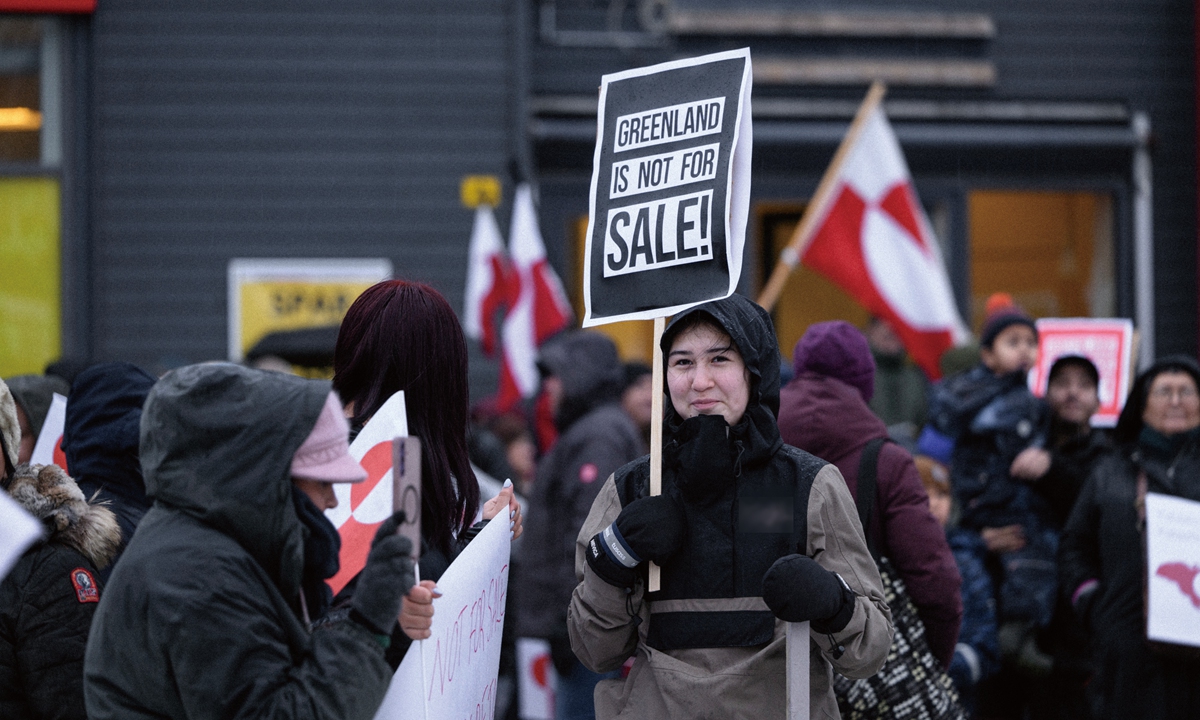
A local resident in Greenland holds a "Greenland is not for sale" sign during a massive protest against the US' continuing threats of taking over Greenland on January 17, 2026. Photo: Courtesy of the protest organizers
Located within the Arctic Circle, Greenland has long been known for its frigid climate, vast expanse and desolate landscape. More than 80 percent of the island is covered by thick ice sheets, and it has for decades been regarded as a silent land at the edge of the world.
However, since January 2026, the icy island has been abruptly thrust into the center of a global political storm after the US president repeatedly made public threats to take over Greenland.
In recent days, Global Times reporters have conducted exclusive interviews with a number of local residents, including political figures and members of the indigenous population. Their accounts reveal a clear and widespread sense of strong resentment toward the actions of the US among Greenlanders from different professions and backgrounds — sentiments that may have long-term implications for the island itself as well as for the future of transatlantic relations.
Center of turmoil
At 9 am, the sky over Nuuk, capital of Greenland, was still dark. The city lay submerged in a deep blue night as icy winds swept fine snow across the streets.
As Najannguaq Hegelund, a 37-year-old Inuit woman, sat by the window, her voice was calm, yet she repeatedly returned to a question she had never seriously considered before: "How can we prepare for a worst case scenario - the US invading Greenland?"
A year ago, such a question would have sounded like a joke that no one in Greenland would take seriously. But over the past few weeks, repeated public statements by US President Donald Trump expressing his desire to "acquire Greenland" have changed everything.
Hegelund previously lived in Denmark for many years. Whenever she saw international news about wars or conflicts on television, she would half-jokingly say to her family, that if there are wars in Europe, Middle East or other areas of the world, "we will just go to Greenland." In her mind, Greenland was the edge of the world, a place forever beyond the reach of turmoil.
The US relentless and seemingly unchecked threats have put many Greenlanders on edge, shattering the calm that had defined their lives for years. Several local residents told Global Times reporters that when fishermen and indigenous people meet these days, they no longer talk only about the weather or the fishing season, but instead ask one another, "did you hear what the Americans said again?"
Some residents have begun stockpiling five days' worth of food and medicine. For the first time, the Greenlandic government has publicly advised people to prepare for emergencies such as power or internet outages.
Hegelund has also developed a new habit: instinctively looking up at the sky more often, paying close attention to every aircraft that passes overhead. One day, she noticed a plane that did not appear on flight-tracking apps but still landed at Nuuk Airport. Although it was later confirmed to be a Danish military aircraft, at the time, Hegelund believed that Greenland had actually been invaded by the US — a thought that sent a wave of panic through her.
"This is not something that we have experienced before in our lifetime," the Inuit woman said with a bitter smile.
Collective anxiety among Greenlanders erupted into an unprecedented protest on January 17. In biting winds and amid falling snow, thousands of local residents gathered in downtown Nuuk and marched toward the US Consulate. Many draped themselves in Greenland's flag and held signs reading "America, go away," "Greenland is not for sale," and "We are not a commodity." When Greenlandic Prime Minister Jens-Frederik Nielsen appeared in the crowd, he raised the Greenlandic flag and cheers broke out among the protesters.
Tillie Martinussen, a former member of Greenland's parliament, took part in the rally as well. "Perhaps in China, a few thousand people don't sound like much," she told the Global Times. "But Nuuk has just over 20,000 residents — this means roughly one in four people took to the streets." She recalled that the weather that day was harsh and the roads were icy, yet elderly people and children still joined the march, and even couples pushing baby strollers came out. Having grown up in Greenland, she said she had never seen anything like it.
"Anger" — Martinussen used the word at least five times during the interview. In her experience, Greenlanders have traditionally been quiet and reserved, rarely expressing emotions openly as people in Europe or North America might. Like the ice-bound land itself, even speaking loudly can sometimes be considered impolite. But recently, she said, everything has changed.
"Lately, the rifles in our shops have almost sold out," she told the Global Times. Traditionally in Greenland, hunting rifles are used to deal with Arctic foxes and reindeer. But now, many people are seriously discussing whether, if the US were truly to invade, they would need to take to the streets and confront them with hunting rifles.
In the former lawmaker's view, this rare surge of anger is the result of long-term accumulation —stemming from what she sees as repeated "humiliations" of Greenlanders by the US.
Those scenes were later edited into MAGA ("Make America Great Again") campaign videos and circulated widely in the US. A year later, the White House revealed that it was considering paying each Greenland resident $100,000 as part of a plan to persuade them to break away from Denmark and join the US.
"Do they think they can buy us?" Martinussen asked angrily, "We find it deeply insulting." She recalled that a year earlier, a few homeless people had picked up the cash scattered in Nuuk's central square, but they had no idea they were being filmed for political propaganda and packaged as symbols of a population "eager to become part of the US." All of this infuriated many Greenlanders. "No one wants to be treated like livestock and sold off at will."
In the narratives of many US politicians and strategic analysts, Greenland is often portrayed as a strategic prize of immense geopolitical value, rich in natural resources. Greenlanders themselves, however, speak far more about the island's dazzling auroras, towering glaciers and pristine natural environment.
Greenland is home to an indigenous culture distinct from that of Europe and the US. According to the Greenland tourism authorities, the first Inuit arrived on the island some 4,500 years ago, and today they account for nearly 90 percent of the island's population of fewer than 60,000. Denmark's formal colonization of Greenland began in the 18th century, yet ethnic Danes now make up only about 7.5 percent of the local population. For thousands of years, the Inuit have sustained their way of life, culture and beliefs in an extreme environment, taking deep pride in their homeland and indigenous traditions.
This unique history has made Greenlanders instinctively wary of any "benevolent takeover" from the outside. "I don't know what agreements are being talked about right now, but we have survived in the Arctic for thousands of years, and we still remember how to survive in the Arctic. I hope it doesn't come to the worst," Aaju Peter, a Greenland-born Inuit activist and lawyer, told the Global Times.
"I don't think there's anything such as a good colonizer, to be frank," Hegelund added.
Greenlanders have long been aware that their homeland occupies a strategic location and is rich in mineral resources. "But we're not a chunk of ice. And in the world, we are also a people. If a country wants to take over Greenland, how sustainable will the mining be? Will there be pollution?"
Martinussen recalled that in the past she loved traveling around the world, and the US had once been one of her favorite countries. As a child, she lingered happily in Disneyland and Universal Studios, experiences that felt like pure magic to her. Today, however, she can no longer see the US the way she once did. "After what has happened recently, I will spend the rest of my life believing that the US, as a political actor, is not trustworthy."
She used a metaphor from Inuit culture to describe her feelings. Greenlanders have, since ancient times, relied on dog sleds; the dogs are strong and resilient, able to survive blizzards at -20 C stylebook. However, if one of these outstanding sled dogs bites you even once, it can no longer be trusted. "The US has already 'bitten' us," she said. "I think future generations of Greenlandic children will grow up with this understanding in their minds."
She added that, for the first time, she is truly beginning to feel that it may be time to push for a new world order. "As Greenlanders, we never imagined that we would find ourselves at the center of this historical process," she told the Global Times. "But now, history is being rewritten."
RELATED ARTICLES