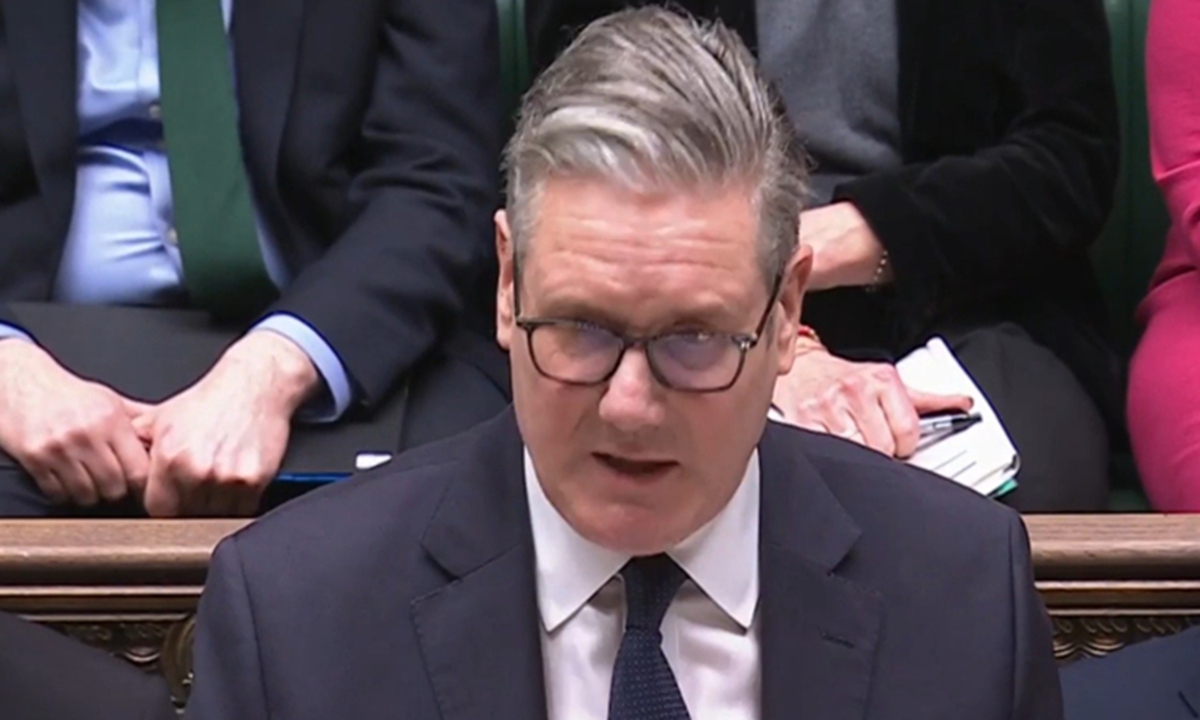
Keir Starmer, UK prime minister, speaks at parliament on Monday, February 2026. Photo: Screenshot from parliamentlive.tv
Editor's Note:British Prime Minister Keir Starmer wrapped up his four-day China visit at the end of January, yet its impact is still brewing. Some believe that the visit represented a marked shift in the UK's relations with China, and at the international level, it demonstrated the realities of a new global order. How should we analyze the implications of Starmer's China visit? What does a mature and more sophisticated relationship mean for the two countries? Global Times (GT) reporters Wang Wenwen and Xing Xiaojing interviewed Ollie Shiell (Shiell), chief executive of the UK National Committee on China, over these matters.
GT: How would you analyze the outcomes of Prime Minister Starmer's China visit?
Shiell: A lot of commentaries around the prime minister's visit still relies on an outdated assumption that the China-UK relationship can only exist in two modes: either fully cooperative or fully confrontational. What appears to be happening instead is a deliberate move away from that binary framing. The signals from both sides suggest an interest in restoring a steadier, professionally managed diplomatic relationship, something closer to the way the UK approached China before the more reactive political cycles of recent years.
GT: When responding to his China visit, PM Starmer said, "I always act in our national interest." However, some Conservative MPs have since labeled his approach to China policy "supine and short-termist." How do you view these remarks? What is the UK's national interest?
Shiell: Democracies are, by design, noisy places. The House of Commons is physically and procedurally designed to ensure governments are challenged, so pushback from Conservative MPs is to be expected. The government's positioning on China appears geared toward long-range dynamics and reflects how both China and the wider geopolitical landscape are likely to evolve over time.
GT: Prime Minister Starmer called for a "mature" and a "more sophisticated relationship" between Britain and China. What is your understanding of a "mature" and a "more sophisticated relationship" between the two countries?
Shiell: I think "sophistication" is the key word. It points to an emphasis on informed, professional diplomacy, using mechanisms and predictable channels to manage both cooperation and disagreement. It's less about transactional pragmatism and more about ensuring the UK's diplomacy is capable, consistent and grounded in process. Starmer appears to be betting that through informed, professional diplomacy, the UK and China can both achieve more of what they want.
GT: Prime Minister Starmer has clearly stated that the UK will not "take sides" between China and the US, while emphasizing that it maintains a "very close relationship" with the US and that "It would be foolhardy to simply say we will ignore (China)." How do you assess his remarks?
Shiell: The UK-US relationship has always been defined by power and tough deal-making. The main thing that has changed is that US President Donald Trump is the first president to present it as a show for the world. There are many consequences of this, not least the fact that approval ratings of Trump among British people have fallen to a record low. When public confidence shifts, it becomes more difficult for any UK government to support positions that lack domestic legitimacy or support. That dynamic may reshape how the UK responds to US pressure. Within this context, the UK does have room to deepen cooperation with China in pursuit of its own security-informed economy, provided China continues to act as a predictable, low-volatility partner.
GT: Prime Minister Starmer's visit is part of the broader trend of the visits by European leaders to China. Does this indicate that Europe is collectively "looking eastward"? How should the UK position itself in this trend?
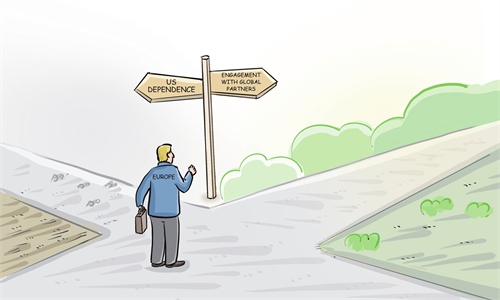
Shiell: Governments across Europe, and beyond, are increasingly looking for partners that offer stability and predictability. This isn't just about "looking East;" it's about reducing exposure to volatility wherever it appears. The shifts in US political dynamics have encouraged many countries to diversify their relationships rather than rely too heavily on any single partner.
The UK seems to be positioning itself within that broader trend: maintaining ties with traditional allies while also pursuing steady, professionally managed engagement with major global players, including China.
RELATED ARTICLES