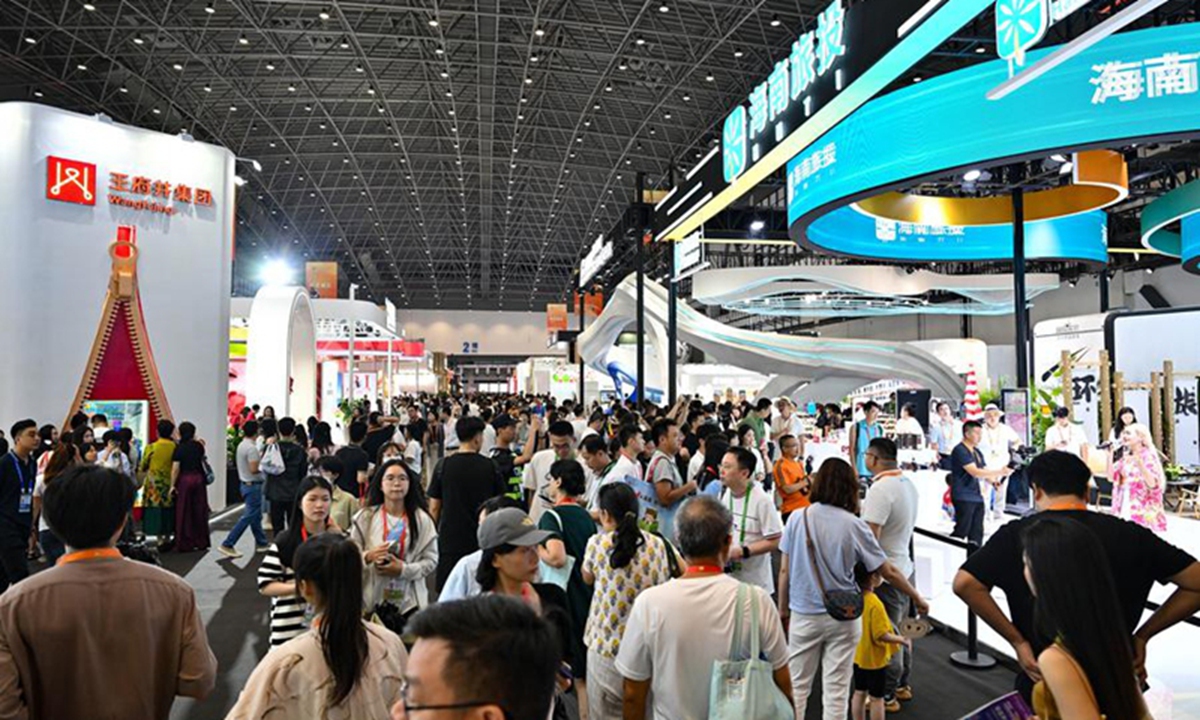
File Photo: Xinhua
In recent weeks, local "two sessions" - the annual meetings of provincial-level lawmakers and political advisors - are convened across the country. Boosting domestic demand, with a particular focus on services consumption, has emerged as a priority in various regional agendas.For instance, North China's Tianjin Municipality plans to expand chain-based and large-scale services supply in eldercare, childcare, healthcare, and domestic services to better meet diversified consumer demand. In Southwest China, Chongqing Municipality aims to upgrade traditional services consumption such as catering, accommodation, eldercare, childcare, and domestic services. North China's Hebei Province has proposed creating a "15‑minute convenient living circle" to enhance the accessibility of daily services.
This trend reflects a pragmatic choice by provincial-level governments, which demonstrates their responsiveness to rising consumption demand and their ramped-up efforts to seize new developmental opportunities. It also underscores China's ongoing shift in consumption patterns and the sustained drive toward achieving high‑quality economic growth.
From a macroeconomic perspective, the rise of services consumption is an inevitable requirement for China's high-quality economic development. Services consumption refers to the total expenditure by people on various non-physical services provided by society, covering areas such as dining and accommodation, domestic services, eldercare and childcare, cultural tourism, and healthcare service. Compared with goods consumption, services consumption is characterized by higher frequency, a stronger multiplier effect, more sustainable growth, and broader space for innovation.
Taking cultural and tourism consumption for an example, an individual or family may travel multiple times a year. Each trip not only generates revenue for tourist attractions and performance venues through ticket sales but also stimulates associated industries such as catering, accommodation, transportation, and retail sales.
Also, by tapping into consumption potential and meeting Chinese people's growing needs for a better life, the expansion of services consumption helps optimize the industrial structure and accelerates the economy's transition from scale expansion to quality improvement.
In recent years, with the improvement of living standards, services consumption has become an increasingly important engine for economic and social development. From 2020 to 2025, China's per capita services consumption grew at an average annual rate of 8.5 percent, with services spending accounting for 46.1 percent of consumption expenditure in 2025, according to data from the Ministry of Commerce.
A vivid illustration is the booming ice‑and‑snow economy. From November 1, 2025 to January 31, 2026, ski resorts nationwide received a total of 118 million visits, including 1.26 million inbound visits, up 89.2 percent year-on-year.
During the same period, total spending at ski resorts and surrounding areas reached 69.15 billion yuan ($9.94 billion), while the number of transactions stood at 890 million, up 6 percent year-on-year, according to the sports economy department of the General Administration of Sport of China.
While China's services consumption has entered a phase of rapid expansion, its share in overall consumption still lags behind that of developed economies, indicating considerable room for growth and positioning the sector in a window of greater opportunities. The emphasis on services consumption during local "two sessions" reflects provincial-level governments' recognition of this potential and their concerted efforts to gain a competitive edge in the new economic landscape, thereby injecting sustained momentum into China's high‑quality development.
Amid a sluggish global economic recovery and rising challenges to traditional trade patterns, the vitality of China's domestic market - especially the optimization of its consumption structure - has become a crucial gauge of the economy's resilience and prospects.
Robust services consumption not only helps buffer external uncertainties but also signals a profound transformation that is under way, shifting from over-reliance on investment and exports to a domestic demand- and consumption-driven growth model, while cultivating synergistic development between advanced manufacturing and high-end services.
The measures proposed during the local "two sessions" - which included diversifying services supply, innovating consumption scenarios, applying new technologies, and improving the consumption environment - provide clear and actionable pathways for cultivating new growth levers. These efforts turn broad policy aims into concrete outcomes, enabling the world to see the pace of China's consumption upgrading and bolstering confidence in its economic path forward.
RELATED ARTICLES