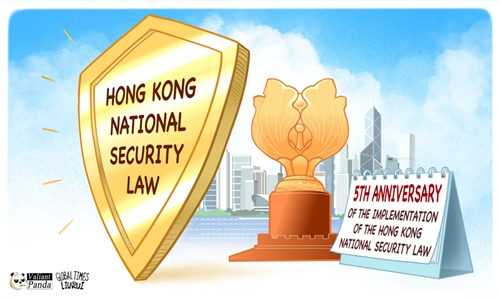
Illustration: Xia Qing/GT
The High Court of the Hong Kong Special Administrative Region (HKSAR) on Monday sentenced Jimmy Lai to 20 years in prison. The sentence was announced along with penalties for other defendants in the national security case. This brought a complete first-instance judgment to the Jimmy Lai case - one that had been protracted, highly complex, involved numerous defendants, featured prominent external interference and posed exceptional challenges to judicial adjudication.The Lai case is a critical milestone in the rule-of-law development of the One Country, Two Systems endeavor. From case initiation to trial, conviction and final sentencing, the proceedings went through complex procedures and various forms of contestation. The sentencing outcome demonstrates that the judicial handling of the case fully met expectations of the rule of law, fully safeguarded the defendant's due process rights and personal freedoms, and clearly underscored both the legitimacy and necessity of the national security law (NSL) for Hong Kong as well as the institutional capacity of the HKSAR's law enforcement and judicial authorities to safeguard national security while upholding judicial independence.
Since the enactment and implementation of the NSL - particularly since the filing and trial of the Lai case - local extremist forces and external interventionist forces have repeatedly used the case to smear and attack the policy of One Country, Two Systems, as well as Hong Kong's judicial independence and rule of law. They have applied excessive pressure in an attempt to undermine the proper implementation of the NSL and the lawful adjudication of the case. For example, the US has sought to comprehensively negate the NSL by enacting the Hong Kong Autonomy Act and by repeatedly imposing related sanctions, including sanctions or threats of sanctions against NSL judges. This highlighted the persistent challenges facing the comprehensive and accurate implementation of the NSL. The standardized handling of the case throughout its full process and the final sentencing outcome represent a rule-of-law victory for the policy of One Country, Two Systems and an important institutional achievement in the HKSAR's fulfillment of its responsibility to safeguard national security.
A 20-year term of imprisonment constitutes a proportionate criminal judgment commensurate with the harm and consequences of Lai's violations of the NSL. It accords with the principle of proportionality between crime and punishment in criminal law and aligns with Hong Kong common law sentencing benchmarks and judicial norms.
First, Lai's acts endangering national security were long-term and organized, involved collusion with external forces, and incited a "color revolution," posing grave social harm. These acts were deeply intertwined with the 2014 illegal "Occupy Central" movement and the unrest in 2019.
Second, the case is not an isolated incident but a group-based crime endangering national security. Alongside Lai, key figures within the media group Next Digital were also prosecuted, convicted and sentenced. These individuals long engaged in acts of incitement, collusion and subversion, providing various forms of support and participation in Lai's sustained conduct endangering national security.
Third, the sentence does not amount to a "harsh punishment" but rather a reasonable term consistent with expectations under the rule of law. The central authorities, the HKSAR government and Hong Kong society likewise demonstrated strong respect for and support of judicial independence and the rule of law, joining the HKSAR courts in opposing and countering external interference and firmly safeguarding Hong Kong's judicial independence and common law system.
Legally speaking, the sentencing does not mark the end of the judicial process. Lai still has the option to appeal and exhaust Hong Kong's judicial procedures in continued resistance. This is his lawful right and an objective of the rule of law's protection. Nevertheless, there is full confidence in Hong Kong's judiciary. Any subsequent judicial procedures or potential legal battles will merely further attest to Hong Kong's judicial independence and the rule of law.
From the judgments in the Lai case, including both conviction and sentencing, all sectors in Hong Kong can see that judicial independence and the rule of law remain trustworthy and rock-solid, while also gaining a deeper understanding of the legitimacy and necessity of the NSL. The NSL has decisively propelled Hong Kong from chaos to order and from order toward prosperity. The Lai case stands as the most powerful proof of the NSL's legitimacy, normativity and compatibility with the development of common law.
The author is a vice-dean of the Law School of Minzu University of China in Beijing and director of the Chinese Association of Hong Kong and Macau Studies. opinion@globaltimes.com.cn
RELATED ARTICLES