Chinese autonomous driving companies expand into Middle East market
By Published: Feb 11, 2026 05:24 PM

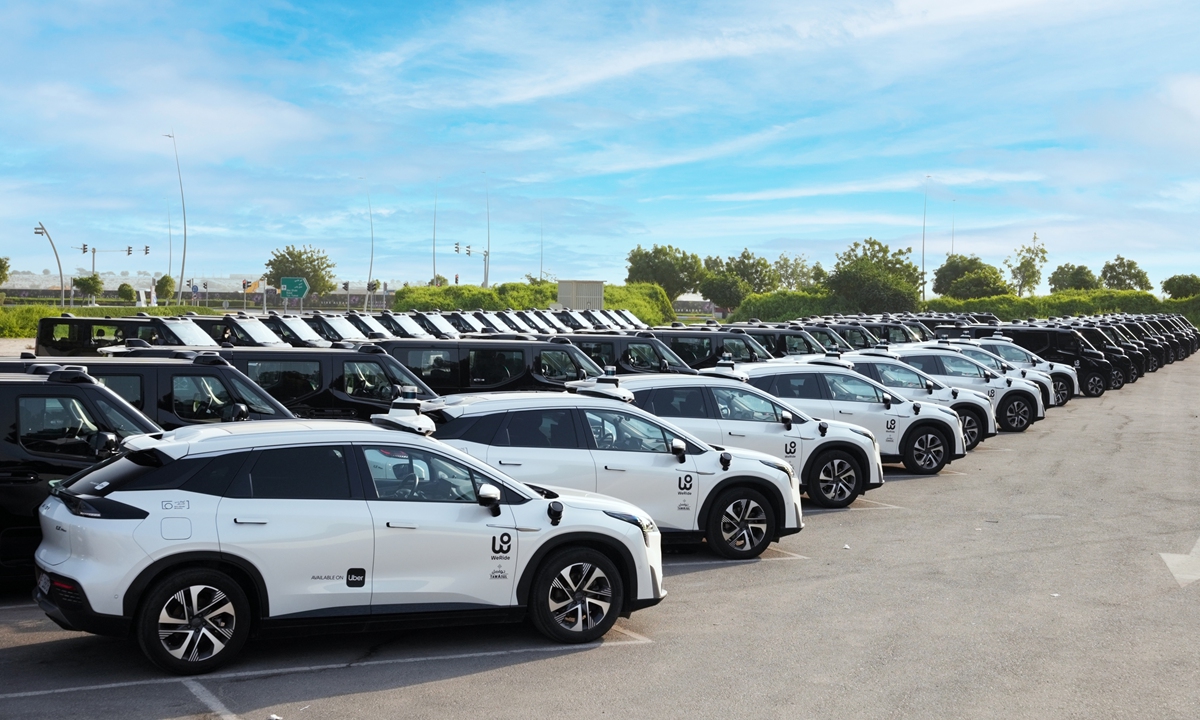
WeRide's Robotaxi fleet operates in Abu Dhabi on November 26, 2025. Photo: Courtesy of WeRide.
Chinese autonomous driving companies are expanding into the Middle East market, accelerating internationalization of their driving platforms.
Baidu on Tuesday and Uber Technologies Inc. in partnership with Dubai's Roads and Transport Authority, announced the next phase of their global partnership, bringing the Apollo Go autonomous ride-hailing service to the Uber platform in Dubai.
Expected to launch soon, the fully autonomous vehicles will be available via the Uber app across select locations within the Jumeirah area, and the deployment will expand based on operational learnings and regulatory approvals across the city, according to the release the company sent to the Global Times.
This collaboration aligns directly with Dubai's ambitious goal of having 25 pecent of all transportation trips be autonomous by 2030.
"As a key deliverable of the strategic partnership between Apollo Go and Uber announced last July, this deployment officially brings our autonomous ride-hailing service to Dubai, utilizing Uber's vast network to turn our shared vision into reality," said Nan Yang, Vice President of Baidu and General Manager of Overseas Business Unit, Intelligent Driving Group.
Baidu is not alone. On Monday, WeRide, a player in autonomous driving technology, and Uber announced a major expansion of a strategic partnership to deploy at least 1,200 Robotaxis across the Middle East. The deployment, which will span Abu Dhabi, Dubai, and Riyadh, is expected to be completed as soon as 2027.
All 1,200 Robotaxis will be available through the Uber app in the three markets, following existing fully driverless commercial Robotaxi operations in Abu Dhabi and passenger operations in Dubai and Riyadh. The fleet will be scaled up progressively, with Uber committed to adding more Robotaxis as key regulatory approvals and performance milestones are met, including the launch of fully driverless commercial operations covering the core areas of each city, according to the official website of WeRide.
Commenting on the map of China's autonomous driving companies in the Middle East, Cui Dongshu, secretary-general of the China Passenger Car Association, said that it is not surprising, as "Chinese autonomous driving companies are now gaining a foothold in the Middle East market, thanks to the supportive policies, and sound environment."
This also reflects continuous efforts for the players to expand global presence for autonomous driving, Cui told the Global Times on Wednesday, adding that outgoing has been a shining point comparing with other global players.
The UAE Artificial Intelligence Strategy 2030 issued by the UAE government permits the operation of fully autonomous vehicles on public roads and sets a goal that by 2030, 25 percent of daily transportation nationwide will be handled by smart and driverless systems, according to a report from Economic Information Daily in December.
Market watchers said that such national-level policy support has provided critical assurance for companies in securing the commercial operation license for fully autonomous driving in Abu Dhabi.
The intensifying competition in autonomous driving is seeing European market become a major ground for innovative Chinese self-driving cars.
Baidu's announcement comes on the heels of another market expansion in December, when the parties announced plans to bring the autonomous ride-hailing service to London, a right-hand drive market, as well as the inauguration of Apollo Go Park in Dubai in January, its first overseas operations and management hub.
Apollo Go has logged more than 240 million autonomous kilometers, of which over 140 million kilometers were completed in fully driverless mode. With a global footprint across 22 cities, Apollo Go's weekly ride count has recently surpassed 250,000, and the service has completed more than 17 million cumulative rides as of October 31, 2025.
On October 17, Stellantis and Pony.ai, a company in autonomous driving, announced they have signed a non-binding Memorandum of Understanding aimed at accelerating the development and deployment of robotaxi cars in Europe.
The collaboration, through Pony.ai's European division headquartered in Luxembourg, will integrate Pony.ai's advanced autonomous driving software with Stellantis' medium-size van AV-Ready Platform - BEV version, to deliver safe, scalable and efficient urban mobility solutions.
Chinese auto driving companies are also extending their cooperation with more partners.
Pony.ai on Monday announced that the first mass-produced bZ4X Robotaxi, developed in collaboration with Toyota, has officially rolled off assembly line.
This milestone marks a new phase of scaled production and commercial deployment for the Pony.ai-Toyota collaboration in Robotaxi development and operations. It also highlights the synergy between the partners across autonomous driving technology, vehicle manufacturing, and supply chain integration.
The companies plan to produce more than 1,000 bZ4X Robotaxis in 2026, with vehicles to be gradually introduced into commercial services across China's Tier 1 cities. This effort supports Pony.ai's goal of expanding its total Robotaxi fleet to more than 3,000 vehicles by the end of this year.
RELATED ARTICLES