China welcomes German companies to expand collaboration in emerging fields; Merz’s trip signals 'pragmatic economic engagement amid changing dynamism'
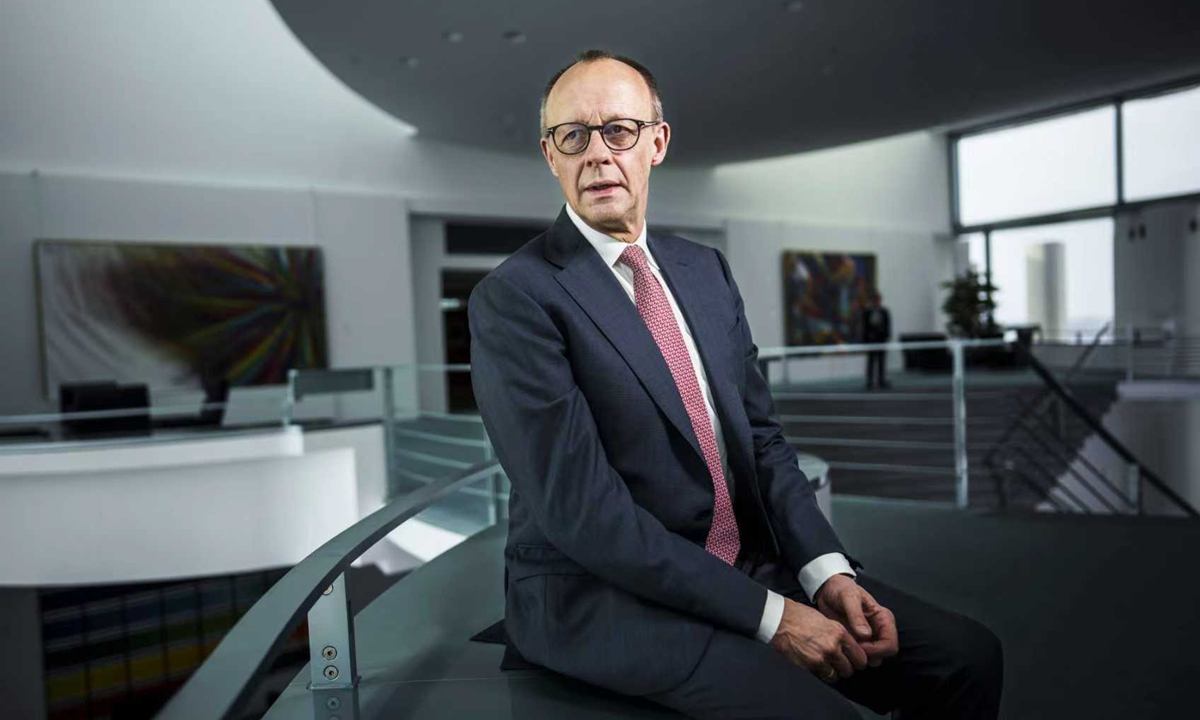
German Chancellor Friedrich Merz poses for a photo at the Federal Chancellery in Berlin, on February 17, 2026.
China's Foreign and Commerce ministries on Tuesday outlined details of German Chancellor Friedrich Merz's upcoming visit, confirming meetings with Chinese leaders and the participation of around 30 senior executives from leading German firms, in sectors ranging from automotive and chemicals to biopharmaceuticals, machinery and the circular economy.
Analysts said the visit sends a clear signal that Berlin is seeking a more pragmatic approach toward China amid shifting global dynamics, as Germany looks to deepen economic engagement and expand its strategic and policy space in the face of transatlantic uncertainty and mounting growth pressures.
The responses follow Monday's announcement by China's Foreign Ministry that Merz is set to pay an official visit to China from February 25 to 26.
In response to questions regarding the visit, Chinese Foreign Ministry spokesperson Mao Ning said on Tuesday that this is German Chancellor Friedrich Merz's first visit to China since he took office. During the visit, President Xi Jinping and Premier Li Qiang will meet and have talks with him respectively for exchanges of views on bilateral relations and issues of mutual interest.
Mao said that China and Germany are the second- and third-largest economies in the world. The sound development of China-Germany relations is in the interest of the two countries and it is what the world expects to see. Through the visit, China stands ready to work with Germany to enhance understanding and mutual trust, deepen practical cooperation, uphold the principles of mutual respect, equality and mutual benefit, achieve greater progress in bilateral relations, and contribute more to world peace and prosperity.
Echoing the high-level political agenda, the visit carries significant economic weight. China's Ministry of Commerce (MOFCOM) said on Tuesday that Chancellor Merz will be accompanied by a high-level business delegation, including around 30 senior executives from leading German firms in key sectors such as automotive, chemicals, biopharmaceuticals, machinery and the circular economy, underscoring Berlin's strong commitment to deepening bilateral economic ties.
China attaches great importance to economic and trade cooperation with Germany and is working closely with the German side to prepare events such as the China-German economic advisory committee meeting, providing a platform for businesses from both sides to exchange views and explore further cooperation, according to the spokesperson.
Germany has long been China's largest trading partner and source of foreign investment in Europe, with the two economies deeply integrated and their cooperation steadily strengthening, the MOFCOM spokesperson said. In recent years, bilateral trade has remained above $200 billion, while two-way investment stock has exceeded $65 billion, accounting for nearly one-quarter of China's total trade and investment with the EU.
Jian Junbo, director of the Center for China-Europe Relations at Fudan University's Institute of International Studies, told the Global Times that the visit should be viewed in the context of broader adjustments in major-power relations. As rifts in transatlantic ties deepen and Europe's strategic reliance on the US-led framework evolves, maintaining stable communication with China can help ease Europe's dual pressures in both strategic and economic spheres.
Jiang Feng, a researcher at Shanghai International Studies University and president of the Shanghai Regional Studies Association, told the Global Times the visit carries significant historical and contemporary importance. He said that beyond consolidating economic ties, the visit is aimed at deepening Germany's strategic understanding of China and forming a clearer, more systematic policy framework toward Beijing.
However, Jian noted that Germany's "threefold positioning" toward China remains fundamentally unchanged. "This is not a strategic pivot, but rather a technical recalibration amid a complex environment," he said. Within the existing strategic framework, Berlin is more inclined to strengthen pragmatic cooperation in economic and trade areas, seeking to balance security concerns with practical interests.
The MOFCOM spokesperson said that as China enters the first year of its 15th Five-Year Plan (2026-2030), German companies are welcome to seize new opportunities created by China's high-level opening-up, consolidate cooperation in traditional sectors and expand collaboration in emerging fields such as clean energy, embodied intelligence, biotechnology and industrial digitalization, turning cooperation potential into tangible results.
As outlined on the German Federal Chancellery's website, Merz will depart on February 24 and arrive in Beijing on February 25. In Beijing, he will attend the China-German economic advisory committee meeting, hold talks with Chinese leaders, and visit the Forbidden City and Mercedes-Benz. He will then travel to Hangzhou for meetings with local officials and tours of Unitree and Siemens Energy.
German media outlet Welt said Merz's trip is of major importance to Germany's business community, noting that China remains a key market for German companies, particularly the country's automakers. At the same time, the report described China as both a vital economic partner and a systemic competitor, underscoring the delicate balance Berlin seeks to strike between cooperation and competition.
"The German chancellor is looking for partners worldwide after the US has partly relinquished its old role. Much is at stake during his belated inaugural visit to China," DW News reported.
Jian noted that while China and Germany compete in advanced manufacturing and high-tech sectors, there remains significant room for cooperation. Merz's decision to bring a large industrial delegation reflects an effort to explore collaboration in emerging industries and high-end manufacturing, seeking mutually beneficial outcomes amid competition.
"For Germany, maintaining close ties with the Chinese market is more conducive to enhancing its industrial competitiveness than simply emphasizing decoupling," he said.
RELATED ARTICLES