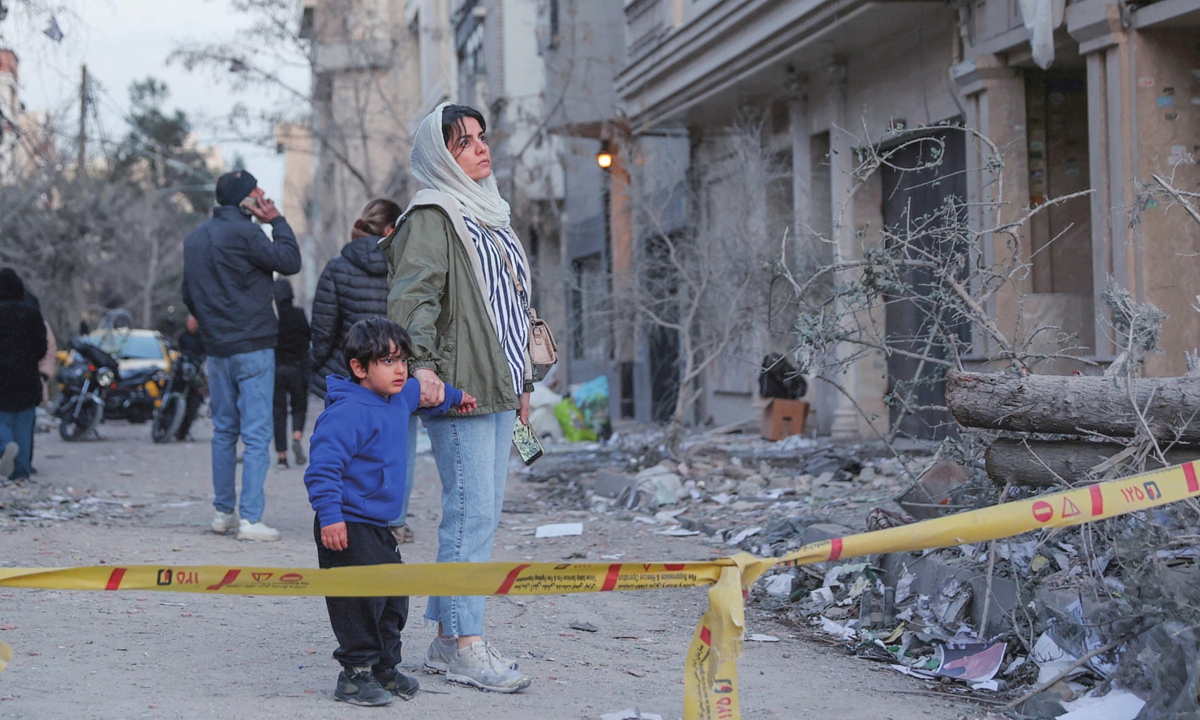
Dozens of government institutions in central Tehran were struck, and the police headquarters was heavily damaged during US and Israeli airstrikes on March 2, 2026. Photo: IC
With the situation in the Middle East at risk of being pushed into the abyss, military actions must stop immediately. The international community must consolidate peace-promoting efforts, steer the situation toward de-escalation, and collectively uphold international law and the fundamental norms governing international relations.
Recently, the US and Israel launched military strikes against Iran without consultation or authorization from the United Nations (UN) Security Council. This act blatantly tramples on international law and the basic principles of international relations, putting the Middle East situation at risk of being pushed into an abyss.
The prohibition of the use of force constitutes the cornerstone of security in the contemporary international system. This consensus was established as early as the Kellogg-Briand Pact before World War II. The UN Charter further stipulates that force shall not be used against the territorial integrity or political independence of any state. The vitality of international law lies in its universality, and its authority lies in its inviolability. By willfully undermining the international rule of law, the US and Israel are not only destabilizing the Middle East but also eroding the very foundations of world peace.
The US claimed that Iran has been advancing its nuclear program and building missiles that will soon reach the American homeland. However, Rafael Grossi, director general of the International Atomic Energy Agency (IAEA), made clear that no evidence had been found of a structured program to manufacture nuclear weapons in Iran. The facts suggest that the decision by the US and Israel to attack Iran may have been driven by political considerations. Relying on military superiority to arbitrarily attack other nations has led insightful observers in the US to remark that American hegemony is shedding its disguise and becoming increasingly out of control.
After the military strikes, a chorus of opposition arose from the international community. UN Secretary-General António Guterres pointed out that the charter provides the foundation for the maintenance of international peace and security, and all member states must respect their obligations under international law. The SCO member states issued a statement saying that they consider the use of force unacceptable, and maintain that the only way to resolve the current conflict lies in dialogue, mutual respect and consideration for the legitimate concerns of all parties based on international law and the purposes and principles of the UN Charter. The Arab League urged all active parties in the international community to work toward de-escalation as quickly as possible, and to spare the region the devastating consequences of widening instability and violence.
A country's attitude toward the international law and order reflects its worldview, its concept of order, and its sense of responsibility. The use of force cannot truly resolve problems; instead, it creates new ones and leaves serious repercussions. The international community must take action to jointly defend international law and the fundamental norms of international relations.
Military operations must stop immediately. The tragic attack on an Iranian primary school has struck at the moral bottom line of humanity. As the humanitarian disaster intensifies, the security of the Strait of Hormuz - a vital global energy trade route - has also been severely affected, and the risk of more forces being drawn into the conflict is rising sharply. The spillover of war serves no party's interests, and the red line of protecting civilians in armed conflicts must never be crossed. The most urgent priority is to prevent further escalation and stop the fighting from spreading across the entire Middle East. The international community should value the security of Gulf countries and support them in taking their future into their own hands.
Dialogue and negotiations should be resumed as soon as possible. Peacefully resolving the Iranian nuclear issue through political and diplomatic means is the only correct option and serves the shared interests of the international community. Recent talks between Iran and the US had already made progress, offering a rare opportunity for a peaceful settlement. Regrettably, this process has now been interrupted by gunfire. In light of the severe situation, relevant parties should return to dialogue, support the IAEA in performing its duties objectively and impartially, and bring the Iranian nuclear issue back onto the right track of peaceful resolution.
Unilateral actions must be collectively opposed. The international community should resist any violation of international law. No major power should be allowed to arbitrarily attack another country on the basis of military superiority; the world must not revert to a "law of the jungle." The international community should send a clear and unequivocal message, firmly opposing unilateral bullying and threats of force in international relations, the imposition of one country's will on others, and the use of might to override right.
The conflict continues and tensions are escalating. The international community should stand firmly on the side of peace and justice, and work together to restore peace and stability in the Middle East. As a responsible major country, China will work with the international community to actively promote peace and de-escalation, and play a constructive role in easing regional tensions and safeguarding peace and stability in the Middle East and the world.
Huan Yuping is an international commentary column of the People's Daily. opinion@globaltimes.com.cn
RELATED ARTICLES