China's low-altitude economy moves beyond technical concepts toward real-world applications
‘Air taxi’ no longer a dream
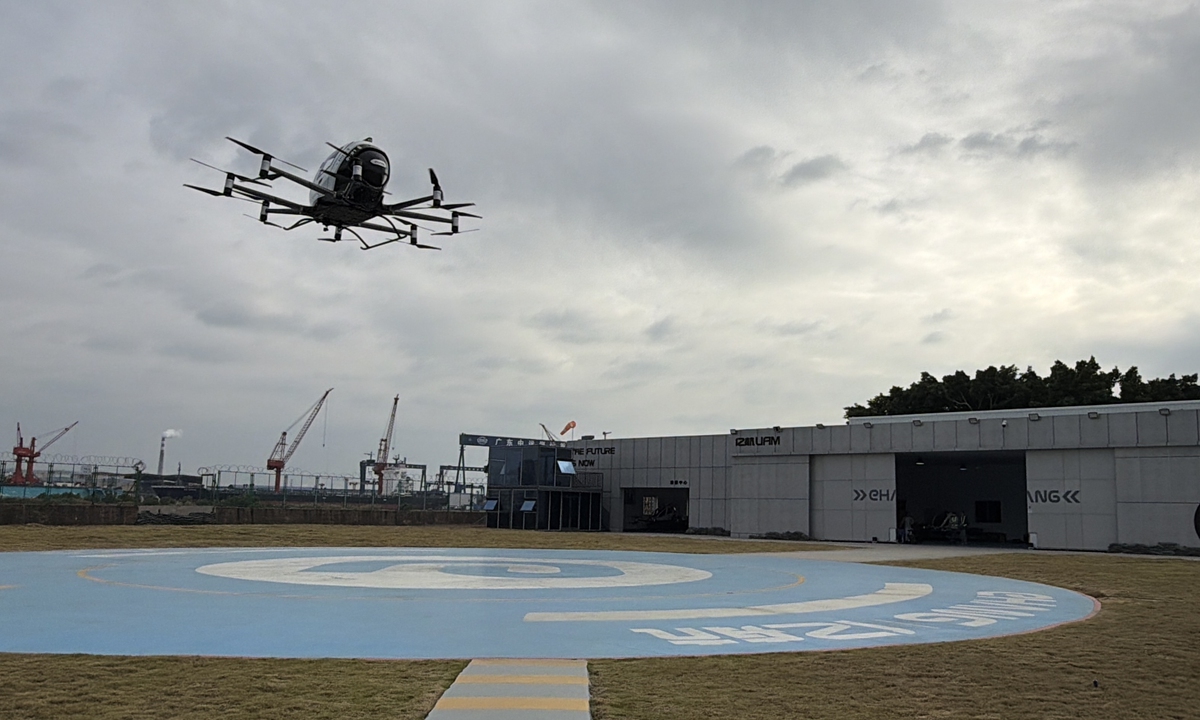
The EH216-S lands at the flight platform of its manufacturing company, Ehang. Photo: Fan Anqi/GT
Editor's Note:Buzzwords such as the low-altitude economy, brain-computer interfaces and embodied intelligence, which have been written into the recommendations for China's 15th Five-Year Plan (2026-30), are sketching out a new blueprint for future industries and pointing to fresh directions for the country's development. How far are these futuristic, almost science-fiction-like industries from the general public?
The Global Times launches a new series titled "LAB China," focusing on key laboratories, industry-academia-research bases and innovation hubs across the country that are rooted in emerging and future industries. In the second installment, Global Times reporters paid a visit to EHang, the world's first company to obtain all four certifications for manned electric vertical takeoff and landing (eVTOL) aircraft. Featuring in-depth coverage of its R&D center, final assembly line and flight test base, this installment explores how China's low-altitude economy is moving from technological breakthroughs to large-scale commercialization, addressing a key question on many people's minds: How far are we from commuting to work by "air taxi"?
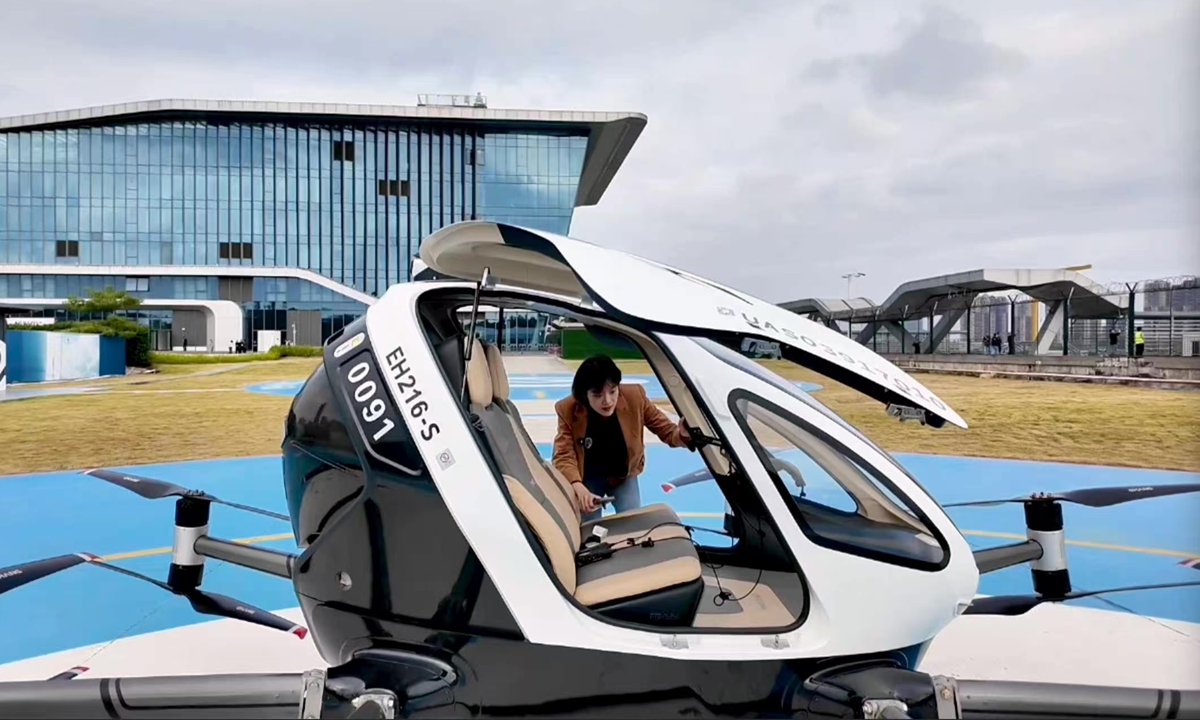
A Global Times reporter experiences the EH216-S manned eVTOL aircraft at a flight base of Guangzhou Suigang Ferry Terminal in Guangzhou Development District. Photo: Chen Zishuai/GT
When Global Times reporters arrived at a flight base of Guangzhou Suigang Ferry Terminal in Guangzhou Development District, the river breeze gently brushed by, as white aircraft that looked like something straight out of a sci‑fi movie stood neatly in place, with their sleek, streamlined fuselage resembling a beetle with eight wings.The security checks before taking off were stricter than expected: In addition to routine metal detection and prohibited‑item screening, health declarations and weight measurements are also required. Feeling their own heartbeats racing, the reporters stepped inside the cabin. The autonomous craft exudes a futuristic feel: two side‑by‑side seats, a tablet‑sized display screen and 270‑degree panoramic glass providing unobstructed views.
"You won't need to operate any equipment," a staff member said while fastening the seatbelt. "The entire flight is monitored by the ground command and control center. Just relax and enjoy."
Moments later, the 16 propellers began to spin, starting with a soft hum. As speed increased, the sound grew steady and even, but far quieter than a traditional helicopter.
This was a pilotless flight, with all controls entrusted to the intelligent navigation system. However, the ride was surprisingly smooth and steady, as if the aircraft was gently lifted by an invisible hand. After climbing to roughly 100 meters, it began automatic flight along a pre‑set route at a constant speed. According to the staff, the aircraft can reach a maximum speed of 130 kilometers per hour.
The EH216‑S is the world's first and only manned eVTOL to obtain three key certificates: type certificate, production certificate, and standard airworthiness certificate.
It has accumulated more than 80,000 safe flights. During airworthiness certification, the Civil Aviation Administration of China (CAAC) conducted more than 450 verification tests ranging from extreme weather simulation and intentional hardware failures to simulated battery fires and other emergency scenarios.
"All core systems of the aircraft use redundant safety design," a staff member said. "If any component fails, the backup system takes over seamlessly, maximizing flight safety."
Compared with general‑aviation aircraft or helicopters, the EH216‑S is smaller, more maneuverable, requires less space and is easier to take off and land, making it an ideal choice for low‑altitude, short‑distance travel services, the Global Times learned from the company.
On December 31, 2025, the EH216‑S successfully completed a point‑to‑point flight across the Qiongzhou Strait. The trip took only 18 minutes, boosting travel efficiency by about 70-80 percent compared with the 60-90 minutes required by traditional ferries. Analysts noted the flight verified the technical reliability of autonomous eVTOLs in cross‑sea scenarios and opened new possibilities for future daily commutes where "air taxis" cross mountains and seas, and connect cities.
Starting with a piece of 'cloth'
Stepping into the production base of EHang in Yunfu, South China's Guangdong Province, Global Times reporters were immediately struck by the first impression of the base. No spectacular scenes of robotic arms, nor the roar of fully automated assembly lines. Inside the bright, clean workshop, workers in uniform blue dust-proof suits focused intently on their tasks. In an adjacent workshop, several technicians gathered around a partially assembled aircraft, carefully installing components by hand.
In one corner of the factory lies the birthplace of the airframe's key components: carbon fiber parts. Each sheet of carbon fiber resembled a deep blue piece of "cloth," light in appearance yet extraordinarily strong and durable. Workers cut them precisely into strips, curves, U-shapes and other forms, with every cut accurate to the millimeter.
They then move to the lay-up area, layering the cut carbon fiber "cloth" into metal molds. "If one layer is not laid properly, internal defects will appear after curing, directly compromising structural strength," a worker said.
The production line shows that the industry is still in its early stage, with market scale relatively small, supply chain still being optimized and conditions for mass production not yet fully mature. According to the company staff, the Yunfu factory currently has an annual capacity of 600 aircraft. Construction of the second‑phase plant is underway, which will increase annual capacity to 1,000 units upon completion.
Integrating into daily life
As the 15th Five-Year Plan pushing the development of strategic emerging industrial clusters such as the low-altitude economy, EHang received the first batch of national Operation Certificates (OC) for manned civil unmanned aerial vehicles issued by CAAC in March 2025.
He Tianxing, vice president of EHang, told the Global Times that the development path of manned eVTOLs can be divided into three stages: awareness, popularization and universal accessibility.
"Over the past five years, the public have become aware of this industry, and starting in 2025, the industry will enter the popularization stage." According to He Tianxing, EHang currently has more than 40 takeoff and landing points set up across the country. "We plan to expand more commercial operation points, covering functions such as aerial tours, urban commuting and emergency support."
In He's view, the true universal accessibility phase will arrive between 2028 and 2030. "In the final year of the 15th Five-Year Plan, we aim to achieve the regular operation of 'air taxis' in key cities."
"Residents can book an unmanned aerial vehicle via a mobile app at a price close to that of ground luxury ride-hailing services, usable daily and available at any time," He said. "A city may have hundreds of takeoff and landing points and hundreds of air routes, truly integrating into the daily travel ecosystem."
RELATED ARTICLES