Japan, France, Canada mull critical minerals bloc; Chinese expert flags G7 divisions, warns exclusionary approaches unlikely to deliver
By Chen Qingrui and Published: Mar 08, 2026 06:51 PM

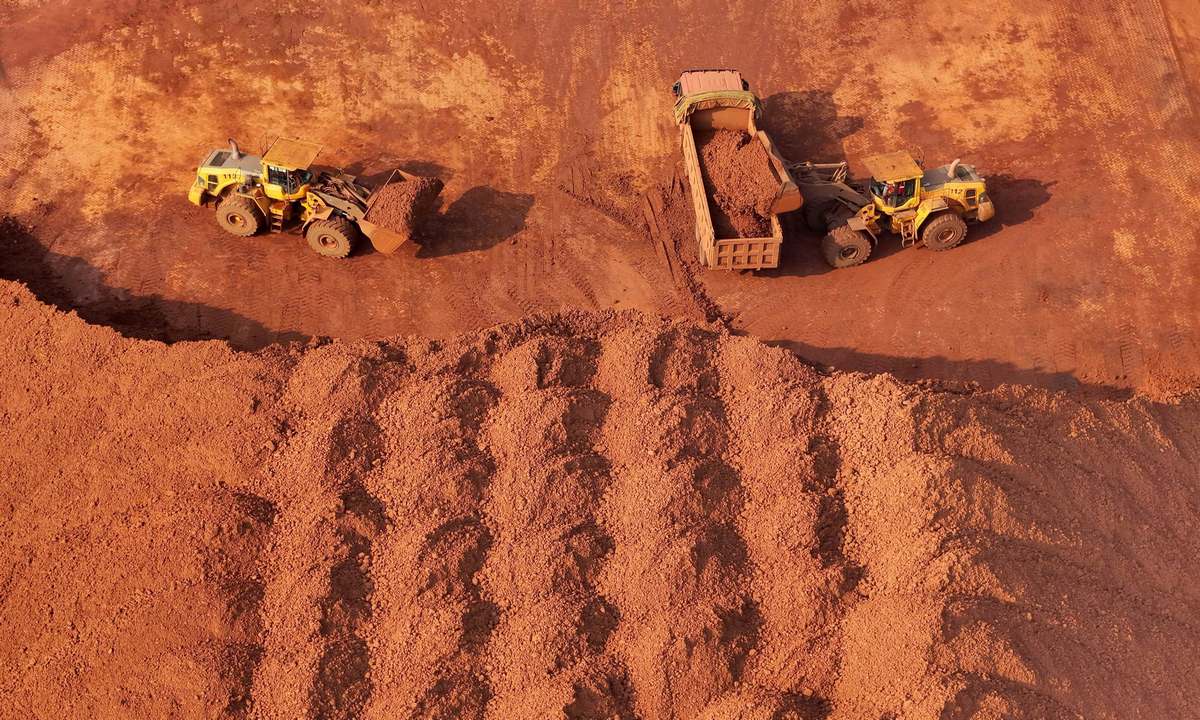
Rare earth resources Photo: VCG
Group of Seven (G7) members Japan, France and Canada are working on alternatives to a US-led trade bloc to secure critical minerals and reduce reliance on China, according to three senior officials from these countries, Reuters reported on Saturday. The move came at a striking moment, as a recent report noted that US is seeking to build a bloc with their allies around China through a critical minerals alliance, but the three G7 "key players" are instead charting their own course.
Recently, blocs launched under the banner of reducing reliance on China's rare earths have been emerging one after another, often with overlapping memberships and similar objectives. A Chinese expert noted that the proliferation of such "Western blocs" reflects coordination failure rather than genuine supply chain resilience.
Some options mentioned by Japan, France and Canada this time include import quotas on certain rare earths, subsidies for mining companies to diversify the supply chain on critical minerals.
Prior to the "alternatives" mentioned by Japan, France, and Canada in the report, Canada had also recently led a separate initiative to bring together mineral-consuming countries in a "critical minerals buying group" — opting for collective purchasing power rather than relying solely on a price floor, reported Reuters on March 3.
This "buyers' club" aimed at the same purpose, to "develop a reliable supply chain of critical minerals outside of China and break that country's monopoly on these metals," according to Reuters. This "buyers' club" is also in the options of Japan, France, and Canada's alternatives this time.
Earlier, the US and several partners announced the launch of the Minerals Security Partnership (MSP) in 2022, an initiative focused on mineral and metal supply chains critical to clean energy technologies, Japan, Canada and France are members of the MSP.
Subsequent policy moves under the MSP have been seen by Western media as part of an effort to lessen reliance on Chinese companies involved in the production of critical minerals.
More recently, pursuing much the same objective, the US has also rolled out yet another plan.
On February 4, the US administration unveiled plans to allies into "a preferential trade bloc" for critical minerals, according to AP.
Under this plan, US Vice President JD Vance said the US-China trade war over the past year had exposed how dependent most countries are on critical minerals largely dominated by Beijing, and claimed that "collective action is needed now to give the West self-reliance."
But a month after that announcement, some countries are making different plans without the US. An example of Canadian Prime Minister Mark Carney's appeal for middle powers to band together as the US has alienated allies, according to Reuters.
Notably, the US recently has repeatedly withdrawn from international frameworks, walked away from agreements and wielded tariff threats even against its allies. Expert said this has made the US-led framework for safeguarding rare earth supply chains appear even less credible in the eyes of G7 members.
"At present, countries like Japan, Canada and France that trade or seek resources all seek stable guarantees for critical mineral supplies. However, significant divergences in national interests have led to overlapping memberships and the continued proliferation of blocs that seek to exclude China, as participants have so far failed to reap tangible benefits," Zhou Mi, a senior research fellow at the Chinese Academy of International Trade and Economic Cooperation, told the Global Times on Sunday.
Also, such unilateral "America First" practices have left many traditional partners disillusioned, persisting with efforts to exclude China amid such divisions would only make their rare-earth supply chains worse, he added. "Even under what they expected the new framework such as a US-led critical minerals alliance, other countries remain exposed to the fallout of unilateralism and protectionist measures."
More fundamentally, he argued that merely swapping one "small bloc" for another - continuing to promote closed trade arrangements - does nothing to enhance the security of rare-earth supply chains.
Recently, Western countries have ramped up initiatives to strengthen their own rare-earth supply capacity.
Some media outlets, including Reuters, have said that measures taken by G7 members over recent years were aimed at "tackling China's dominance in rare earths."
Canada has recently announced the result of 30 new partnerships and investments, which will unlock C$12.1 billion ($8.83 billion) in critical minerals projects with 12 allied partners, according to Natural Resources Canada's report on March 4.
Data from the International Anergy Agency showed that China accounted for around 60 percent of global mining output in 2024, and its dominance is even greater in the separation and refining stages, representing about 91% of global production.
Despite misleading hype from some Western media, China's objective is to regulate exports and not ban them, and to facilitate trade that adheres to established regulations rather than disrupt normal commercial activity, Xinhua News Agency reported.
In April last year, China announced export controls on seven categories of medium and heavy rare-earth-related items, citing the need to better safeguard national security and interests and fulfill non-proliferation and other international obligations. Since then, Chinese authorities have repeatedly stressed the use of facilitation measures, including general licenses, to promote compliant trade in dual-use items and safeguard the stability of global supply and industrial chains.
On December 18, 2025, China's Ministry of Commerce spokesperson He Yadong said that some Chinese exporters had preliminarily met the basic requirements for applying for general licenses, adding that a number of applications submitted by Chinese exporters had already been approved.
RELATED ARTICLES