Chinese high-tech zone rolls out OpenClaw support policies; experts warn potential risks with AI agents
By and Guo Yuandan Published: Mar 09, 2026 10:19 PM

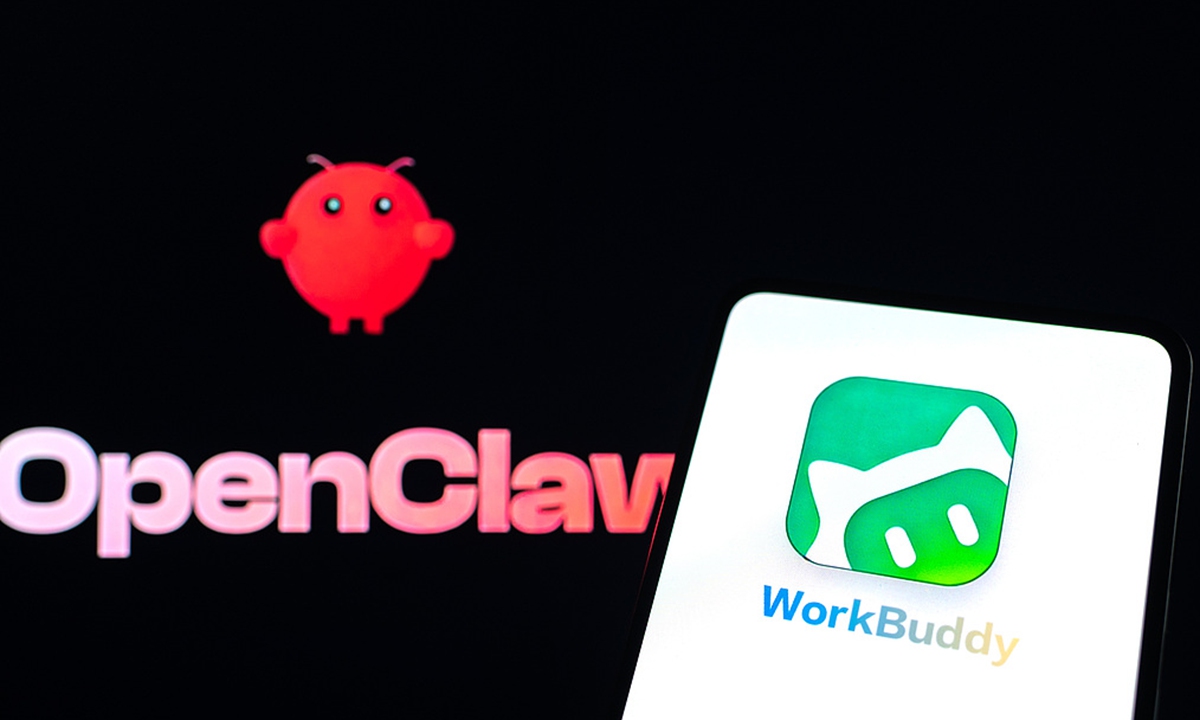
OpenClaw Photo: VCG
China's Wuxi high-tech zone in East China's Jiangsu Province announced on Monday measures to support businesses developing open-source artificial intelligence (AI) agents such as OpenClaw, aiming to attract talent, promote industrial growth, and provide substantial financial incentives.
Experts interviewed by the Global Times suggested that while embracing new technology with open arms, people should also guard against the risks that come with them.
According to the official WeChat account of the Wuxi high-tech zone on Monday, the 12 corresponding policies provide support across a wide range of areas, from basic infrastructure to industry implementation, talent development, and regulatory compliance, with subsidies of up to 5 million yuan ($720,000).
At the same time, in order to minimize the potential risks from the open-source AI agent, the Wuxi high-tech zone noted that it will strengthen the management of security standards. For example, anyone deploying OpenClaw must pass domestic adaptation certification to reduce supply chain risks.
OpenClaw, created by Austrian developer Peter Steinberger, is designed to allow large-language models to operate computers autonomously, controlling files, executing commands and interacting through messaging applications such as WhatsApp and Telegram, according to the Xinhua News Agency.
Since Steinberger created it in November 2025, the open-source project has attracted more than 145,000 endorsements on the US software development platform GitHub, according to Xinhua.
Meanwhile, the growing attention to OpenClaw has been accompanied by the buzzword "raising crayfish," which has also caught the eyes of Chinese netizens. The term refers to OpenClaw because its logo resembles a crayfish.
Amid its growing popularity, some Chinese local governments have stepped up measures to support investment in the open-source sector, with a particular focus on businesses and talent related to OpenClaw.
The trend of "raising crayfish" not only took place in Wuxi but also in Shenzhen, South China's Guangdong Province. Over the weekend, Shenzhen's Longgang district government issued corresponding measures on supporting the development of OpenClaw, the Shenzhen Evening News reported on Monday.
According to the report, the district plans to use the OpenClaw project as a starting point, and a comprehensive "all-in-one" support program has been launched to cover the entire development process, allowing developers to focus on technological innovation and application deployment without worrying about infrastructure, data resources, or hardware costs.
Amid the global AI wave, China offers what could be the broadest range of market applications and policy support, Ma Jihua, a veteran industry analyst, told the Global Times on Monday, noting that local governments are taking concrete action, supporting innovation and fostering ecosystems for intelligent manufacturing and open-source AI.
Commenting on the rising foothold of the open-source AI agent, Xiao Xinguang, founder of anti-virus company Antiy Labs and a member of the National Committee of the Chinese People's Political Consultative Conference, told the Global Times on Monday that before this, no matter how advanced AI service providers such as DeepSeek or OpenAI were, they could not operate a user's computer on their behalf.
"The core value of OpenClaw lies not in content generation or interaction, but in 'action' — it can not only produce text and images but also execute tasks on behalf of the user," Xiao said.
The surge in OpenClaw's popularity has also spilled over into China's A-share market. On Monday, related concept stocks saw a rush of investment, with sectors such as cloud computing, computing power leasing, and AI applications rising sharply throughout the day. Businesses such as UCloud, a cloud computing service provider, hit the 20 percent daily trading limit, financial news site Yicai reported.
While the development of new technologies is "unstoppable," and while we embrace them with open arms, we must also guard against the risks they bring, experts said.
Wang Liejun, a security expert from Qi-Anxin Group, a Chinese cybersecurity company, told the Global Times on Monday that OpenClaw is designed with the highest system-level permissions to execute complex tasks. However, if misconfigured or maliciously manipulated, its "super permissions" and "super capabilities" could easily bypass human-set security safeguards, creating significant risks, Wang said.
Some users lack security awareness during deployment, directly exposing OpenClaw's management interface to the public internet and failing to change default credentials or close unnecessary ports. This allows hackers to easily scan for and take over these "AI assistants," using them as a pivot to attack internal networks or directly steal sensitive data from the servers, Wang noted.
In February, the National Vulnerability DataBase under China's Ministry of Industry and Information Technology also said that it found that in some instances, the open-source AI agent OpenClaw may pose relatively high security risks under default or improper configurations, potentially leading to cyberattacks and information leaks. It advised relevant organizations and users to guard against potential cybersecurity risks when deploying and using OpenClaw.
"The rapid adoption of new AI agents such as OpenClaw reminds us that technological progress must go hand-in-hand with risk management. Sustainable AI development can only be achieved when innovation and safety advance together," Ma said.
RELATED ARTICLES