SIPRI report shows Japan’s arms imports up 76% in five years; expert says report turns blind eye to resurgence of Japanese militarism
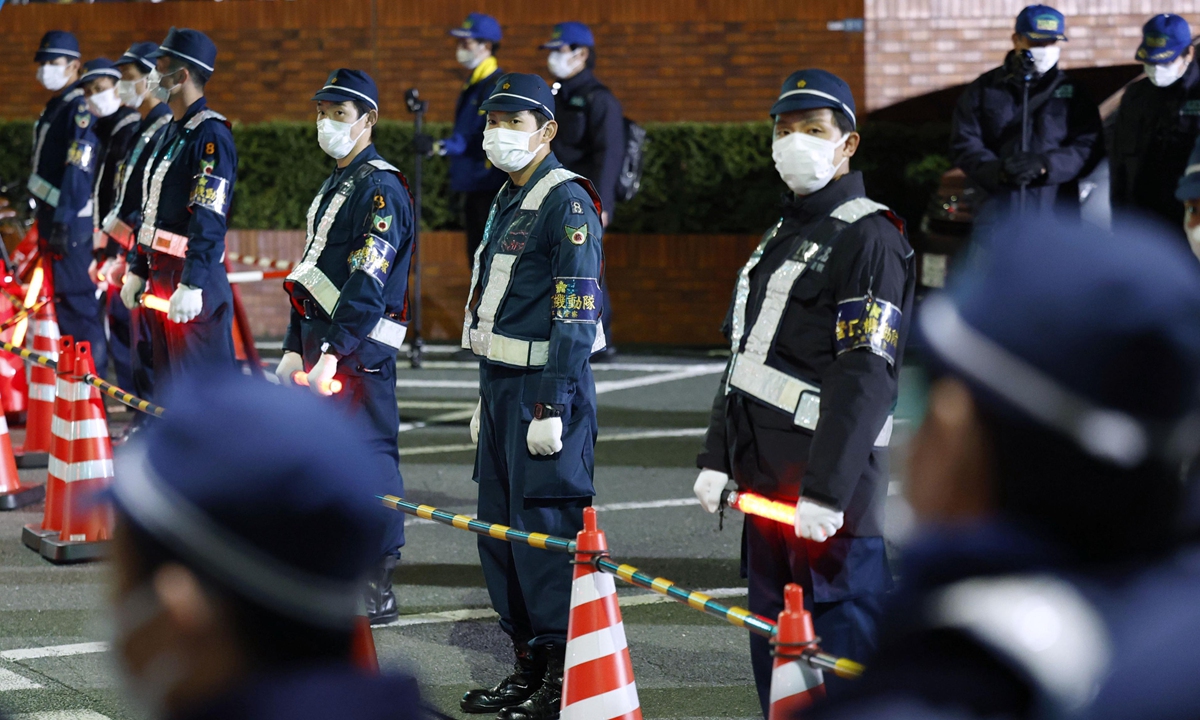
Police officers stand guard near Japan Ground Self-Defense Force Camp Kengun in Kumamoto, southwestern Japan, on the evening of March 8, 2026, ahead of the scheduled arrival of a GSDF vehicle carrying a long-range missile launcher. Photo: VCG
The latest report released by the Stockholm International Peace Research Institute (SIPRI) on Monday showed that in East Asia, Japan has seen a significant increase in arms imports, while China has dropped out of the top ten arms importers for the first time since 1995. Additionally, the report turned a blind eye to the threat posed by the resurgence of Japanese militarism to regional and global peace and stability, routinely hyping the so-called "China threat" narrative.An expert said that there has always been a force in the West that habitually and instinctively takes an anti-China stance on China-related issues, adding that "When China's arms imports rise, they hype up so-called military expansion; when China's imports fall, they accuse China of developing its military through self-reliance and coercing neighboring countries." In fact, it is China that is subjected to the pressure and threats arising from Japan's dangerous actions, the expert noted.
The report showed that India, Pakistan, Japan and Australia are four states in Asia and Oceania ranked among the 10 largest arms importers globally in 2021-25. It also noted that China dropped out of the top 10 arms importers for the first time since 1991-95.
The report also indicated that in East Asia, Japan is one of the countries to see large increases in its arms imports between 2016-20 and 2021-25, up 76 percent, according to the report.
The report claimed that Japan's defense ministry is speeding up work to build counterstrike capabilities amid the rapidly deteriorating security environment surrounding Japan, such as China's increasing military activities.
Siemon Wezeman, Senior Researcher with the SIPRI Arms Transfers Programme, claimed in the report that in South Asia, the high volume of arms that India imports is "largely due to the perceived threat from China."
Zhuo Hua, an international affairs expert at the School of International Relations and Diplomacy at Beijing Foreign Studies University, told the Global Times on Monday that the report has linked the sharp increase in arms imports by countries such as Japan and India to China, and the hype over the so-called "China threat" narrative is easily debunked.
Among the four major arms importers in the Asia-Pacific mentioned in the report, Japan and Australia are allies of the US in its military containment strategy against China, while India is a country the US is seeking to pull into its anti-China coalition. The US, meanwhile, happens to be the largest source of the growing arms imports in the region, Zhuo said.
"Therefore, this is entirely the result of the synergy between the US Indo-Pacific Strategy and the re-militarization and re-armament policies of these countries, as well as the result of the US attempt to replicate the European war economy model in the Asia-Pacific," the expert added.
"In particular, since the appointment of Japanese Prime Minister Sanae Takaichi, a series of erroneous moves have been made by Japan to vigorously break free from the constraints of the country's pacifist constitution and go further down the path of military buildup and expansion," Zhuo said.
What Japan has not halted is its relentless military buildup and arms expansion. Earlier on Monday, Japan's Ground Self-Defense Force (GSDF) has brought launchers and other equipment related to sophisticated long-range missiles into its Camp Kengun in the city of Kumamoto in preparation for their deployment, the Japan Times reported, citing informed sources.
Zhuo noted that China is the one bearing the brunt of such dangerous developments in its neighborhood.
Additionally, the report showed that the increase in global arms flows was the biggest since 2011-15. It was overwhelmingly due to the growth in transfers to Ukraine (which received 9.7 percent of all arms transfers in 2021-25) and other European states, the report added.
Under the subheading "Europe the largest arms-importing region", the report also reveals that European states received 33 percent of global arms imports, with the region's imports increasing by 210 percent between 2016-20 and 2021-25.
The report also revealed that the US supplied 42 percent of all international arms transfers in 2021-25, up from 36 percent in 2016-20.
The US exported arms to 99 states in 2021-25, including 35 states in Europe, 18 in the Americas, 17 in Africa, 17 in Asia and Oceania and 12 in the Middle East, the report said. For the first time in two decades, the largest share of US arms exports went to Europe (38 percent) rather than the Middle East (33 percent). Nevertheless, the top single recipient of US arms was Saudi Arabia (12 per cent of US arms exports), according to the report.
Zhou said the global arms transfer structure has once again made it clear that most conflicts and wars in today's world are essentially the spillover effects of the US creating wars to profit from them, and are even redefining the relationship between the US and its European allies.
He added that on one hand, the US is instigating and creating conflicts around Europe, deteriorating its regional security environment, and on the other hand, the US has repeatedly sent uncertain signals about its security commitments to Europe, sowing anxiety and panic among European NATO members.
"This is why data shows that over the past five years, Europe has not only become the largest arms-importing region, but also the top destination for US arms exports," Zhuo noted.
RELATED ARTICLES