Second nuclear energy summit kicks off in Paris amid climate, energy challenges; expert highlights global importance and China’s leading role
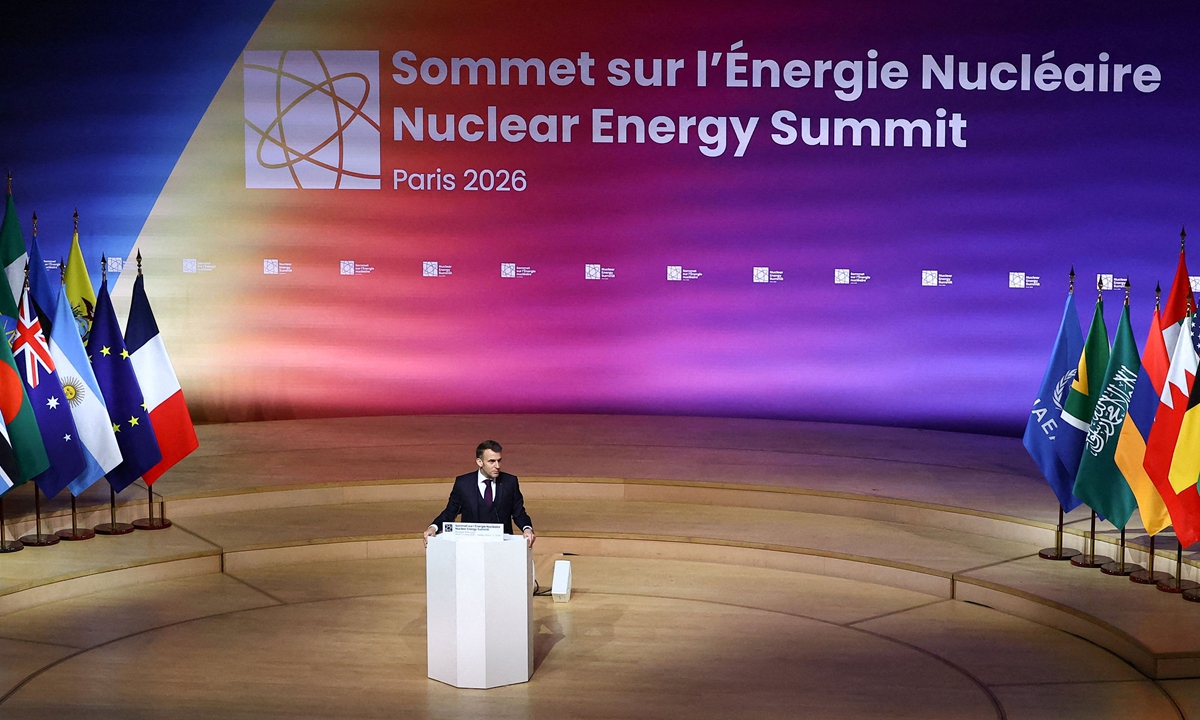
France's President Emmanuel Macron delivers a speech during the Nuclear Energy Summit at the Seine Musicale venue in Boulogne-Billancourt, outside Paris, on March 10, 2026. Photo: VCG
The second Nuclear Energy Summit, the world's highest-level multilateral meeting exclusively focused on the topic of nuclear energy, kicked off in France on Tuesday. As attention on the nuclear energy intensifies, a Chinese expert emphasized its vital role and highlighted China's leading position in the field.
According to the Chinese Foreign Ministry on Monday, President Xi Jinping's Special Representative, Member of the Political Bureau of the CPC Central Committee and Vice Premier of the State Council Zhang Guoqing is scheduled to be in France from March 9 to 12 for the second Nuclear Energy Summit upon invitation.
When asked about the visit, Chinese Foreign Ministry spokesperson Guo Jiakun said on Monday that the gathering aims at enhancing political consensus, advancing multilateral coordination and enabling nuclear energy to play a bigger role in tackling global climate change, strengthening countries' energy security and resilience and realizing UN Sustainable Development Goals.
Heads of State and Government, heads of international organizations, financial institutions, industry representatives and experts are scheduled to discuss the role of civil nuclear energy in addressing major energy and climate challenges in the summit, according to the International Atomic Energy Agency (IAEA), which cooperates with the government of France in hosting the summit.
Building on the inaugural Nuclear Energy Summit in Brussels in 2024, the Summit this time aims to strengthen international cooperation and to promote solutions for the safe and sustainable development of civil nuclear power, according to the IAEA.
At the opening of the summit on Tuesday, French President Emmanuel Macron said that nuclear power is key to reconciling energy independence and sovereignty, decarbonization and carbon neutrality by 2050, and competitiveness and job creation in economies, France 24 reported on Tuesday.
The conflicts in the Middle East are also a reminder of how vulnerable countries that dependent on imported fossil fuels are to supply risks and market volatility, highlighting the importance of sovereignty, renewable energy, and nuclear power as decarbonized energy sources, a report by France 24 said.
In the speech at the event, EU Commission President Ursula Von der Leyen said the decision to reduce the share of nuclear energy in the electricity production mix in the European Union was a strategic mistake given that the bloc is neither an oil or gas producer, per Reuters.
Wind and solar power are intermittent, whereas nuclear power provides stable and reliable output, Lin Boqiang, director of the China Center for Energy Economics Research at Xiamen University, told the Global Times on Tuesday, adding that nuclear energy serves as one of the crucial pillars supporting economic development for countries and promoting it will play a vital role in achieving carbon neutrality and addressing global climate change.
In September 2025, the IAEA revised up its projections for the expansion of nuclear power for the fifth year in a row, estimating that global nuclear power capacity could more than double by 2050.
Spokesperson Guo also noted during the press conference on Monday that China is a global leader in nuclear energy, and an important advocate, participant and contributor in international nuclear energy cooperation. While ensuring its own nuclear security, China actively fulfills its international obligations on nuclear security and vigorously advances international cooperation on nuclear energy, he said.
For instance, China's Hualong One has become the world's most deployed third-generation nuclear reactor technology, with 41 units currently in operation or under construction globally, according to the Xinhua News Agency on August 30, 2025.
Each unit generates over 10 billion kilowatt-hours annually - enough to power 1 million people in a moderately developed country - while reducing carbon dioxide emissions by 8.16 million tons, per the report.
Citing the example, the expert noted that China's long-term practical experience in nuclear power fully demonstrates that it can make substantial contributions to the development of clean energy.
RELATED ARTICLES