Lawmakers review draft laws with spotlight on environmental code
By Feng Fan and Published: Mar 11, 2026 12:30 AM

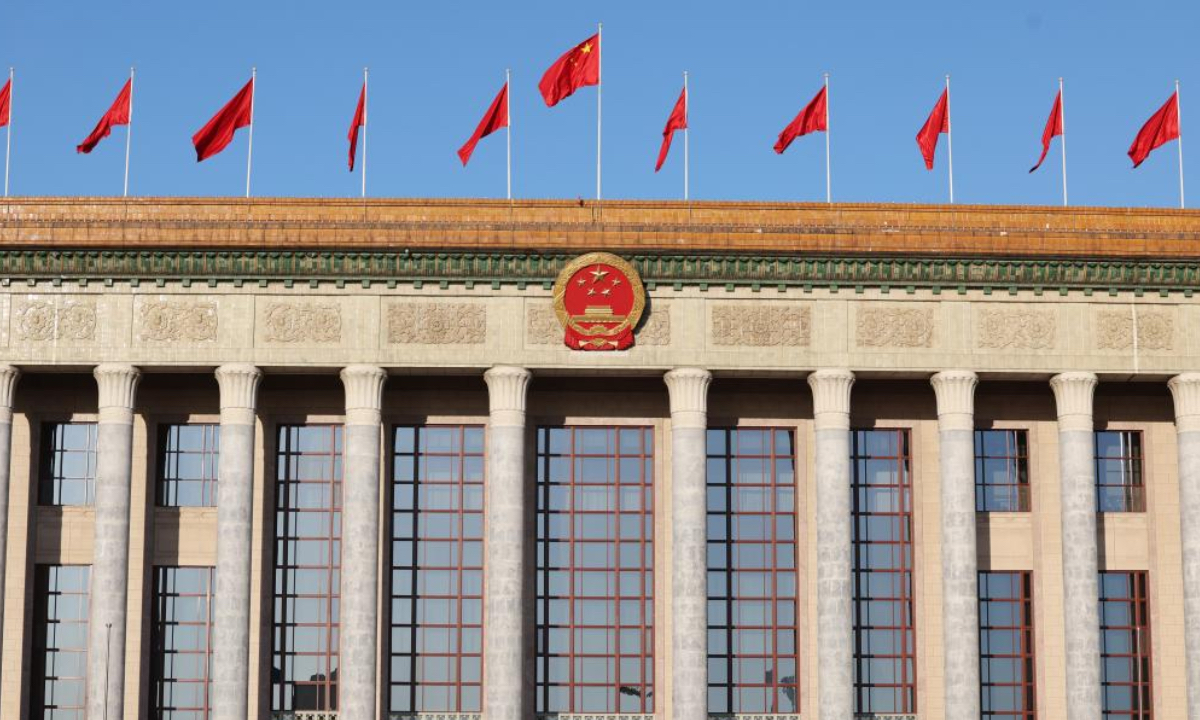
This photo taken on March 9, 2026 shows the Great Hall of the People ahead of the second plenary meeting of the fourth session of the 14th National People's Congress (NPC) in Beijing, capital of China. (Xinhua/Jin Liwang)
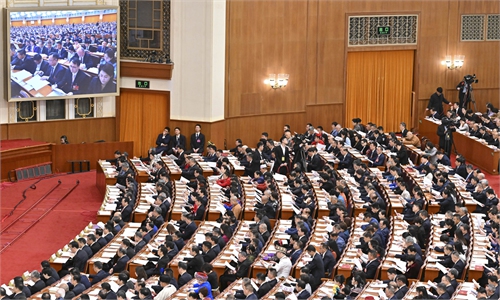
Lawmakers on Tuesday gathered again in groups to review the work reports of the Supreme People's Court and the Supreme People's Procuratorate as well as law drafts during the ongoing "two sessions," bringing their first-hand observations from a grassroots perspective and ideas from their communications with the people into the process of legislation and governance.
Legislation is a key focus of China's "two sessions." This year, several important draft laws, including the draft environmental code, the draft law on promoting ethnic unity and progress, and the draft law on national development planning, are being submitted for review.
Observers said the lawmakers' active participation in the discussions and reviews process is not only a vivid illustration of China's whole-process people's democracy, but also serves as an important bridge that connects top policymakers to the wider public, to ensure sound, democratic and law-based decision-making in the pursuit of Chinese modernization.
The second 'Code'
Of Tuesday's NPC agenda, the draft environmental code has drawn particular attention. If adopted, it would become China's second formal statutory code after the Civil Code was adopted in 2020.
The current draft of China's environmental code contains five sections and 1,242 articles, forming one of the most comprehensive legal frameworks ever proposed in the field of environmental governance.
According to Li Hongzhong, vice chairman of the NPC Standing Committee, the compilation of the code represents a major legislative undertaking that systematically integrates, revises and elevates existing ecological and environmental legal frameworks, the Xinhua News Agency reported.
The latest legislative move comes amid China's historic gains in ecological conservation over the past decade or so. Championing green development, the country has recorded the world's fastest growth in forest resources and afforestation, led globally in renewable energy development, and achieved one of the fastest national reductions in energy intensity worldwide, according to Xinhua.
The idea of codifying ecological and environmental governance at the national level was formally proposed at the third plenary session of the 20th Communist Party of China (CPC) Central Committee in 2024. However, preparations for the major legislative project had begun even earlier.
In the process, multiple committees of the NPC have participated, different departments have been coordinated, and an expert team was formed for consultation, according to Xinhua
The legislative process also placed strong emphasis on consultation. After the preliminary draft was reviewed by the Leading Party Members' Group of the NPC Standing Committee, it was distributed to 132 relevant institutions to gather feedback.
The legislative process entered a new phase in December 2025, after receiving in-principle approval from the CPC Central Committee. It underwent third reading at the NPC Standing Committee, and then submitted to the ongoing fourth session of the 14th NPC for deliberation.
Zhi Zhenfeng, a research fellow with the Institute of Law at the Chinese Academy of Social Sciences, told the Global Times the formulation of the code is not a simple compilation of existing laws, but rather a systematic integration and refinement of more than 30 ecological and environmental laws and regulations currently in force.
For many deputies attending the session, the significance of such legislation goes beyond the meetings. NPC deputy and botanist Ren Hai told the Global Times that the comprehensive legal framework carries unique practical importance, noting that the Code can "help prevent fragmented governance and promote a more systematic and coordinated approach to ecological and environmental protection."
Such a holistic approach aligns with China's current stage of transitioning toward high-quality economic and social development, Ren said.
For green development
Given China's leading role in ecological protection and the green transition, the draft environmental code has drawn attention also from international observers due to its implications for China's green development.
China has already done a lot for ecology. I think after adoption of the code, China would further expedite conservation work, Muhammad Asghar from the Associated Press of Pakistan, who is covering this year's "two sessions," told the Global Times on Tuesday.
China has made major progress in addressing environmental issues. Therefore, in the field of green energy, we also need partnerships so that we can create a favorable environment and ensure reforestation, said Héribert-Label Élisée Adjovi, a reporter from Benin when asked about his expectation for China's "two sessions."
Some scholars and institutions took note of this legislative move long before the NPC annual session. Covington & Burling LLP, an international law firm specializing in energy and environmental issues, noted in a blog post discussing the draft that it "consolidates and elevates into a single legal instrument many of China's environmental laws," and "also marks a significant development in the regulation of biological genetic resources."
Similarly, Sino-German Cooperation on Climate Change, a program supported by the German Federal Government, wrote on its website that the draft code represents a structural shift in China's environmental governance framework from sector-specific laws and policy regulations to an integrated legal mechanism. By embedding climate action and green development into its core, the code lays the groundwork for long-term ecological resilience, technological innovation and international cooperation.
As the world's largest developing nation, China's experience in reconciling rapid industrialization with environmental protection offers a distinct approach compared with Western development models, according to Gong Gu, a scholar on environmental law at Peking University, cited by Xinhua.
"By codifying the proven practices, the legislation provides a viable choice for other developing nations toward sustainability, opening new possibilities for global ecological governance," Gong said.
China has shifted from being a participant in global environmental governance to becoming a leader, and this code provides a vivid example of a "China solution" to global ecological governance, Qin Tianbao, a law professor at Wuhan University, who participated in the drafting of the legislation, told the Global Times.
Chinese lawmakers said the legislation also reflects the country's broader transition toward higher-quality development.
Chinese modernization is modernization characterized by harmonious coexistence between humanity and nature. The formulation of the environmental code will help better embrace, at the institutional level, the concept of adaptive management in the relationship between humans and nature, providing a solid legal foundation for building a Beautiful China and advancing Chinese modernization, Ren said.
Chen Wei, a deputy to the 14th NPC, told the Global Times on Tuesday, "Being an NPC deputy and acting in such important democratic process means great responsibility. It brings about pressure as well as strong motivation."
RELATED ARTICLES