Oil prices rebound despite IEA’s record reserve release; Hormuz situation risks pose ‘limit’ and ‘manageable’ impact on China: expert
Hormuz situation risks fuel global supply fears, but impact on China ‘manageable’: expert
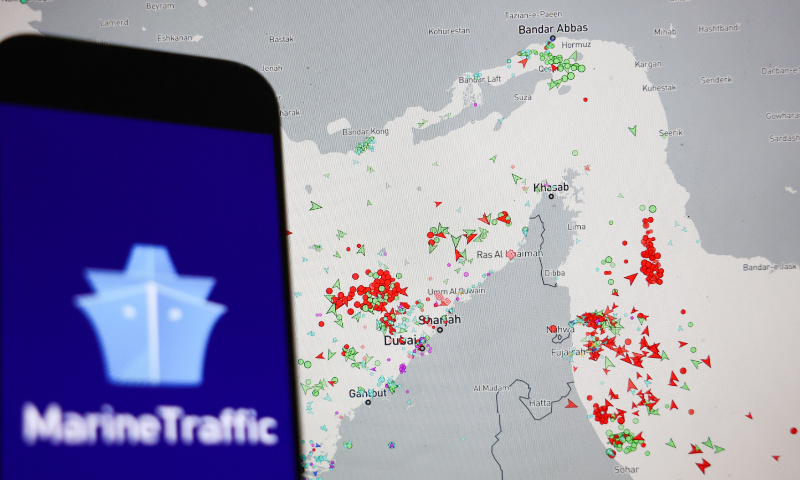
A map shows current ship traffic in the Strait of Hormuz provided by MarineTraffic on March 5, 2026, with different icons showcasing the type of cargo that ships are carrying. Photo: VCG
International oil markets turned highly volatile this week as escalating Middle East tensions rattled global supply expectations. The International Energy Agency (IEA) responded on Wednesday by announcing the largest coordinated release of strategic petroleum reserves in its history.
The US and several other major economies quickly followed with plans to release national oil reserves. Yet the coordinated actions did little to ease market concerns over supply, as the conflict continues to weigh on the global economy and investor confidence.
On Wednesday evening, international oil prices continued to climb sharply, with London Brent crude futures for May delivery once again rising above $100 per barrel. As of press time, Brent crude futures were trading at around $99 per barrel, up more than 8 percent.
The price briefly approached $120 per barrel on Monday but retreated after US President Donald Trump said that the conflict would end "very soon" and markets anticipated intervention from the IEA.
According to an IEA statement issued on Wednesday, the agency's 32 member countries agreed to make 400 million barrels of emergency oil stocks available to the market, marking the largest coordinated release in its history. The volume far exceeds the 182 million barrels released in two phases in 2022 following the Russia-Ukraine conflict.
Under the IEA framework, member countries collectively hold about 1.2 billion barrels of strategic oil reserves that can be tapped in emergencies. Such coordinated releases have occurred only five times since the agency was established in response to the oil crises of the 1970s.
As part of the coordinated action, the US will release 172 million barrels from its Strategic Petroleum Reserve, with deliveries expected to begin next week and continue for roughly 120 days, the US Department of Energy noted on Wednesday.
Germany said on the same day that it would release 19.51 million barrels from its strategic oil reserves to help ease rising oil prices, Reuters reported.
Japan said that it might begin releasing 80 million barrels of oil from its strategic reserves as early as March 16, marking the first time the country has independently tapped its national reserves since establishing its oil stockpiling system in 1978. Also, South Korea said early on March 12 that it would release 22.46 million barrels from its reserves.
Xi Junyang, a professor at the Shanghai University of Finance and Economics, told the Global Times on Thursday that the sharp swings in oil prices reflect rising market concerns over crude supply amid escalating tensions in the Middle East, growing shipping risks in the Strait of Hormuz, and damage to some regional oil production facilities.
"While the IEA's decision to release strategic reserves may help stabilize oil prices to some extent, it would only partly ease upward pressure in the short term and is unlikely to fully restore market stability, as such reserves are primarily meant for emergencies and their deployment is inherently limited," the expert said.
The Strait of Hormuz remains one of the world's most critical energy shipping routes. About 25 percent of global seaborne oil trade passed through the strait in 2025, according to the IEA. Tanker traffic through the narrow waterway has been severely disrupted by rising security threats linked to the regional tensions.
Traffic through the strait has dropped by 97 percent since the US-Israel war against Iran began on February 28, according to UN data cited by Reuters.
Xi Junyang said that as the situation in the Middle East remains highly uncertain, oil prices may remain volatile in the near term. Even if the situation eventually stabilizes, prices are unlikely to return quickly to the lower levels seen before the conflict, he added.
A spokesperson for Tehran's Khatam al-Anbiya military command headquarters warned on Wednesday that oil prices could reach $200 per barrel, saying global prices depend heavily on regional security, which he accused the US and Israel of destabilizing.
Rising oil prices will place dual pressure on corporate production and the global economic recovery, Xi Junyang said, adding that higher energy costs will significantly raise operating expenses for businesses and could fuel broader inflation along supply chains, potentially slowing global economic growth.
However, the expert noted that the impact on China will remain limited and manageable. "China's diversified energy import sources, substantial strategic reserves and the relatively strong yuan can help cushion the cost impact of rising oil prices," he said.
Asked whether arrangements could be made to ensure the safe passage of oil exports through the Strait of Hormuz, Chinese Foreign Ministry spokesperson Guo Jiakun said on Tuesday that the Strait of Hormuz and waters nearby are an important route for international goods and energy trade.
Keeping the region safe and stable serves the common interests of the international community. China urges parties to stop the military operations at once, avoid further escalation, and prevent the regional turmoil from having a larger impact on global economic growth, Guo noted.
RELATED ARTICLES