Japan approves bill to set up intelligence body; move stirs up tensions in Asia-Pacific and fuels resurgence of Japanese militarism: Chinese expert
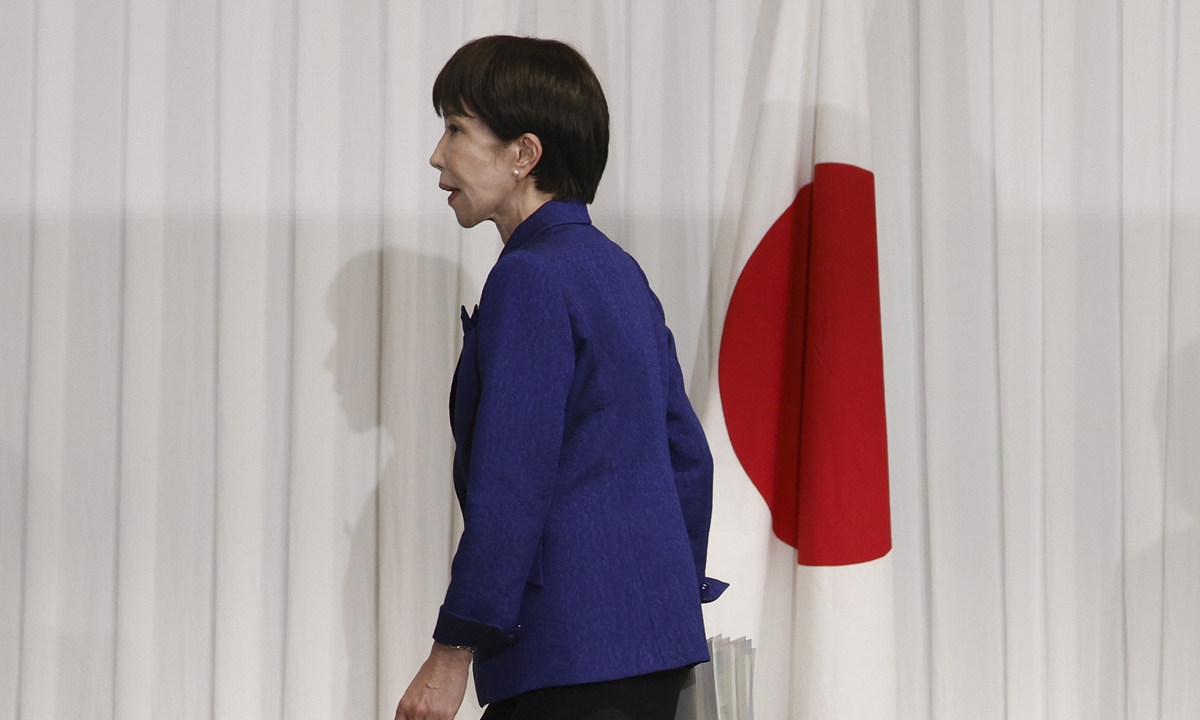
Japan's Prime Minister Sanae Takaichi, leader of the ruling Liberal Democratic Party (LDP), leaves after speaking during a press conference at the LDP headquarters in Tokyo, Japan, on February 9, 2026. Photo: VCG
The Japanese government on Friday signed off on a bill to create a "National Intelligence Council," a new command center for intelligence policy headed by the prime minister, and an operational "National Intelligence Agency," Asahi Shimbun reported. A Chinese expert said that this move will not only stoke tensions across the Asia-Pacific region but also facilitate Japan in advancing its scheme to revive militarism.
The report said the Japanese government aims to pass the legislation during the current Diet session and launch the new organizations as early as July. Once established, the council will be tasked with formulating Japan's first-ever "National Intelligence Strategy" by the end of the year.
The government is seeking to have the new agency streamline intelligence operations - currently fragmented among entities such as the Foreign Ministry, Defense Ministry, the National Police Agency, and the Public Security Intelligence Agency - allowing for faster analysis to bolster policy decisions, per Asahi Shimbun.
These new bodies will be given the same status as the National Security Council (NSC) and its National Security Secretariat (NSS), a change designed to give the prime minister's office strong, direct leadership over intelligence policy, mirroring its role in foreign and security affairs, according to Asahi Shimbun.
Lü Chao, a professor at the Liaoning Academy of Social Sciences, told the Global Times on Friday that by establishing a centralized national intelligence agency, Japan seeks to break through the predicament of "fragmentation" in its current intelligence architecture, achieve the centralized governance and efficient utilization of intelligence resources, and enhance its capacity to predict and respond to regional developments.
The administration also aims to consolidate Prime Minister Sanae Takaichi's authority through this attempt, tighten surveillance over domestic dissenting voices, Lü believed.
Japanese Chief Cabinet Secretary Minoru Kihara said at a press conference on Friday that "amid the increasingly complex and severe international environment recently, it is crucial for the government to make precise policy decisions based on higher-quality, timely intelligence," Nikkei Shimbun reported.
Asahi Shimbun also reported that the council calls for a major buildup of specialized intelligence analysts.
It is also expected to set out directions for the establishment of intelligence gathering systems both at home and abroad and how to use gathered intelligence, NHK reported.
Lü said that Japan's move will stoke tensions across the Asia-Pacific and force regional nations to heighten their vigilance. Such a fraught climate will trigger a cascade of knock-on effects, exerting a detrimental impact on regional security and mutual trust as well as advancing cooperation initiatives, he added.
Just one day earlier, the Kyodo News, citing bilateral relations sources, reported that Japan and the US plan to expand the sharing of classified information through close cooperation between their defense forces to improve their deterrent and response capabilities.
Japan also seeks to integrate into the US intelligence architecture in the Asia-Pacific by bolstering its capacity to exercise oversight over overseas intelligence, Lü said.
Opposition to the bill had already emerged in Japan as early as last month. Some 900 citizens took part in the relevant protests on the evening of February 24 outside the Second Members' Office Building of the House of Representatives to protest against policies including strengthening national intelligence functions, according to the official website of the Japanese Communist Party on February 26.
Junya Ogawa, leader of Japan's Centrist Reform Alliance, raised concerns during a House of Representatives question session on February 24, noting that "there is a danger that the intelligence collected by the council may be politically exploited," Hokkaido Shimbun reported.
Once established, the operational characteristics and scope of authority of this council would render it fundamentally indistinguishable from those of the pre-WWII era, a manifestation of the resurgence of Japanese militarism, the expert noted.
RELATED ARTICLES