China calls for keeping global critical mineral supply chains safe, stable, opposes ‘small-circle’ rules
Price floors, tariffs no fix for refining innovation concern: expert
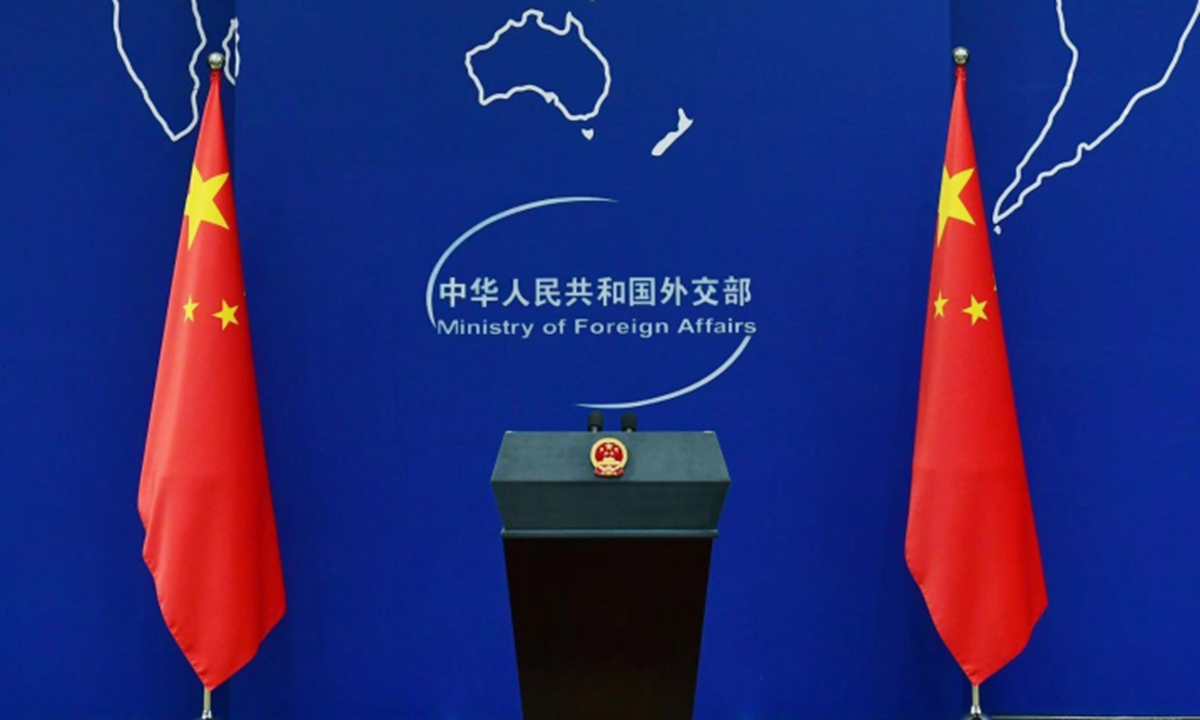
Photo: Chinese Foreign Ministry
China on Friday called on all parties to play a constructive role in safeguarding the stability and security of global critical minerals supply chains and expressed opposition to undermining the international economic and trade order through "small-circle" rules.
Foreign Ministry spokesperson Guo Jiakun made the comments at the regular press conference on Friday when asked about a reported plan on a trade agreement on critical minerals between the US, Japan and the European Union (EU).
"An open and inclusive international trade environment beneficial to all serves the common interests of all countries. All parties have the responsibility to play a constructive role in keeping global industrial and supply chains on critical minerals stable and secure," Guo said.
"We oppose countries using rules of small groupings to undermine international economic and trade order," the spokesperson said.
The US, Japan and the EU are set to announce plans in the coming weeks to lay the foundation for a trade agreement on critical minerals, Bloomberg reported on Friday, citing people familiar with the issue, claiming that China has "threatened it would retaliate against the formation of a bloc that would target its exports."
The agreement was spearheaded by the Office of the US Trade Representative, which has led negotiations with Brussels and Tokyo on the framework. It will also head talks for a trade deal that is set to include a price floor and tariffs for the materials to counter any market distortions by China, said the people, who spoke on the condition of anonymity, per Bloomberg.
Previously, Reuters explained that the idea of guaranteeing minimum prices through coordinated trade rules was intended to unlock private investment in mining and processing projects.
"Their wish is that a price floor would guarantee suppliers a minimum return, allowing them to cover costs and sustain production amid global competition. However, such mechanisms do little to improve suppliers' underlying capacity or technological capabilities," Zhou Mi, a senior research fellow at the Chinese Academy of International Trade and Economic Cooperation, told the Global Times on Friday.
Tariffs and other trade barriers could instead drive up procurement costs for critical minerals, forcing consumers of the resources to shoulder higher prices and additional supply chain risks, said Jian Junbo, director of the Center for China-Europe Relations at Fudan University's Institute of International Studies.
Industry observers said that amid the lingering trust crisis triggered by US' unilateralism, the actual outcome of this US-led agreement would be "super low." Deepening interest divisions could further disrupt supply chains and leave all parties "paying a heavy price", while mechanisms such as tariffs or price floors would not fundamentally enhance production capacity or technological capabilities.
Conflicting interests
According to the Bloomberg, the US is aiming to start negotiations for the trade agreement with the EU and Japan in critical minerals in April, shortly after a comment period for stakeholders to weigh in ends on March 19.
However, divisions and conflict of interest between the US and its allies are apparent. Notably, Politico reported on Wednesday that the EU and the US are closing in on a deal to reduce "dependence on China for critical mineral inputs", but the agreement could end up "cementing an unequal partnership dominated by Washington."
Tobias Gehrke, a senior policy fellow at the European Council on Foreign Relations, said that while Europe was better off working with the Americans, the bloc should have no illusions, per Politico. "It's America First, also in minerals," Gehrke said.
Noting that the plan envisaged a price floor to underwrite alternative sources of supply, the report said it could "turn into a mechanism whereby the Europeans end up sponsoring the US' priority access to the critical minerals."
Andreas Kroll, CEO of Noble Elements, a German-based rare-earth commodity trading firm, also said in the report that Europe is "sitting at the kids' table" compared with the US. "Many of our mid-sized customers are asking themselves whether they should relocate their production to the US" due to supply dependencies, Kroll said.
Apart from concerns about US dominance within the EU, Japan, France and Canada have recently been working on alternatives to a US-led trade bloc to secure critical minerals and "reduce reliance on China", according to a Reuters report on March 6.
The move came after the US said it was seeking to build a bloc with its allies around China through a critical minerals alliance, while these three G7 "key players" are instead charting their own course.
Western countries have faced mounting challenges in maintaining stable supply chains in recent years, particularly in critical minerals, where pressures largely stem from difficulties in achieving breakthroughs in refining and processing technologies, Zhou said. However, market misperceptions and misplaced accusations against China risk diverting attention from this most critical link, he added.
"The US, the EU and Japan are hoping to ease supply pressures from the demand side. However, their interests are far from aligned. The US remains the dominant player, prioritizing absolute security and stability in its critical minerals supply chains and expecting allies such as Europe and Japan to accommodate its strategic needs," Zhou noted, adding that policy bias will weaken others' access to stable supplies and make critical minerals supply chains even less secure.
Zhou warned that relying on tariffs or price floors will not fundamentally enhance production capacity or technological capabilities. Such interventions could instead weaken market-driven innovation and fail to create genuine economies of scale.
RELATED ARTICLES