China urges de-escalation as US seeks help in securing Hormuz passage; US tries to drag in others to turn issue into a multilateral one: expert
By Zhang Yuying and Published: Mar 16, 2026 11:39 PM

Photo: Chinese Foreign Ministry
As Washington, facing the likelihood of being mired in longer conflict in Iran war, urged other countries, including China, to help assist in passage of the Strait of Hormuz over the weekend, most US allies have kept distant from the request. On Monday, China's foreign ministry spokesperson took a stream of questions over the matter.
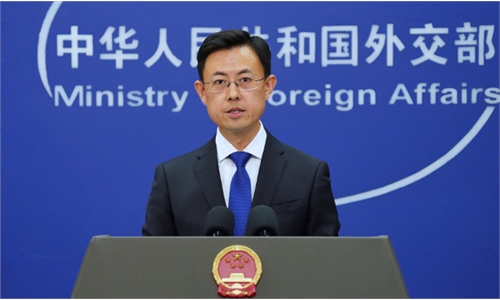
Lin Jian, spokesperson from China's Ministry of Foreign Affairs, stressed on Monday that the recent tense situation in the Strait of Hormuz and waters nearby has impacted the route for international goods and energy trade, disrupting peace and stability in the region and beyond.
These remarks were made in response to media inquiries about the Trump administration's plans to announce as early as this week that multiple countries have agreed to form a coalition that will escort ships through the Strait of Hormuz, and Trump's call for countries, including China, to send ships to escort vessels in the strait.
China once again calls on parties to immediately stop military operations, avoid further escalation of the tense situation and prevent regional turmoil from further impacting the global economy, Lin added.
Lin's response came after US President Donald Trump ratcheted up pressure in recent days for countries to help escort ships through the Strait of Hormuz. In his newest remark, Trump on Sunday claimed that NATO faces a "very bad" future if US allies fail to assist in opening up the Strait of Hormuz, sending a blunt message to European nations to join his war effort in Iran, Financial Times reported.
While answering reporters' questions as he flew back to Washington from Florida aboard Air Force One, Trump claimed on Sunday that he has "demanded" that about seven countries heavily reliant on Middle East oil join the coalition to "police" the Strait of Hormuz, Politico reported. But Trump declined to name the countries his administration is negotiating with, per the report.
On Saturday, the US president wrote on his social media account that "Hopefully China, France, Japan, South Korea, the UK, and others" will send ships to the area.
When asked a follow-up question on whether the US had sought China's assistance in helping secure the Strait of Hormuz, Lin said on Monday that "We once again call on parties to immediately stop military operations, avoid further escalation of the tense situation and prevent regional turmoil from causing greater damage to global economic growth. We are in communication with relevant parties to work for the de-escalation of the situation," Lin added.
More than two weeks into a war against Iran that he chose to launch, "President Trump faces a stark choice - stay in the battle to achieve the dauntingly ambitious goals he has set, or try to extract himself from an expanding and intensifying conflict that is generating damaging military, diplomatic and economic shock waves," The New York Times reported on Sunday.
Regarding the current dilemma the US is facing with, Axios cited a source as saying on Monday that "as long as the blockade holds and Gulf oil is restricted, Trump could not end the war even if he wanted to.''
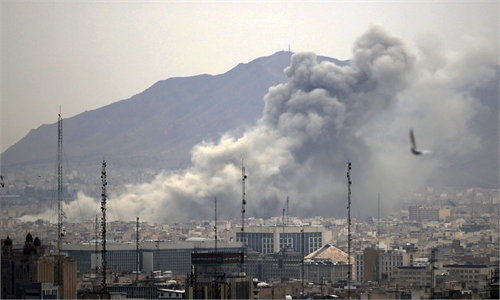
Maritime tracking data showed that no ships passed through the Strait of Hormuz on Saturday, marking the first full day since the Middle East conflict began without any confirmed commercial traffic in either direction. Crossings dropped to zero, below the previous seven-day average of 2.57 daily transits, South China Morning Post reported, citing maritime analytics firm Windward.
Sun Degang, director of the Center for Middle East Studies at Fudan University, said the US did not expect this war to turn into a protracted and attritional conflict. However, amid rising oil prices and plunging stock markets, Washington is growing increasingly anxious to bring it to an end as soon as possible, particularly to restore the normal flow of traffic through the Strait of Hormuz. Yet it may not be able to achieve this on its own, so the US is seeking to drag more countries and turn this crisis into a multilateral one.
Among the allies named by US President to assist in escorting ships through the Strait of Hormuz, majority countries' response to the US call for "team effort" appears cautious.
According to BBC on Monday, UK Prime Minister Keir Starmer said that he would not allow the UK to be drawn into "the wider war."
Japanese Prime Minister Sanae Takaichi told parliament on Monday that "We have not made any decisions whatsoever about dispatching escort ships. We are continuing to examine what Japan can do independently and what can be done within the legal framework," per Reuters.
Germany's Foreign Minister Johann Wadephul said he was "very skeptical" that expanding the EU's naval mission would improve security, per Politico.
EU foreign ministers are set to meet Monday in Brussels to discuss a push by EU foreign policy chief Kaja Kallas to deploy additional ships to the bloc's own maritime mission.
Australian Transport Minister Catherine King told national broadcaster ABC on Monday that "We won't be sending a ship to the Strait of Hormuz. We know how incredibly important that is but that's not something we've been asked or we're contributing to," according to the DW.
Many international media outlets widely noted the lukewarm response. The Guardian characterized the response as "decidedly muted," and Fortune said the US President's call was "met with no promises."
Apart from disapproving of the US' decision to launch the war and fearing being dragged into the chaotic situation in the Middle East, Washington's past behavior - sabotaging its allies on issues such as defense, trade and even sovereignty - has humiliated and undermined them, Li Haidong, a professor at China Foreign Affairs University, told the Global Times.
RELATED ARTICLES