Illustration: Chen Xia/GT
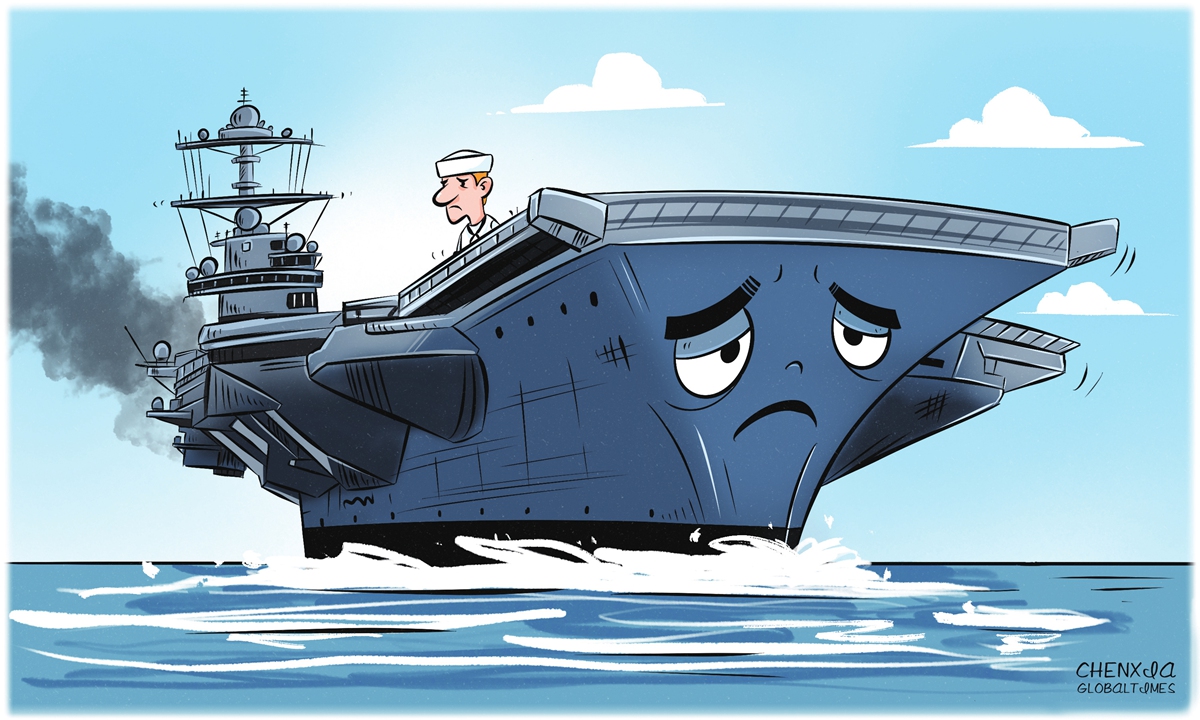
Aboard USS Gerald R. Ford, priced at roughly $13 billion and billed as the most advanced US aircraft carrier in existence, the crew has repeatedly endured some seriously awkward and uncomfortable conditions: dysfunctional toilets, no clean laundry, and no beds. These repeated breakdowns have exposed the profound fatigue now gripping the US Navy, and perhaps the broader structure of American global dominance under sustained high-tempo and long-duration operations.
According to a New York Times report published Monday, it took more than 30 hours for sailors to put out the fire aboard the Ford last week. The US Navy initially downplayed the incident, but reports indicated that more than 600 sailors and crew members had lost their beds and have since been bunking down on floors and tables.
This fire is merely the latest in a string of persistent maintenance failures aboard the Ford. Earlier reports highlighted consistent plumbing issues with the nearly 650 toilets aboard the vessel. Sailors were reportedly forced to wait in restroom queues for up to 45 minutes.
The Ford is now entering its 10th month of deployment, first patrolling the Mediterranean, then rerouted to the Caribbean to add weight to pressure Venezuela, and finally surged to the Middle East for the US-Israel war against Iran.
According to reports, crew members on the Ford have been told that their deployment will probably be extended into May, which would put them at an entire year at sea, twice the length of a normal aircraft carrier deployment. The ship's maintenance schedule has been impacted, and the vessel is exhausted. Its sailors are even more so.
"Ships get tired too, and they get beat up over the course of long deployments," the New York Times reported, quoting Rear Adm. John F. Kirby, a retired naval officer. "You can't run a ship that long and that hard and expect her and her crew to perform at peak capacity."
A US Naval Institute report on Tuesday local time indicated that the Ford will travel to Naval Support Activity Souda Bay for more than a week of pierside repairs. This seems like a temporary band-aid solution, as the standard maintenance period for the carrier and its strike group after a typical six- to seven-month deployment would likely take four to six months in a shipyard, according to reports.
Anti-war sentiment is spreading within the US. Public discussions about the Ford's troubles range widely: Some attribute the issues to mechanical failures, electrical glitches, or extra-long, extended deployments. Yet some netizens speculate that low morale among the carrier's sailors - perhaps reluctance to fight in this conflict - may also play a role.
The fire has been contained for now, but the deeper concern remains: Will overstretched operational demands trigger the next incident - and the one after that? The longer maintenance is deferred, the more problems accumulate. And with increasingly fatigued sailors and airmen, will there be enough alertness and energy left to contain recurring emergencies?
The US military, the most vital, indispensable pillar upholding American hegemony, now appears to be approaching some kind of breaking point - unable to deliver the kind of sustained global dominance Washington has long taken for granted.
The flames are out, yet the war is far from over. The US knew that the initial carrier strike group in the theater would deplete its munitions and supplies at a rapid rate, explaining the Pentagon's decision to deploy the Ford as reinforcement. Yet the irony is biting: Even on history's most costly warship, a laundry-room fire has laid bare a brutal truth - in a war of attrition, victory never hinges on the price tag of the weapons. It hinges on who can endure the longest grind.
When Tehran expends "cheap drones" to force the US to fire highly sophisticated interceptor missiles, the asymmetry becomes headline news, and it is widely observed that a prolonged conflict plays to Iran's strengths. By contrast, what exactly does the US aim to achieve, and does it have the capacity to weather a protracted conflict? That remains an open question.
For Washington, strategic ambiguity in this war is already a real problem. But the burnout of equipment and the wearing down of its people may be the far more immediate and daunting challenge.
RELATED ARTICLES