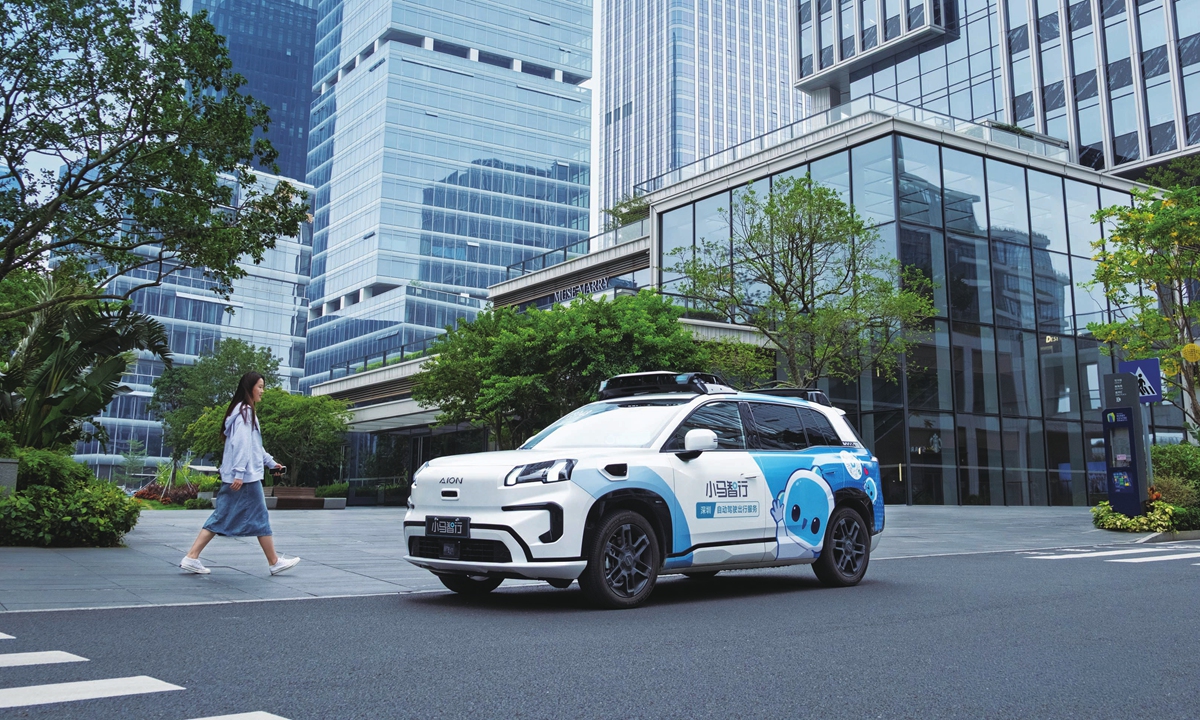
A passenger walks to a Pony.ai robotaxi in Shenzhen, South China's Guangdong Province, during the 2026 Spring Festival holiday. Photo: Courtesy of Pony.ai
The South Korean government has sent an inter-agency research delegation to China to study autonomous-driving policies, the Yonhap News Agency reported on Wednesday. The visit will run from Wednesday to Friday.
The report noted that this marks the first time the South Korean government, to strengthen the competitiveness of its autonomous-driving industry, sent a cross-ministerial research team to a technologically advanced country.
The delegation aims to learn from China's advanced autonomous-driving technologies and policy frameworks, explore support measures for commercialization, and accelerate the development of autonomous-driving pilot cities, according to Yonhap.
The delegation consists of more than 20 officials from eight government bodies, including the Ministry of Land, Infrastructure and Transport, the Ministry of Finance and Economy, and the Ministry of Trade, Industry and Resource.
The South Korean side will study China's policies on physical artificial intelligence (AI) development, as well as related support measures and regulatory frameworks. The delegation will also visit the innovation and operation center of Beijing's high-level autonomous-driving demonstration zone and leading local autonomous-driving companies, the report said.
The delegation is expected to experience autonomous vehicles developed by Baidu and Pony.ai, focusing on on-road operations and safety performance. The companies mentioned in the report did not provide responses or further details to the Global Times.
Yonhap said that the South Korean government believes that in order to quickly catch up with leading countries such as China and the US in autonomous driving, it is necessary to conduct on-site studies of physical AI support policies and public-private collaboration models.
Chinese industry observers said that China's autonomous-driving industry has formed a relatively complete policy framework from opening roads for testing, to unmanned pilot operations, and to data compliance and regulatory sandbox exploration, and it is emerging as a model for global study.
South Korea's visit is aimed at understanding how China has coordinated across government bodies to transform fragmented testing into "pilot cities" with viable commercial ecosystems, said Wang Peng, an associate research fellow at the Beijing Academy of Social Sciences.
China's most demonstrative strengths lie in its ability to ensure efficient cross-ministerial coordination, rapidly aligning standards across transport, public security and industry regulators, Wang told the Global Times on Wednesday.
"This has enabled the establishment of 'one network, one standard and one regulatory framework' within pilot zones, effectively addressing the fragmented governance and regulatory conflicts seen in countries such as South Korea."
He noted that the global autonomous-driving sector has entered the deep end of commercialization, where regulatory gaps have become more constraining than technological bottlenecks.
As early as the beginning of 2025, a wave of legislation on autonomous-driving was already taking shape across China, while the nation's relevant authorities have continued to refine safety requirements for the sector without pause.
The Ministry of Industry and Information Technology (MIIT) has released draft revisions for five mandatory national standards covering intelligent connected vehicles and autonomous-driving system safety requirements for public consultation, according to a notice published on its official website on February 12.
Data from the MIIT showed that as of the end of 2025, the penetration rate of new passenger vehicles equipped with Level 2 and above autonomous-driving functions in China was estimated to approach 65 percent, according to a report released by the China Auto Dealers Chamber of Commerce.
The growing adoption of Level 2 systems is laying the groundwork for the large-scale development of higher-level autonomous driving, the report said.
RELATED ARTICLES