Illustration: Chen Xia/GT
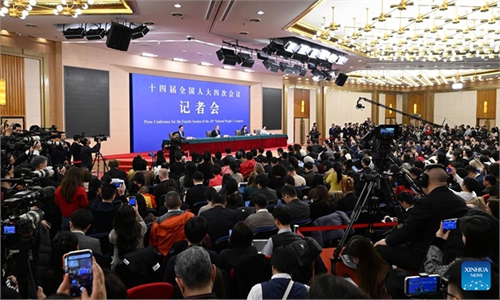
The recently-concluded two sessions in Beijing have delivered a clear signal about China's economic direction for 2026 and beyond. On the one hand, officials stress greater self-reliance, particularly in critical technologies and strategic industries. On the other, they reaffirm China's commitment to opening-up and to building a community with a shared future for humanity. To many observers, this raises an obvious question: How can a country build self-sufficiency while simultaneously lowering the drawbridge to global cooperation?The answer lies in understanding that, for China, these are not competing impulses but elements of a carefully calibrated strategy for an era of mounting global uncertainty. The self-reliance now being emphasized is not the isolationism of a bygone era; rather, it is seen as the foundation for secure and sustainable international cooperation.
For decades, China's policy of opening-up meant integrating into a global system largely shaped by the West. By embracing trade, welcoming foreign investment and linking its factories to global supply chains, the country became one of the driving engines of globalization. Today, however, the fragmentation of global supply chains and the growing weaponization of technology are reshaping that equation.
In this new environment, reliance on foreign suppliers for critical technologies, especially advanced semiconductors, has become a strategic liability. When essential components or energy resources lie beyond national control, openness can quickly turn from a source of prosperity into a source of vulnerability.
This is where self-reliance enters the equation as a strategic enabler. By investing in domestic innovation and securing supply chains for critical goods, China is building a buffer against external shocks. The goal is to ensure that the country's core economic functions cannot be easily disrupted by geopolitical headwinds. This is the logic behind the dual circulation strategy: A stronger domestic economy provides the stability needed to remain actively engaged with the global one.
Far from closing the door, this resilience allows China to open it wider. A nation secure in its economic foundations can engage the world from a position of confidence rather than dependency. China can hardly be blamed for taking this course when Western restrictions on key technologies are designed to slow its rise.
China can welcome foreign investment not merely for low-value manufacturing, but for the expertise, technology and competition that sharpen domestic firms. In this framework, domestic and international players coexist and compete, raising the capabilities of the entire industrial base.
Many countries are already benefiting from China's growing ecosystem of open and accessible technologies. The rise of open-source AI is a clear example. Chinese firms have increasingly released models and tools that allow developers, startups and researchers around the world, particularly in developing countries, to experiment, adapt and innovate without the prohibitive costs often associated with proprietary systems.
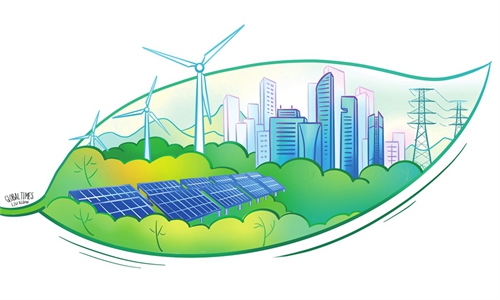
This approach is not limited to AI. China has also shared technological capabilities in areas such as digital payments, e-commerce platforms and renewable energy. Together, these approaches are not only driving China's own technological advancement but also contributing to the broader diffusion of modern infrastructure and digital innovation worldwide.
These innovations allow many developing economies to leapfrog traditional stages of development and build modern digital and energy infrastructure. By contrast, much of the Western technology ecosystem remains tightly controlled through patents, licensing restrictions and costly proprietary platforms designed to protect profits and technological dominance.
Furthermore, this policy reframes the meaning of a "shared future." A stable global order cannot be built on fragile foundations. When major economies are vulnerable to supply disruptions or economic coercion, the entire system is at risk. By strengthening its own resilience, China aims to become a more reliable partner in an uncertain world.
The message to the Global South and to the rest of the world is that China's market will remain open and its supply chains will remain functional even during periods of global turbulence, precisely because it has strengthened its own foundations.
Critics may argue that this is merely a euphemism for decoupling. But decoupling implies a severing of ties. What China is proposing instead is an evolution of integration - a shift from a "simple" globalization based on labor-cost arbitrage to a more complex form of integration built on technological capability and mutual strategic necessity.
In the end, the two sessions have laid out a vision for a China that is strong enough to be open. The self-reliance being built today is the muscle that will allow the country to engage in tomorrow's global economy not as a dependent player, but as a resilient partner capable of weathering the storms of the 21st century. It's a recalibration, not a retreat.
The author is the founding director of the Belt and Road Initiative Sri Lanka (BRISL), a Sri Lanka-based organization that specializes in BRI cooperation. opinion@globaltimes.com.cn
RELATED ARTICLES