US intelligence report shows shifted tone on Taiwan question; 'China threat' narrative persists despite signs of 'softened stance'
China US Photo:VCG
The US intelligence community released its 2026 annual threat assessment report on Wednesday, which though viewed by some US media outlets as having "hints of a softened US stance," still hypes "China threat" rhetoric, over which a Chinese foreign ministry spokesperson on Thursday urged relevant US agencies and personnel to discard ideological bias and Cold-War and zero-sum mentality.
The 34-page report refers to China 69 times; by contrast, the 2025 edition mentions China 103 times.
The report claimed that China does "not currently plan" to resolve the Taiwan question in 2027, and seeks to "achieve unification without the use of force," according to Reuters.
The latest report also claimed that China wants to "set the conditions for eventual unification with Taiwan short of conflict." While previous assessments have said Taiwan is a "significant potential flashpoint for confrontation" between the US and China, and that Beijing would continue to apply military and economic pressure to "project power over Taiwan," reported Bloomberg.
The assessment underscores the lack of clarity around US evaluations of China's intentions, and just how much US forecasts have shifted since 2021, the Bloomberg commented.
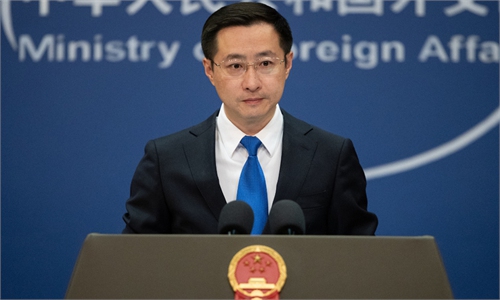
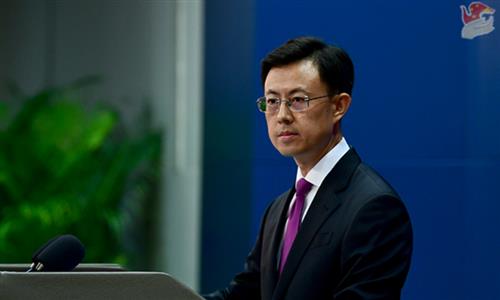
The Taiwan question is China's internal affair. Resolving the Taiwan question is a matter for the Chinese ourselves that brooks no external interference. The US needs to abide by the one-China principle and the three China-US joint communiqués and act all the more prudently on the Taiwan question, said Chinese Foreign Ministry spokesperson Lin Jian on Thursday.
Relevant US agencies and personnel need to discard ideological bias and Cold-War and zero-sum mentality, form a correct perception of China, and stop peddling the "China threat" narrative, Lin added.
In the report, the US intelligence community also claimed "a significant shift" in Japan's remarks on the Taiwan question, as Japanese Prime Minister Sanae Takaichi's "survival threatening situation" claims over Taiwan question serves as "a possible legal justification for military authorities" under Japan's 2015 Legislation for Peace and Security.
At a press conference on Thursday in Tokyo, Chief Cabinet Secretary Minoru Kihara pushed back against the report's assessment, claiming, "The government's position has been consistent, and the view that it represents a significant shift is inaccurate."
In response, Chinese Foreign Ministry spokesperson Lin said at Thursday press conference that Japan's claim that it "has not changed its position" is hardly convincing. That kind of attitude will not possibly enable Japan to establish trust with its Asian neighbors and the international community.
The Bloomberg also mentioned that "other hints of the softened US stance were scattered through the latest intelligence assessment," as it stripped out language included in the 2025 report that "China stands out as the actor most capable of threatening US interests globally."
It also removed language that said China was deploying coercive measures "to advance unification with Taiwan, project power in East Asia, and reverse perceived US hegemony."
While the report's tone toward China has shifted from its previous emphasis on "extreme risk warnings" to a relatively more rational assessment and has adjusted some of its wording on the Taiwan question in the report, the fundamental nature and underlying logic remain unchanged: it continues to hype up the "China threat" narrative and exaggerate the so-called impact of the Taiwan question on the US and the world, Sun Xihui, an associate research fellow with the National Institute of International Strategy at the Chinese Academy of Social Sciences, told the Global Times on Thursday.
The US is attempting to contain China's development by hyping up the Taiwan question, strengthen its strategic encirclement of China by ganging up with its allies, and divert attention from its domestic problems, Sun said, stressing that in the face of such old and repetitive hype by the US, China's position and attitude towards the Taiwan question have always been clear and firm.
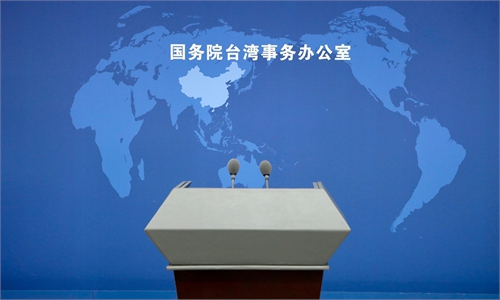
The US has recently engaged in further provocations on the Taiwan question. According to Reuters on March 13, a major US arms package for Taiwan that includes advanced interceptor missiles could be approved, a move condemned on Wednesday by the Taiwan Affairs Office of the State Council, which stressed China's firm and consistent opposition to arms sales by relevant countries to the Taiwan region.
The Bloomberg report also mentioned that on Tuesday, US President Donald Trump said that he has a "good relationship with China," despite his postponed visit to the country.
"The dual nature of US policy toward China is reflected in the fact that while Washington's core objective is to contain China so as to maintain its global hegemony, it also needs to cooperate with China and pursue practical interests, covering economic and trade areas as well as other regional hotspot issues," Sun said.
Li Haidong, a professor at China Foreign Affairs University, said that compared with previous US reports which frequently hyped the possibility of mainland taking military action against Taiwan island and even specified clear timelines, the latest report has clearly shifted to far more restrained language, with a relatively calmer overall tone.
However, it is noteworthy that the US has not ceased hyping up the Taiwan question. It continues attempting to pressure other Asia-Pacific countries to take side. In the long run, the fundamental tone of US suppression and containment toward China is unlikely to undergo any fundamental change, Li noted.
China-US relations are shaped by two-way interactions, and their nature cannot be dictated by any single country. As China's capacity to steer bilateral relations continues to grow, China has acted responsibly to advance China-US relations, in sharp contrast to the US's persistent suppression and containment against China, Li added.
RELATED ARTICLES